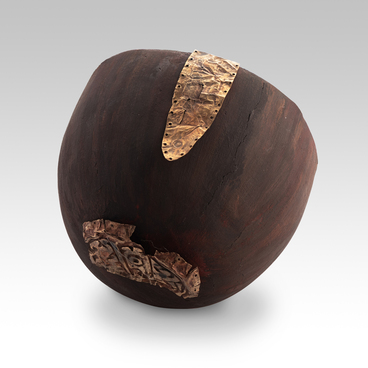
Since ancient times, the practice of hiding money was widespread. Treasures were buried in the ground and embedded in the stone walls of forts and houses to protect them from frequent fires and enemy attacks. For this purpose, potters created special money containers — pots, or “kubyshkas” in Russian, varying in size and shape. Thus, the phrase “money in a pot” came to mean that funds were safely hidden.
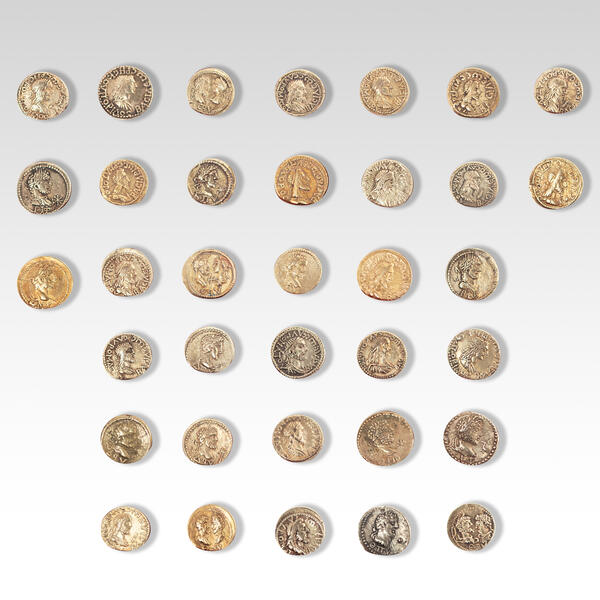
A cache of 34 gold staters, antique coins dated between 155 and 216 CE, was discovered on the territory of Rostov-on-Don. They were minted during the reigns of the Bosporan kings Eupator, Sauromates II, and Rhescuporis II.
The hoard was discovered in early April of 1958 in the northeastern outskirts of the Nizhne-Gnilovskoye settlement, within one of the cliff formations. The coins were located at a depth of approximately half a meter, concealed in the base of a clay vessel. Other coins were scattered around. The treasure consisted of seven staters of Eupator, twenty coins of Sauromates II, and seven coins of Rhescuporis II. Based on the most recent stater, which was dated to the 513th year of the Bosporan era (216 CE), it was possible to determine when the hoard was hidden.
Gold Bosporan staters were high-value currency. They were not commonly used in everyday transactions. They were circulated primarily for important commercial transactions involving foreign merchants. For this reason, they are more frequently found in hoards, less frequently in the layers of Bosporan settlements, and even less frequently in burials.
The complex of the Nizhne-Gnilovskoye settlement is adjacent to a group of hoards that were concealed in the first — second third of the 3rd century CE. This occurred in the context of military instability in the Bosporus region, which was brought about by barbarian raids. Another significant factor contributing to the formation of these hoards during the reign of Sauromates II and his successors was a significant devaluation of the stater. This collection of coins is significant for the study of gold coin production, monetary circulation, and the economic and military situation in the Bosporan Kingdom at the start of the 3rd century. Additionally, the well-preserved portraits depicted on these coins provide some of the only representations of the Bosporan kings.