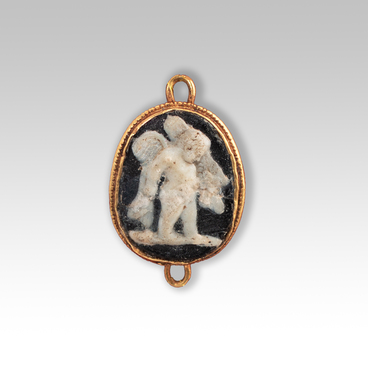
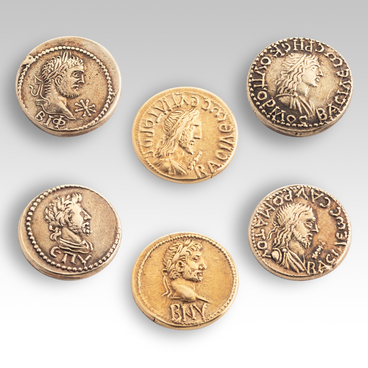
The artifacts on display were discovered in 1987 in kurgan No. 10 of the Kobyakovsky burial site, which is located on the eastern outskirts of Rostov-on-Don. The burial contained the remains of a wealthy nomadic woman from the Sarmatian aristocracy.
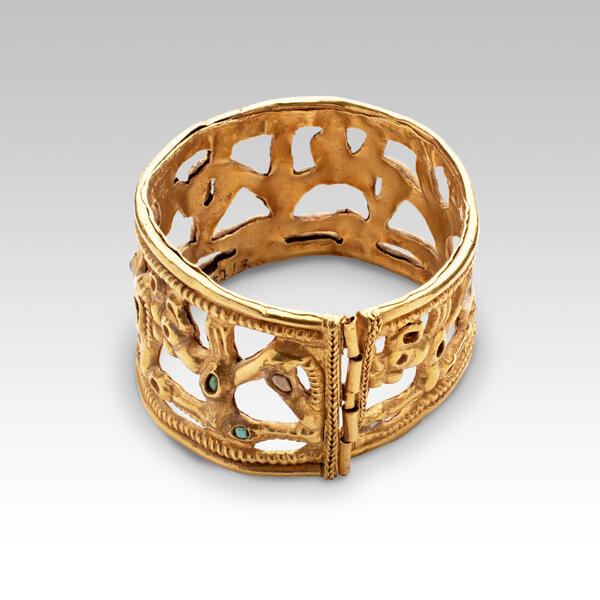
The bracelets were located near the hands of the deceased woman.
These pieces of jewelry consist of two plates. The front openwork plate is made in high relief and is inlaid with stones. The inside is smooth, and is notched along the contours of the upper front part. The contours of images on both sides are identical.
The sections of the bracelets are connected by pins, consisting of two short edge tubes on one side and three on the other, into which a rod is inserted. This allows both edges to be connected using a hinge.
The zoomorphic ornamentation is based on images of real and fantastical animals and birds, as well as separate parts of these creatures. The level of stylization varies.
The griffins with heads of birds that adorn the bracelets are attributed to the ornithomorphic style. This term refers to depictions of winged creatures, whether real or fantastical, on objects of ancient art. These types of patterns are sometimes classified as belonging to the so-called “animal style” as they include representations of animals. The gold bracelets were made in the so-called Sarmatian polychrome animal style and, likely, were produced in the workshops of the Bosporan Kingdom.
One of the key stylistic features of the polychrome style is the combination of gold, bronze, and multicolored inlays of ornamental stones such as carnelian, almandite, garnet, and turquoise, along with the inclusion of colored glass inserts. In ancient times, glass paste was considered equivalent to the most precious materials, thus, in the presence of such additional decorations, gold gained even greater value.
Artifacts in the Sarmatian polychrome animal style
are represented by a diverse range of items, including torcs, bracelets,
buckles, belt and sewn-on plates, vials, decorative phalerae from horse
harnesses, and other objects.