The nature of northern shores is inhospitable, therefore the inhabitants of Siberia and Zapoliarye had to use its gifts accessible to them in most effective and economical manner in order to survive. Kibas is the earliest invention of Pomors who could make useful things out of anything that turned up by chance. Those things included fishing tackle among others.
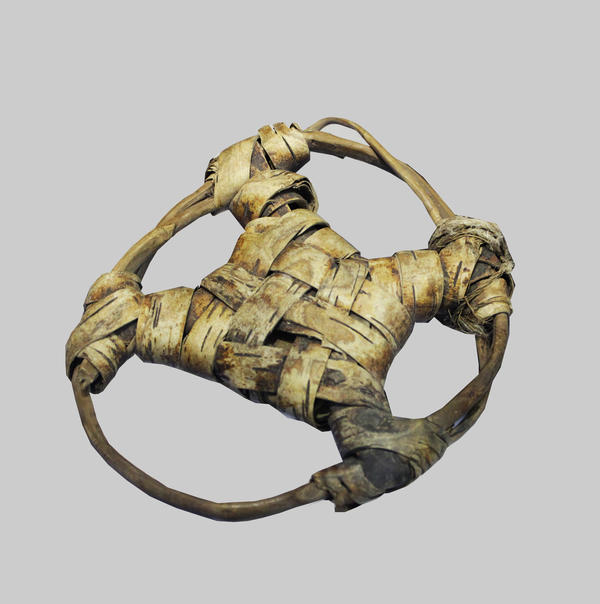
Kibas is a weight of seine net made out of stone and wood. Ring of the devise was most frequently crafted from a coiled osier or juniper twig, which together with a stone placed in the center of the ring, was enlaced with birchbark. The stone was fixed to the ring with birchbark braces. As a result, compositionally complete device looked like a cross inscribed into a circle.
Why nothing else but birchbark? It was easy to get and work on material and, again, always available. Houseware, footware, harness and, of course, fishing and hunting gear were made of birchbark. In old days the birchbark works were wide-spread in the North. No surprise then that coastal northerners not only exchanged among themselves the articles made of birchbark but acquired the names of those articles from their neighbors as well.
In such a way the word ‘kibаs’ comes from Karelia. Archeologists claim that the Karelians started using pebbles wrapped in birchbark as seine weights as early as the year dot. The word proper is consonant with Vepsian, Finnish and Karelian word ‘kivi’ meaning ‘stone’. Many other ‘special’ names of tackles also came to the Russian language from Finno-Ugric parlances.
Apart from its purely practical function, kibаs was regarded by northerners as something like ‘lucky horseshoe’. In Pomorye, by the way, stones for fishing gear were collected in ‘lucky places’, wherein a good catch or kill occurred. Kibases not only were taken for fishing purposes but were also hung on the walls of tonia hut (house at the fishing place) as amulet bringing good fortune or plentiful catch. Or otherwise, it was presented to friends as a symbolic wish of roust northern health.
2011 was announced the Year of Pomor Culture in Arkhangelsk. After careful selection from a multitude of options the kibаs, unique and indigenous artifact of Pomor culture, was chosen.
Kibas is a weight of seine net made out of stone and wood. Ring of the devise was most frequently crafted from a coiled osier or juniper twig, which together with a stone placed in the center of the ring, was enlaced with birchbark. The stone was fixed to the ring with birchbark braces. As a result, compositionally complete device looked like a cross inscribed into a circle.
Why nothing else but birchbark? It was easy to get and work on material and, again, always available. Houseware, footware, harness and, of course, fishing and hunting gear were made of birchbark. In old days the birchbark works were wide-spread in the North. No surprise then that coastal northerners not only exchanged among themselves the articles made of birchbark but acquired the names of those articles from their neighbors as well.
In such a way the word ‘kibаs’ comes from Karelia. Archeologists claim that the Karelians started using pebbles wrapped in birchbark as seine weights as early as the year dot. The word proper is consonant with Vepsian, Finnish and Karelian word ‘kivi’ meaning ‘stone’. Many other ‘special’ names of tackles also came to the Russian language from Finno-Ugric parlances.
Apart from its purely practical function, kibаs was regarded by northerners as something like ‘lucky horseshoe’. In Pomorye, by the way, stones for fishing gear were collected in ‘lucky places’, wherein a good catch or kill occurred. Kibases not only were taken for fishing purposes but were also hung on the walls of tonia hut (house at the fishing place) as amulet bringing good fortune or plentiful catch. Or otherwise, it was presented to friends as a symbolic wish of roust northern health.
2011 was announced the Year of Pomor Culture in Arkhangelsk. After careful selection from a multitude of options the kibаs, unique and indigenous artifact of Pomor culture, was chosen.