Great poet of the North, taleteller, artist, traveler Stepan G. Pisakhov, coming from a bourgeois Jewish family, developed interest in painting contrary to the aspirations of his relatives. The father of the future master and tireless wanderer saw him as a man of a more down-to-earth occupation – a shoemaker. But Stepan Pisakhov did not come up to his expectations.
In 1939, in the epoch of active exploration of the North, an exhibition of Postnikov, Guzhov, and other local artists, including Pisakhov, was opened in Arkhangelsk. The master exhibited his painting Icebreaking Steamer ‘Sedov’ by Franz Joseph Land dedicated to the jubilee of the icebreaker legendary expedition. More than a decade ago on June 26, ‘Georgy Sedov’ had departed from Arkhangelsk for hunting sea animals with an associated task to study routes of their migration. Pisakhov participated in that trip.
In 1939, in the epoch of active exploration of the North, an exhibition of Postnikov, Guzhov, and other local artists, including Pisakhov, was opened in Arkhangelsk. The master exhibited his painting Icebreaking Steamer ‘Sedov’ by Franz Joseph Land dedicated to the jubilee of the icebreaker legendary expedition. More than a decade ago on June 26, ‘Georgy Sedov’ had departed from Arkhangelsk for hunting sea animals with an associated task to study routes of their migration. Pisakhov participated in that trip.
A few months before, on May 23, 1928, dirigible ‘Italy’ departed in the North Pole direction. It carried an Italian research expedition led by General Umberto Nobile. The dirigible reached its destination, but, on the way back, a tragedy happened: the rainwater on the hull of the airship was frozen and the zeppelin, suddenly gaining weight, dipped down with the speed of 0.5 meters per second.
The aeronauts tried to control the descent, but with no success. At about half past ten in the morning of May 25, the dirigible gondola crashed into an ice ridge and broke off. The dirigible with 6 people on board (‘Alessandrini’s group’) and most of the equipment drifted east having left on the ice the majority of the crew members. In 20 minutes, the aeronauts noticed a plume of smoke towering in the east.
The people in distress were found by chance, and only a week later. An urgently established commission started preparation for the rescue expedition. In total, about twenty vessels and more than twenty aircrafts took part in the rescue of the Italian researchers. But only icebreaker “Krasin” managed to complete the mission – it received on board those in distress on July 12. Unfortunately, the fate of Alessandrini’s group still remained unknown.
On August 1, ‘Georgy Sedov’, with Pisakhov on board, received an order to stop hunting and participate in the rescue of the Italians. ‘Sedov’ set a course for the North. The icebreaker had to go through heavy ice near Franz Joseph Land. It only advanced to the 81st degree of the Northern latitude. The icebreaker crew explored part of the archipelago, but, unfortunately, the Italians were never found.
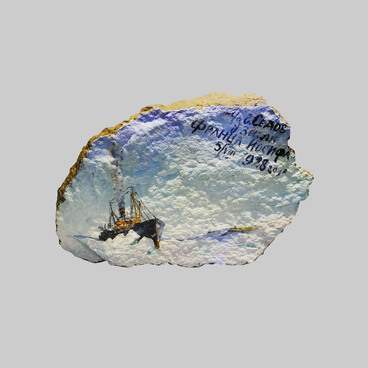
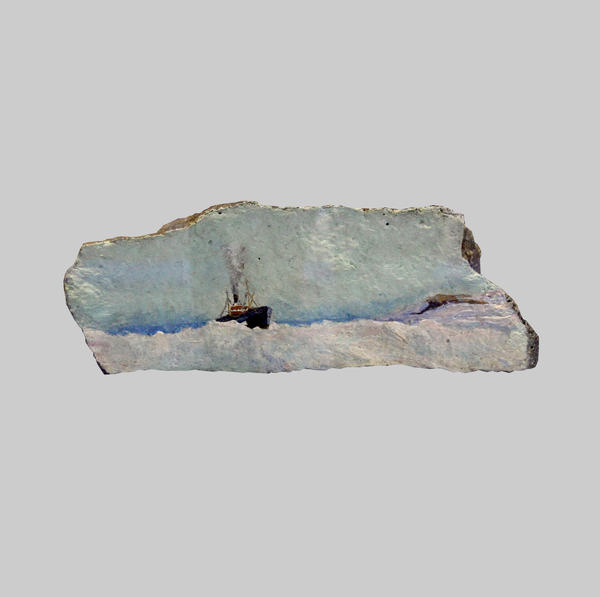
From that voyage, Stepan Pisakhov brought many travel notes, etudes on rocks and sketches which formed the basis for painting Icebreaking Steamer ‘Sedov’ by Franz Joseph Land. One of the stones with the icebreaker pulling through the ice was given to the vessel captain – Vladimir Ivanovich Voronin, and then was included in the exhibition of the Northern Maritime Museum.