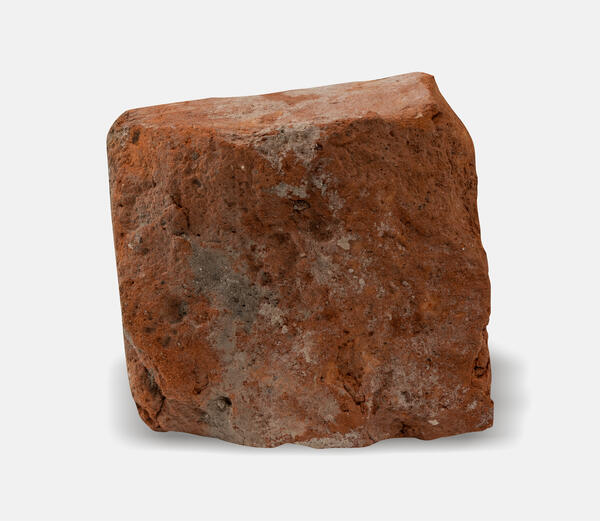
The earliest records about brick production in Prussia date back to 1240 when the knights of the Teutonic Order began to conquer the Prussian lands. The Old Prussians used wood as their main building material, but wooden buildings caught fire easily. There were also no sandstone or limestone deposits in Prussia: the boulders that had been brought there during the Last Glacial Period, did not form deposits and were not found in large quantities. The Order had no other choice but to start using bricks for the construction of fortresses, castles, and churches. The appearance of bricks was facilitated by the widespread distribution of clay deposits, their excellent quality and ease of extraction. In the late 13th — early 14th centuries, mass production of bricks was established in Prussia.
The Order is known to have recruited teams of freemasons and bricklayers from across Europe for the production of bricks. They moved from one construction site to another. As evidenced by the high quality of the bricks and masonry, these were highly skilled craftsmen. The extracted clay had to be exposed to air for two years. After that, it was placed in a pit and kneaded, often with feet. During the kneading process which lasted from 12 to 48 hours, all the unnecessary material was removed, and sand was added. Then the clay was sent to the molding tables, where a craftsman formed bricks using a wooden mold. There was no standard brick size. The requirement that a brick must be small enough to be picked up with one hand was introduced later. The bricks produced by the Teutonic Order were rather large, and all their dimensions could be above average. The shaped bricks were air-dried under a roof for several days. The dried bricks were placed inside the kiln for firing, being arranged according to a prescribed herringbone pattern. For even distribution of heat, gaps of 2–4 centimeters were left between them. In the kiln, the bricks were exposed to temperatures from 850 to 950 degrees Celsius. Ceramic bricks gave rise to a new architectural style — Brick Gothic.
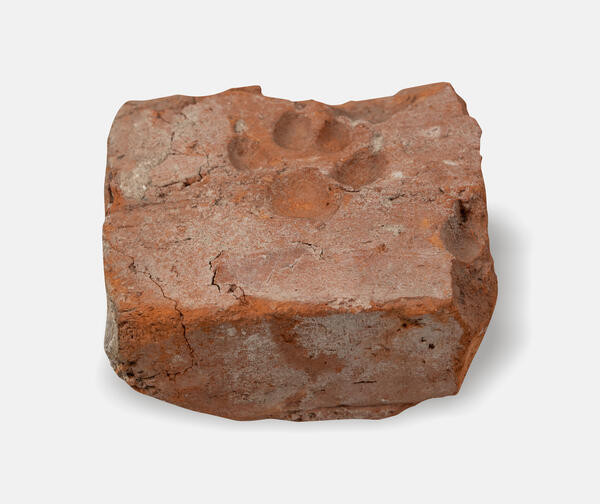
The museum’s exhibition includes a collection of
large red ceramic bricks. Most of them are solid construction bricks. Some
bricks have footprints of various animals and birds.