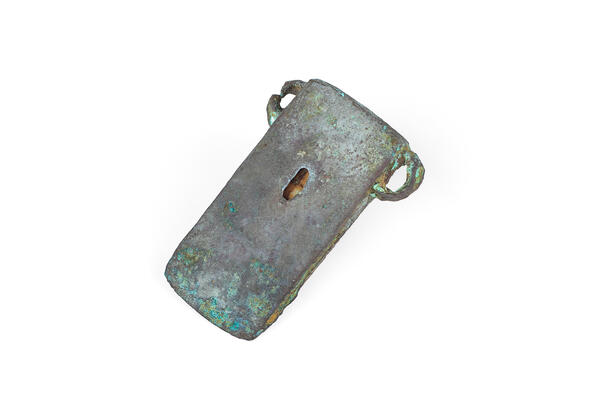
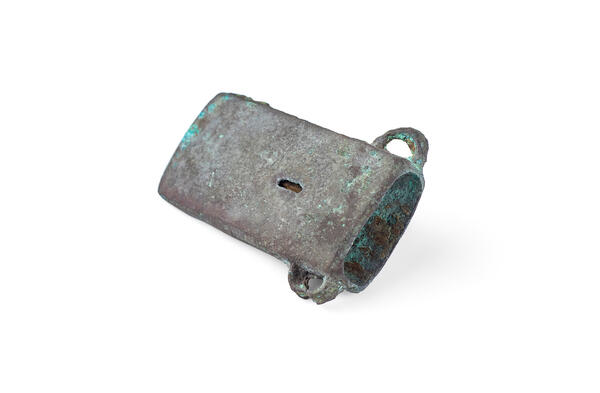
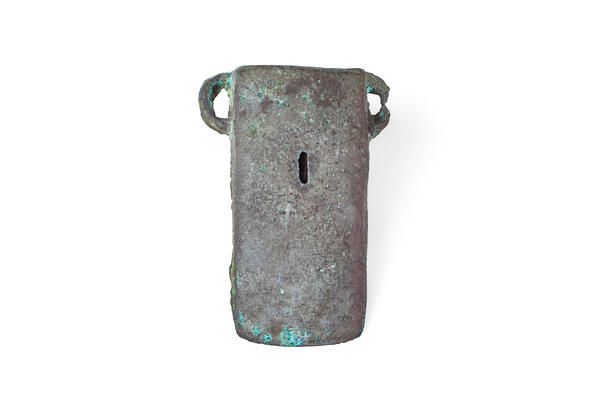
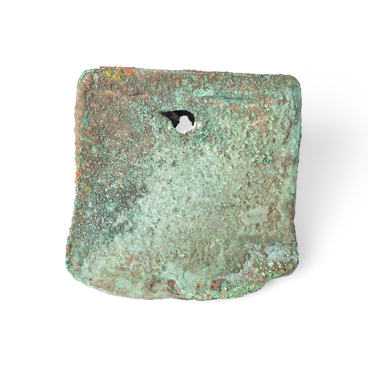
A shaft-hole double-eared celt of reduced size was made of bronze. The craftsman gave it a wedge shape, made the tool hollow with an arc-shaped blade. He placed two bracket-shaped ears on the side edges of the shaft hole, one on each side, and made asymmetric holes for attaching the object to the handle.
This artifact was discovered during archaeological research on the territory of the city of Sayanogorsk. In the period from 1990 to 1991, the Beya Archaeological Expedition of the Institute of the History of Material Culture of the Russian Academy of Sciences was excavating archaeological sites that were threatened with destruction due to the construction of the city. In those years, researchers studied groups of mounds called “Letnik II.” They were attributed to the Tagar culture of the 9th–3rd centuries BCE.
Among the numerous grave goods of the mound, archaeologists discovered a bronze double-eared celt. It was dated to the late period of the culture, approximately 4th–3rd centuries BCE. The item belongs to the Bronze Age. Given the size of this tool, it can be assumed that the celt was not a utilitarian, but a votive object, that is, intended for sacrifice or funeral rite. Since the 5th century BCE, it became common for the people ofTagar culture to put not real weapons in burials, but their reduced “impractical” copies.
Celt, a variety of ax, chisel and hoe made of copper or bronze, first appeared in the Late Eneolithic era, the Copper Age, from about 2500 to 1700 BCE. The tools became widespread already in the Bronze Age. Later, these objects were effectively used until the final displacement of bronze by iron in the 3rd century BCE.
Celt axes with side
semicircular ears were weapons of the late Bronze Age and the beginning of the
Early Iron Age, the so-called Early Scythian period. The handle of the celts
was usually made of wood; it was inserted into the shaft of the celt, secured
in place through holes, with ears serving as an additional fastening. To secure
a celt on a handle, a leather cord was used.