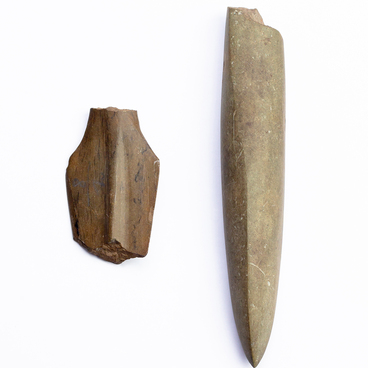
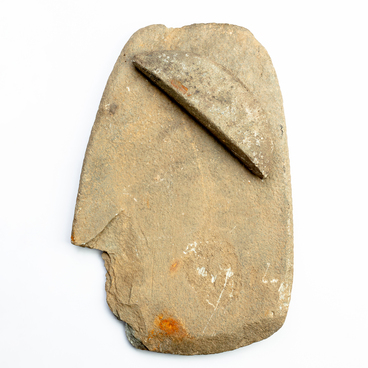
The ax is one of the oldest composite tools. It originates from a stone that was pointed on one side and rounded on the other. Such a primitive hand ax is called a chopper.
An important step in the evolution of this tool was the combination of a chopper and a stick into one tool, thus creating the stone ax. The additional leverage significantly increased the force of the strike and made the tool more convenient to use.
The method of fastening the stone chopping part to the wooden handle could vary. The stone was attached to the split handle either with a bandage or rubber resin, or simply driven into a solid handle.
The first axes with handles appeared in the Late or Upper Paleolithic 12–35 thousand years ago.
Initially and for a long time, they were primarily used as household tools. Axes were used not only for butchering meat, but also for processing wood.
These tools were crudely chipped stone cores. Gradually, the axes began to flatten on the sides and take the shape of a chisel.
While processing wood, the blades became smoother and more efficient. Ancient people noticed this trend about 6–7 thousand years ago and began to grind them — at first only along the cutting edge, and then over the entire surface, including on the butt.
Slabs of sedimentary rocks such as sandstone were used for grinding. In the late Stone Age, when stone processing reached a high level, stone axes were made with a hole for the handle, known as the “eye.”
Thus, the ancient ax looked almost like a modern one, although it was made of stone.
With the advent of wars, axes began to be used as weapons. In the late Stone Age era, the Neolithic, with the increase in the craftsmanship of stone processing, combatodels began to appear. These were usually small axes that were designed for single-handed combat.
Bronze products began to replace stone ones from
about the second millennium BCE. Axes made of stone, due to their accessibility
and cheapness, continued to coexist with metal ones for a long time. In some
regions of the world, non-metallic tools, including axes, are still in use
today.