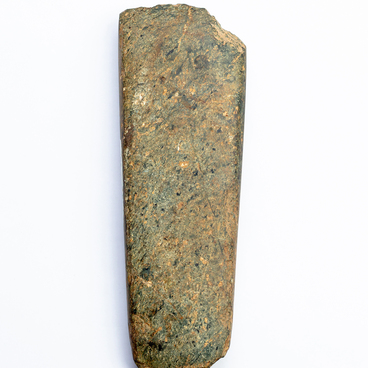
The archaeological section of the collection of the Spassk Museum features a grain grater — an ancient device for grinding grain.
It consisted of two parts: a lower stone with a flat, slightly concave surface, or a grain-grinding plate, and an upper, smaller, rounded stone known as a grindle-stone. Sometimes, instead of the bottom stone, natural rock indentations were used for grinding grain.
The upper grinding stone of the grain grater could have any shape. Often, flat pebbles were used in its stead.
The method of using the grain grinder was as follows: grain was poured onto the lower stone and ground with the upper one. Grain grinders were also used to grind dried fruits, salt, and other food products.
From the Late Paleolithic, grain graters became widespread. By the Neolithic era, they had become common household items.
To manufacture them, stones of hard rock types were used, such as granite, basalt, durable sandstone, and others.
As the demand for flour increased, the size of the grinding stones grew, making it increasingly difficult for one person to handle them. Gradually, the design of grain grinders improved: a hole was made in the upper stone for filling grain, and a simple lever was used to move the upper stone over the lower one. This significant invention led to further modernization of flour production tools.
Over time, the grain grater was replaced by primitive millstones.
The grain grater played a significant role in the development of food production. Despite its ancient origin, it has not completely fallen out of use. Even today, there are mountain settlements where these tools continue to be utilized.