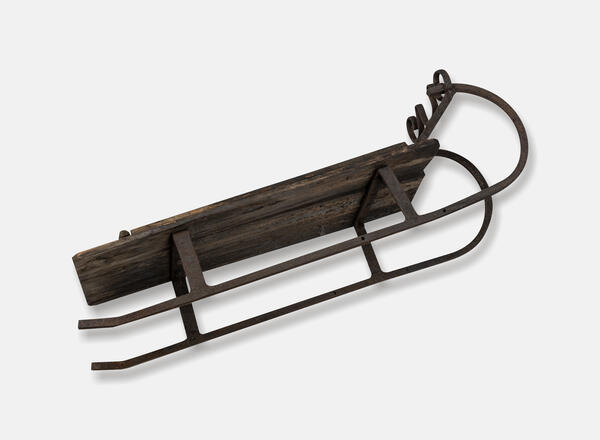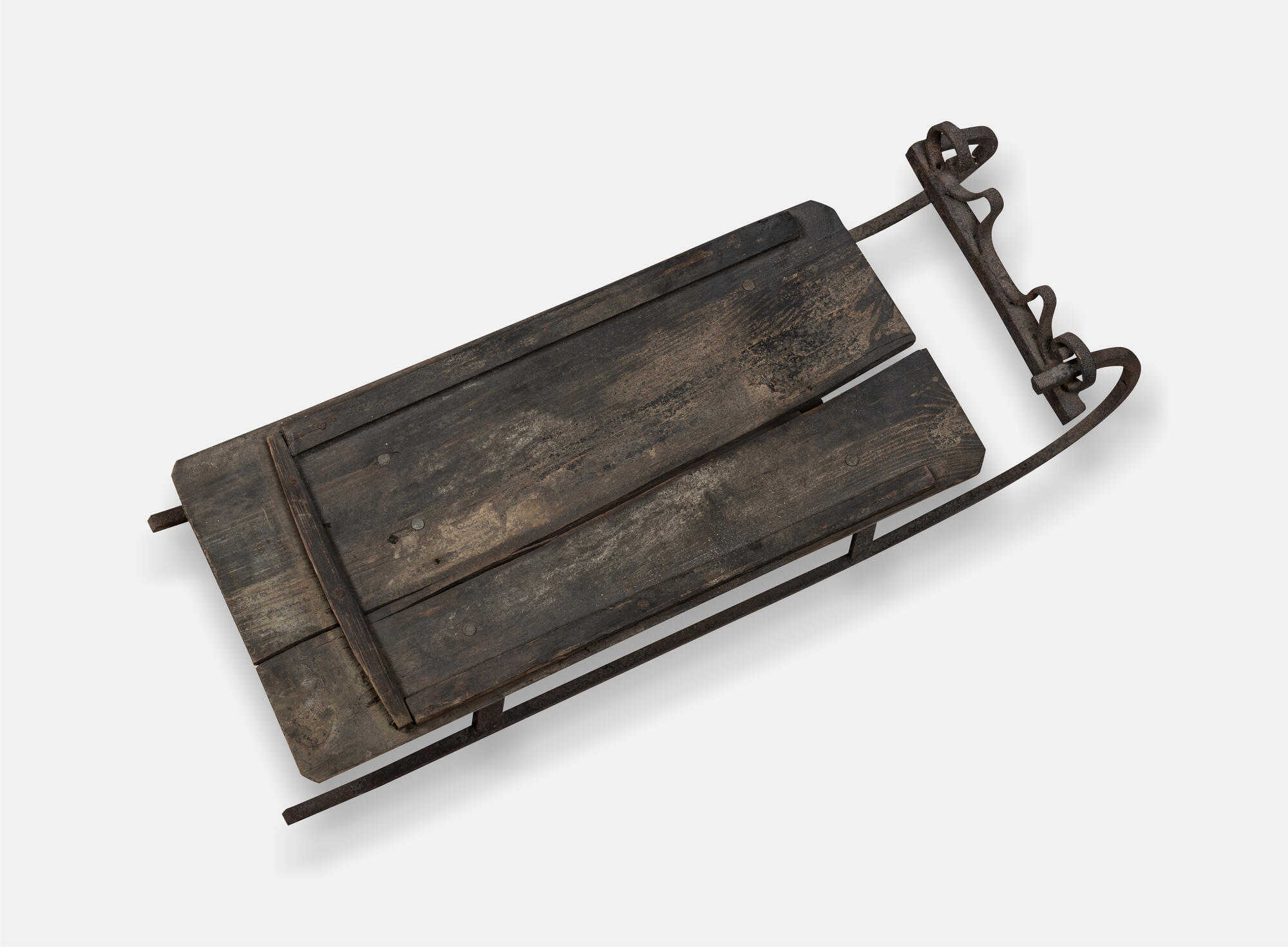


The exhibition features a child’s sled made in the early 20th century. The earliest sleds differ little from modern designs. They too consisted of a wooden seat and metal runners.
The first sleds are believed to have appeared in the 2nd millennium BC. They were invented by the peoples of the North. The runners of ancient sleds have been found in Finnish peat bogs and in the Northern Urals. The design of early sleds was genius in its simplicity. Most remarkable is that it has remained almost unchanged for several thousand years. Two poles were tied together. The front ends were tied to a dog, horse, or ox, and the rear ends were pulled along the ground.
Using sleds was not limited to snow-covered areas. They were known not only in northern but also in southern countries. Many peoples, who already had wheeled vehicles, traditionally used sleds in funeral rites — as was the case with ancient Egypt. This was due to the fact that riding a sled was considered more honorable than riding a chariot. Sleds were usually pulled by draft animals, such as dogs, deer, and horses. In the 17th century, wind-powered sleds became widespread. The peoples of Scandinavia and Northern Europe used sleds with sails for traveling on icy lakes, as can be seen in the paintings of that time. Such sleds were also used in the Curonian Lagoon. In pre-Petrine Russia, due to the poor road conditions, sleds were the most popular vehicle even in summer. In swampy and forested areas of Arkhangelsk, Vologda, Olonets, and Kostroma Governorates, sleds continued to be used throughout the year until the early 20th century. Sleds were usually drawn by one horse, and on holidays, such as weddings or traditional rides of the Maslenitsa week, the sled was drawn by a richly harnessed troika and filled with bright fabrics and furs.
In Kievan Rus, riding a sled was also considered
more respectable than riding a wheeled vehicle, which was why sleds were used
for great occasions, especially by high-ranking clergymen, who preferred riding
sleds in summer until the end of the 17th century. An early sled
resembled a boat with a curved front and back, or a long box tapered in the
front, with the passenger being able to lie down.