The sculptures that can be found in the southern Russian steppes are called kurgan stelae. They usually depict women or male warriors. In the old times, they were placed at the kurgan tops where everyone can see them. Details of clothes, jewelry, or weapons were carved in a primitive way.
Nizami Ganjavi, a Persian poet of the 12th century, who told about the stela worship by Cumans, first mentioned kurgan stelae. When the Pope’s ambassador, William of Rubruck, was passing the Cuman steppe, he observed the nomads who mounded large hills and erected statues, facing east, with bowls in their hands. Two, five, or even ten statues were installed on kurgans.
Researchers suppose that those ancient sculptures were the attributes of some complex rituals connected with ancestor worship. The statues were not grave monuments, they were erected in steppe on high places, in special sanctuaries. Archaeologists often found the remains of such sanctuaries enclosed with a primitive crude stone fence on kurgan tops and high watersheds.
During the Russian exploration of the steppe, kurgan stelae were destroyed as an obstacle to land cultivation. In a best-case scenario, they were brought to peasants’ huts for household needs or to landlords’ estates for decorating their parks. Concerned about this, scientists obtained a protection document for the unique sculptures at the end of the 19th century. Though by that time, most of them were held in the museums of southern Russian cities.
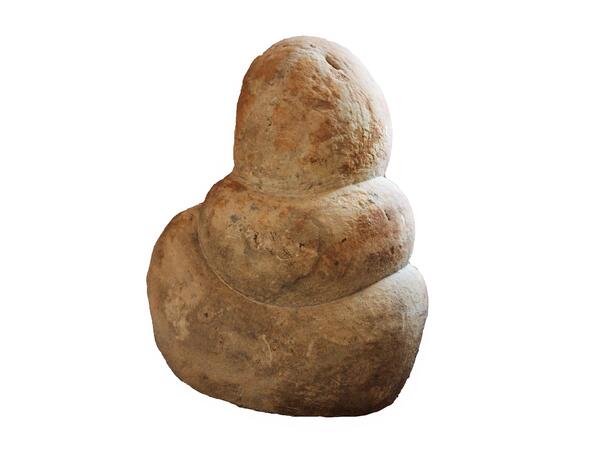
The kurgan stela from the museum exhibition was discovered accidentally on the territory of the Oryol region. It was found in 1984 on the outskirts of Verkhovye village during excavations.
According to the Institute of Archaeology of Russian Academy of Sciences, this monument’s form is unusual, uncharacteristic of monumental sculpture. The researchers could not name the exact time of its creation, but they have concluded that the statue was not made earlier than the Middle Ages. A similar image of eyes, for example, is found in small statuary and stone sculptures of Saltovo-Mayaki culture — the Khazars and Bulgars. Therefore, experts call the 9th–11th century the most likely date of the stela creation.
Nizami Ganjavi, a Persian poet of the 12th century, who told about the stela worship by Cumans, first mentioned kurgan stelae. When the Pope’s ambassador, William of Rubruck, was passing the Cuman steppe, he observed the nomads who mounded large hills and erected statues, facing east, with bowls in their hands. Two, five, or even ten statues were installed on kurgans.
Researchers suppose that those ancient sculptures were the attributes of some complex rituals connected with ancestor worship. The statues were not grave monuments, they were erected in steppe on high places, in special sanctuaries. Archaeologists often found the remains of such sanctuaries enclosed with a primitive crude stone fence on kurgan tops and high watersheds.
During the Russian exploration of the steppe, kurgan stelae were destroyed as an obstacle to land cultivation. In a best-case scenario, they were brought to peasants’ huts for household needs or to landlords’ estates for decorating their parks. Concerned about this, scientists obtained a protection document for the unique sculptures at the end of the 19th century. Though by that time, most of them were held in the museums of southern Russian cities.
The kurgan stela from the museum exhibition was discovered accidentally on the territory of the Oryol region. It was found in 1984 on the outskirts of Verkhovye village during excavations.
According to the Institute of Archaeology of Russian Academy of Sciences, this monument’s form is unusual, uncharacteristic of monumental sculpture. The researchers could not name the exact time of its creation, but they have concluded that the statue was not made earlier than the Middle Ages. A similar image of eyes, for example, is found in small statuary and stone sculptures of Saltovo-Mayaki culture — the Khazars and Bulgars. Therefore, experts call the 9th–11th century the most likely date of the stela creation.