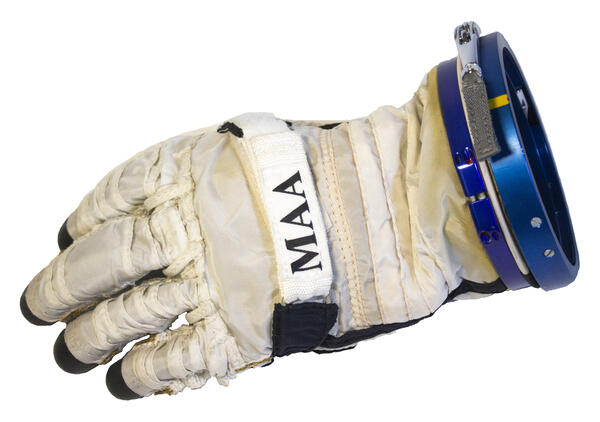
An astronaut glove from the spacesuit “Sokol” is part of the astronaut’s personal protective equipment that he or she wears for spacewalks. A sealed rubber glove has a pressure restraint layer over it. It is a layer of nylon that protects hands from being blown away by sudden pressure changes. For the same purpose, the outside of the finger part of the glove is lined with rubber-coated capron knitwear.
In order not to lose the hand’smobility in such a glove, in the pressure restraint layer several folds are made that work as a hinge. There are also volumetric protrusions in the places where the fingers are bent that simplify movements. Astronauts can move in a 120-kilogram spacesuit with the help of their hands only, and every effort they makes to squeeze their fingers in the sealed gloves is comparable to training with an expander (a resistance band for training wrists and fingers). Overall, an astronaut makes at least 1,200 such grip movements during a spacewalk.
Usually, one pair of astronaut gloves is used for one spacewalk.
This astronaut glove on the display belonged to Alexander Misurkin, the flight engineer of the crew of “Soyuz TMA-08M”. The astronaut himself donated it to the museum in 2014.
Alexander Misurkin graduated from Lyceum №1 in Oryol and entered the Kacha Higher Military Aviation School of Pilots. In September 1998, he continued his studies at the Armavir Military Aviation Institute and graduated as a pilot-engineer.
On March 29, 2013, Misurkin made his first space flight as a flight engineer on the spacecraft “Soyuz TMA-08M” along with crew commander Pavel Vinogradov and second flight engineer Christopher Cassidy from the United States. It was the first human-crewed space flight to the International Space Station under the shortened program.
The crew’s stay on the ISS lasted for 167 days. On September 1, 2013, the astronauts returned to Earth. During his time onboard, the ISS Misurkin made three spacewalks. On August 26, 2016, he was awarded the title Hero of the Russian Federation.
In order not to lose the hand’smobility in such a glove, in the pressure restraint layer several folds are made that work as a hinge. There are also volumetric protrusions in the places where the fingers are bent that simplify movements. Astronauts can move in a 120-kilogram spacesuit with the help of their hands only, and every effort they makes to squeeze their fingers in the sealed gloves is comparable to training with an expander (a resistance band for training wrists and fingers). Overall, an astronaut makes at least 1,200 such grip movements during a spacewalk.
Usually, one pair of astronaut gloves is used for one spacewalk.
This astronaut glove on the display belonged to Alexander Misurkin, the flight engineer of the crew of “Soyuz TMA-08M”. The astronaut himself donated it to the museum in 2014.
Alexander Misurkin graduated from Lyceum №1 in Oryol and entered the Kacha Higher Military Aviation School of Pilots. In September 1998, he continued his studies at the Armavir Military Aviation Institute and graduated as a pilot-engineer.
On March 29, 2013, Misurkin made his first space flight as a flight engineer on the spacecraft “Soyuz TMA-08M” along with crew commander Pavel Vinogradov and second flight engineer Christopher Cassidy from the United States. It was the first human-crewed space flight to the International Space Station under the shortened program.
The crew’s stay on the ISS lasted for 167 days. On September 1, 2013, the astronauts returned to Earth. During his time onboard, the ISS Misurkin made three spacewalks. On August 26, 2016, he was awarded the title Hero of the Russian Federation.