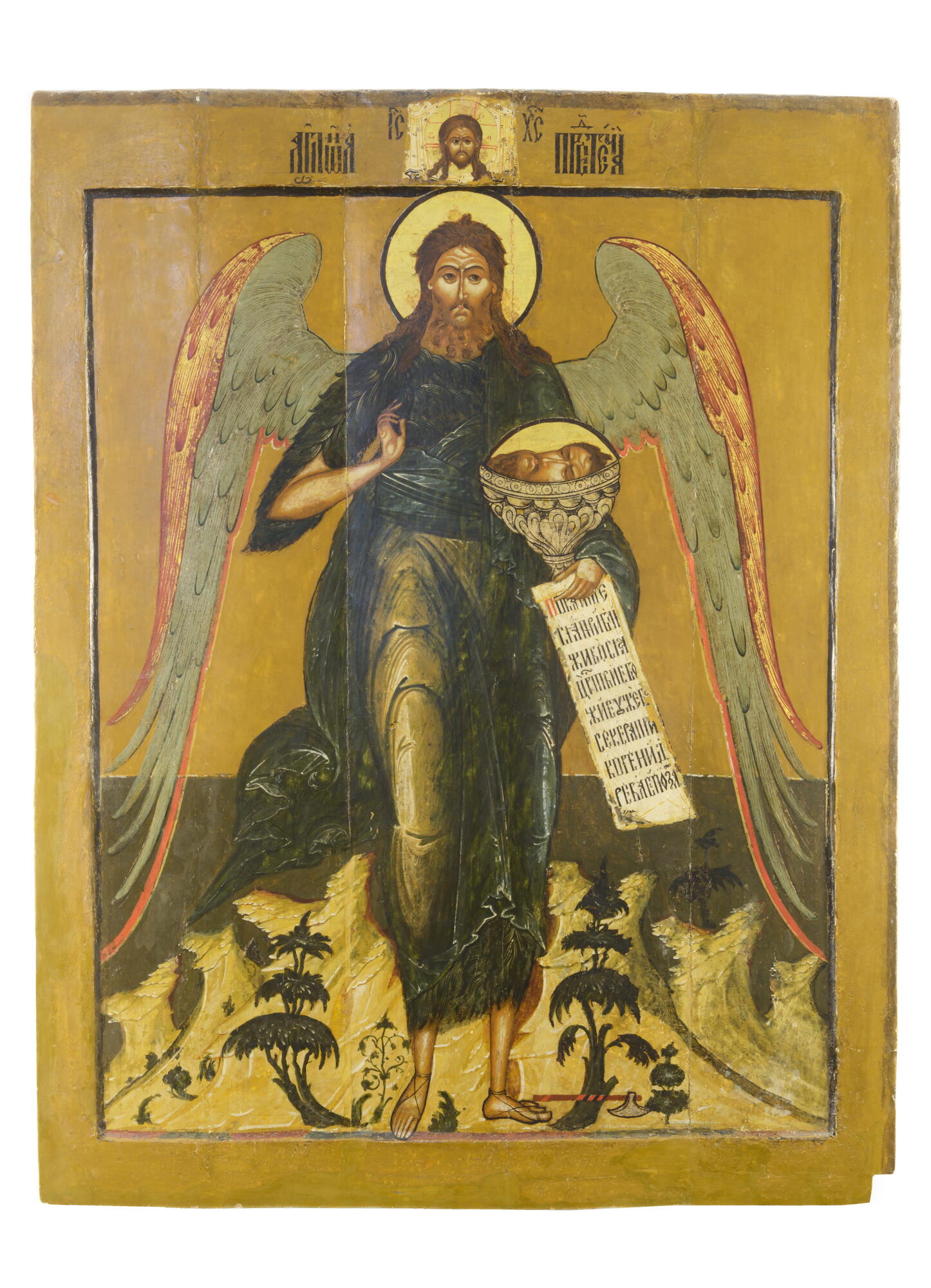


This icon of John the Baptist was transferred to the Radishchev Art Museum in 1958 from the Yaroslavl Art Museum as part of the collection of 17th-century icons. Before becoming part of the permanent exhibition, these works were restored for several decades by Moscow and Saratov specialists.
A number of stylistic features of the icon “John the Baptist — Angel of the Desert” indicate that it was made in the first half of the 17th century and is the earliest work from the transferred collection.
John the Baptist was the last Old Testament prophet and herald of a new Christian era in the history of humankind. His task was to prepare the people for the Savior, to call them to repentance and to grant them the sacrament of baptism in the waters of the Jordan River. Christ Himself was baptized by John, thus consecrating the rite. Since then, the sacrament has symbolized the spiritual birth of every Christian, and John has become one of the most revered saints by both Western and Eastern Christians.
The iconography of “St. John the Baptist — Angel of the Desert” has been known since the 13th century, but became widespread in Russian art three centuries later. Its basis was the prophecy of the prophet Malachi that the Lord sends His angel to people before coming Himself.
John the Baptist is depicted in full length as a winged creature. His long hair and beard are tousled, and his stern, swarthy face is haggard because of incessant fasting and prayer. He wears an outer garment made of camel hair and a dark blue himation (a cloak). In his hands, the prophet holds a scroll and a bowl with his severed head and at his feet there is a tree with a stuck axe.
The Saratov icon also features the image of the Savior Not Made by Hands, painted, as in other ancient icons, in the upper field. Researchers believe that the icon painter adhered to the patterns of the Stroganov school. For example, the face of the saint, as well as his hands and feet are rendered in very light colors, which was typical for the capital’s workshops.
This monument of fine art dates to the first half of the 17th century.
A number of stylistic features of the icon “John the Baptist — Angel of the Desert” indicate that it was made in the first half of the 17th century and is the earliest work from the transferred collection.
John the Baptist was the last Old Testament prophet and herald of a new Christian era in the history of humankind. His task was to prepare the people for the Savior, to call them to repentance and to grant them the sacrament of baptism in the waters of the Jordan River. Christ Himself was baptized by John, thus consecrating the rite. Since then, the sacrament has symbolized the spiritual birth of every Christian, and John has become one of the most revered saints by both Western and Eastern Christians.
The iconography of “St. John the Baptist — Angel of the Desert” has been known since the 13th century, but became widespread in Russian art three centuries later. Its basis was the prophecy of the prophet Malachi that the Lord sends His angel to people before coming Himself.
John the Baptist is depicted in full length as a winged creature. His long hair and beard are tousled, and his stern, swarthy face is haggard because of incessant fasting and prayer. He wears an outer garment made of camel hair and a dark blue himation (a cloak). In his hands, the prophet holds a scroll and a bowl with his severed head and at his feet there is a tree with a stuck axe.
The Saratov icon also features the image of the Savior Not Made by Hands, painted, as in other ancient icons, in the upper field. Researchers believe that the icon painter adhered to the patterns of the Stroganov school. For example, the face of the saint, as well as his hands and feet are rendered in very light colors, which was typical for the capital’s workshops.
This monument of fine art dates to the first half of the 17th century.


