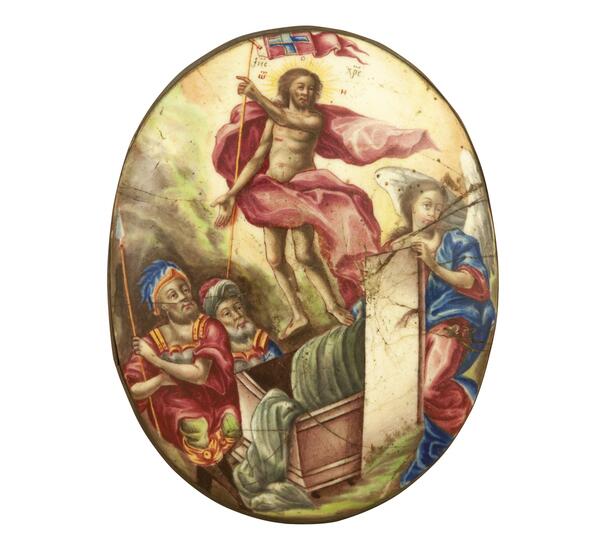
The small icon “Resurrection of the Lord” is made in the technique of painted enamel. It comes from the Zubrilovka estate of the famous princely family of the Golitsyn-Prozorovskys. The owners of the estate were fond of art in general and painted enamel in particular, so they bought such works of art for their Transfiguration Church.
Researchers believe that once the icon was not a separate object, but a fragment of a precious revetment decorating the Gospel that has not been preserved. The traditional way of designing sacred books usually included a silver chased or engraved cover, inlaid with jewels and pearls, and containing biblical scenes or images of saints made in enamel.
The technique of creating various types of enamel came from Byzantium and has been known in Russia for a long time. Several layers of enamel (an opaque vitreous mass) are applied on the front and one layer — on the reverse side of a convex copper plate. Then it is fired at temperatures up to 800 degrees and fused with metal, forming a smooth shiny surface — the basis for painting.
This work is painted with refractory paints. Such paints are applied first, followed by fusible ones — this is taken into account during each subsequent firing. When creating a complex multi-color composition, the object can be fired up to seven times.
Moscow, Rostov Veliky and Solvychegodsk were considered the main centers of pictorial enamels. The craft catered for the most diverse tastes of the customers — from the highest-ranking clergy to city dwellers and villagers.
Since the middle of the 17th century, enamel has become highly important in decorating religious and secular items. At the same time, miniatures on enamel became popular. A rich color palette, bright colors that never fade, and a shiny smooth surface made enamel a valuable technique for decorating various objects.
The artist who created the enamel from the collection of the Radishchev Art Museum is unknown. Perhaps the work was done in one of the jewelry workshops in Moscow. The unencumbered expressiveness of the figures, the professionally organized composition, the subtle elaborate coloring based on the combination of cobalt, purple, pink, yellow, green and ocher colors — all these features prove the piece was created by an experienced artist.
Researchers believe that once the icon was not a separate object, but a fragment of a precious revetment decorating the Gospel that has not been preserved. The traditional way of designing sacred books usually included a silver chased or engraved cover, inlaid with jewels and pearls, and containing biblical scenes or images of saints made in enamel.
The technique of creating various types of enamel came from Byzantium and has been known in Russia for a long time. Several layers of enamel (an opaque vitreous mass) are applied on the front and one layer — on the reverse side of a convex copper plate. Then it is fired at temperatures up to 800 degrees and fused with metal, forming a smooth shiny surface — the basis for painting.
This work is painted with refractory paints. Such paints are applied first, followed by fusible ones — this is taken into account during each subsequent firing. When creating a complex multi-color composition, the object can be fired up to seven times.
Moscow, Rostov Veliky and Solvychegodsk were considered the main centers of pictorial enamels. The craft catered for the most diverse tastes of the customers — from the highest-ranking clergy to city dwellers and villagers.
Since the middle of the 17th century, enamel has become highly important in decorating religious and secular items. At the same time, miniatures on enamel became popular. A rich color palette, bright colors that never fade, and a shiny smooth surface made enamel a valuable technique for decorating various objects.
The artist who created the enamel from the collection of the Radishchev Art Museum is unknown. Perhaps the work was done in one of the jewelry workshops in Moscow. The unencumbered expressiveness of the figures, the professionally organized composition, the subtle elaborate coloring based on the combination of cobalt, purple, pink, yellow, green and ocher colors — all these features prove the piece was created by an experienced artist.