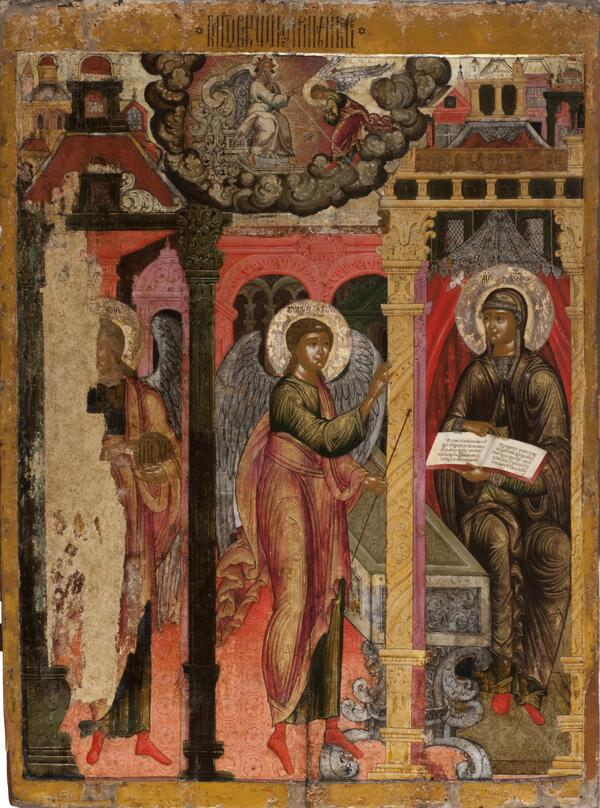
The Annunciation icon belongs to works created during the heyday of the Yaroslavl icon painting school in the 17th century. It was brought to Saratov in the middle of the 20th century, when the Yaroslavl collections were distributed among Soviet museums. This was done in order to preserve the monuments and enhance local collections with works of tempera painting.
The icons were in poor condition, most of them were patched with thin paper that fixed the pictorial layer. Both Moscow and local specialists dedicated a lot of time to the restoration of numerous religious artworks.
In this Annunciation icon, there are traces of the exposure of Yaroslavl painting to the influence of Western European engraving. One of the main features of the art of that time was the creative interpretation of traditional iconographic types. Therefore, the image from the museum collection also has a number of original features.
“Annunciation with a book” is one of the basic iconographic types of this plot. According to the Church tradition, when the angel appeared to Mary, she was reading the Book of the Prophet Isaiah. Therefore, most often the open pages of the book featured his prophetic words: “Behold, a virgin shall conceive…” In our case, the open book displays the words from the song of praise of the Virgin Mary: “My soul doth magnify the Lord…” (Luke 1:46–55).
The Annunciation image began to feature three Archangels in the second half of the 17th century and became increasingly common in the 18th century. Its origin is connected with icon painters seeking to embody the entire story as it was described in the Gospel of Luke. Therefore, the icon received additional details: the Sabaoth blessing the Archangel Gabriel and the image of the “departed” Archangel holding his finger next to his lips as a sign of “silence”.
The composition turned out to be complex, consisting of the foreground, divided into three parts by decorative columns, and a fragment behind the clouds. In general, architectural elements played a significant role in this work: they not only demonstrated the stages of the event, but also helped to organize the space. Another means to achieve the same effect was the well-known technique used by the Yaroslavl icon painters in the second half of the 17th century — depicting characters and scenes in arched frames.
The icons were in poor condition, most of them were patched with thin paper that fixed the pictorial layer. Both Moscow and local specialists dedicated a lot of time to the restoration of numerous religious artworks.
In this Annunciation icon, there are traces of the exposure of Yaroslavl painting to the influence of Western European engraving. One of the main features of the art of that time was the creative interpretation of traditional iconographic types. Therefore, the image from the museum collection also has a number of original features.
“Annunciation with a book” is one of the basic iconographic types of this plot. According to the Church tradition, when the angel appeared to Mary, she was reading the Book of the Prophet Isaiah. Therefore, most often the open pages of the book featured his prophetic words: “Behold, a virgin shall conceive…” In our case, the open book displays the words from the song of praise of the Virgin Mary: “My soul doth magnify the Lord…” (Luke 1:46–55).
The Annunciation image began to feature three Archangels in the second half of the 17th century and became increasingly common in the 18th century. Its origin is connected with icon painters seeking to embody the entire story as it was described in the Gospel of Luke. Therefore, the icon received additional details: the Sabaoth blessing the Archangel Gabriel and the image of the “departed” Archangel holding his finger next to his lips as a sign of “silence”.
The composition turned out to be complex, consisting of the foreground, divided into three parts by decorative columns, and a fragment behind the clouds. In general, architectural elements played a significant role in this work: they not only demonstrated the stages of the event, but also helped to organize the space. Another means to achieve the same effect was the well-known technique used by the Yaroslavl icon painters in the second half of the 17th century — depicting characters and scenes in arched frames.