The Resurrection of Christ on the third day after His execution and burial is one of the main tenets of Christian doctrine. Having endured terrible torments and died on the cross, the Son of God destroyed the concept of death by His return to the world of the living. This event became a symbol and prototype of the future resurrection of all believers. The main Christian holiday, Easter, was established to commemorate the miracle that happened.
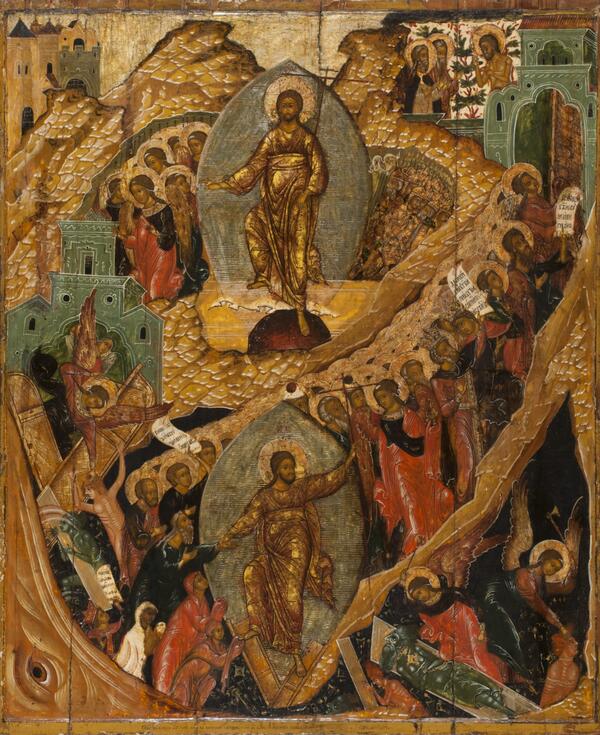
The troparion of the Bright Resurrection of Christ states that “Christ is risen from the dead, trampling down death by death, and upon those in the tombs bestowing life.” The Yaroslavl image is a detailed version of the subject, combining the historical — the Rising from the tomb — and the symbolic — the Descent into Hell — images of the Resurrection of Christ.
This tradition, which originated in the late 16th century, was finally formed in Moscow in the middle of the 17th century, when both scenes began to be placed strictly one above the other, compositionally linked by a single diagonal of the procession of the righteous from hell to heaven.
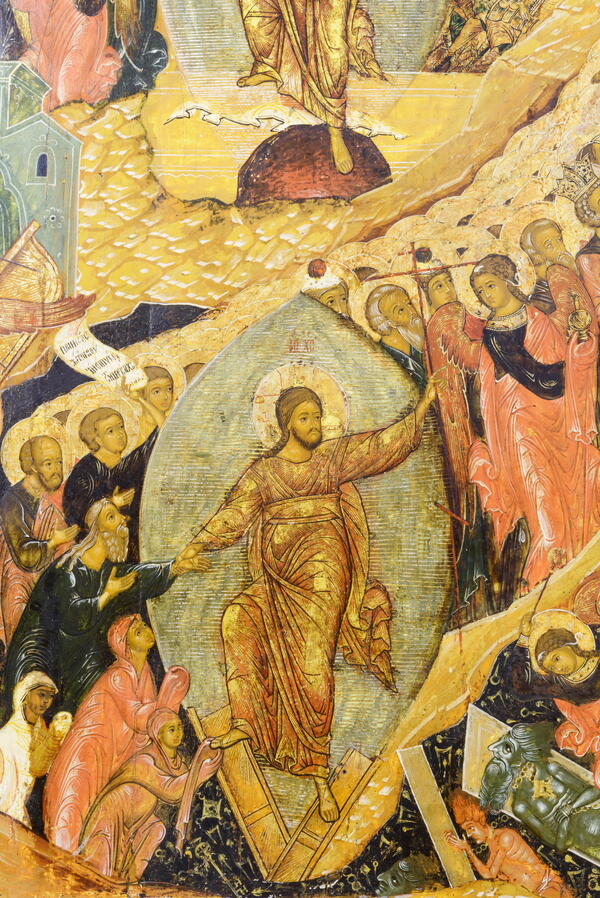
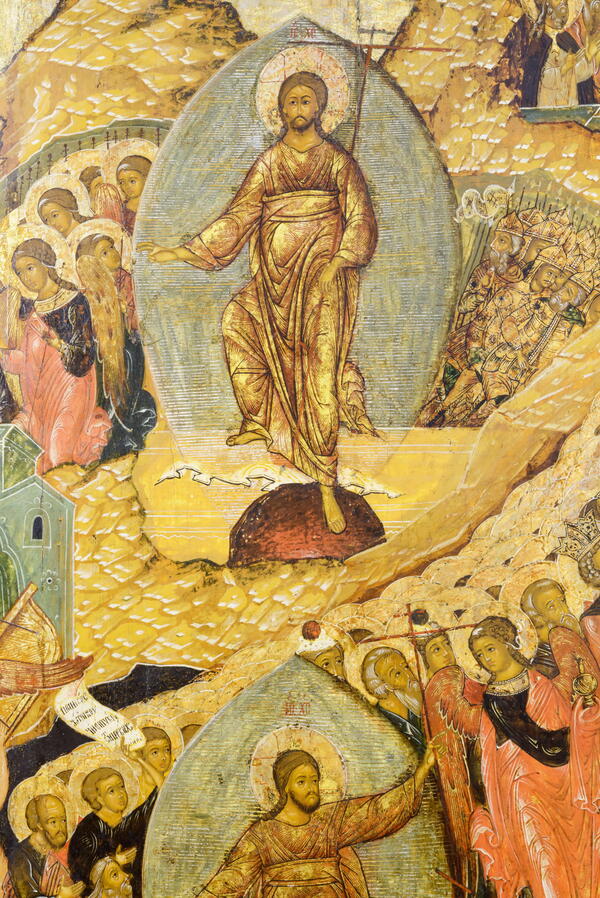
The image is divided into two parts. At the top, Christ is depicted in a mandorla, an oval nimbus symbolizing divine light, surrounded by archangels and selected saints. In the lower part of the icon, the Savior, like the sun, descends into hell; His feet trample the crosswise broken gates of the underworld.
Christ stretches out His right hand to Adam, and Eve stands behind her husband, stretching out her hands to the Savior. The Old Testament prophets and forefathers move to paradise — they are depicted in the upper right corner of the icon. The robber Rach and two respectable old men — the prophets Elijah and Enoch — meet the procession. Thus, the symbolic meeting of the two testaments — the Old and the New ones — takes place in the resurrection of Christ.
It is interesting how the iconography of this image also includes the image of the mouth of hell in the lower left corner. It is believed that the personification of hell entered Russian icons from Western art. Although there are such examples in early Yaroslavl painting, by the middle of the 17th century, local icon painters began to get more and more interested in the historical and everyday details of the plot. The mouth of hell in the large icon “Resurrection — Descent into Hell” indicates that the icon painter used an early iconographic version of the classical image.
The troparion of the Bright Resurrection of Christ states that “Christ is risen from the dead, trampling down death by death, and upon those in the tombs bestowing life.” The Yaroslavl image is a detailed version of the subject, combining the historical — the Rising from the tomb — and the symbolic — the Descent into Hell — images of the Resurrection of Christ.
This tradition, which originated in the late 16th century, was finally formed in Moscow in the middle of the 17th century, when both scenes began to be placed strictly one above the other, compositionally linked by a single diagonal of the procession of the righteous from hell to heaven.
The image is divided into two parts. At the top, Christ is depicted in a mandorla, an oval nimbus symbolizing divine light, surrounded by archangels and selected saints. In the lower part of the icon, the Savior, like the sun, descends into hell; His feet trample the crosswise broken gates of the underworld.
Christ stretches out His right hand to Adam, and Eve stands behind her husband, stretching out her hands to the Savior. The Old Testament prophets and forefathers move to paradise — they are depicted in the upper right corner of the icon. The robber Rach and two respectable old men — the prophets Elijah and Enoch — meet the procession. Thus, the symbolic meeting of the two testaments — the Old and the New ones — takes place in the resurrection of Christ.
It is interesting how the iconography of this image also includes the image of the mouth of hell in the lower left corner. It is believed that the personification of hell entered Russian icons from Western art. Although there are such examples in early Yaroslavl painting, by the middle of the 17th century, local icon painters began to get more and more interested in the historical and everyday details of the plot. The mouth of hell in the large icon “Resurrection — Descent into Hell” indicates that the icon painter used an early iconographic version of the classical image.