The pectoral cross appeared on the territory of Old Rus at the time of Christianity adoption. It was worn on the chest under the clothing or on top of it and suspended from the neck by a cord or chain. In Russia and Little Russia, the cross was considered an exclusive sign of bishops and archimandrites until the 18th century. Now all Russian Orthodox monks and priests wear pectoral crosses.
The tradition of creating miniature carved crucifixes and icons came to the Slavic lands from Byzantine monasteries. In the 18th–19th centuries, the largest and most important carving centers were on Mount Athos and in Kyiv, where artisans made both highly artistic works from precious materials and inexpensive mass products.
Small carved crosses, “panagias” (icons of the Mother of God) and the icons with numerous many miniature scenes created by Athos and Kyiv-Pechersk monks amazed with the virtuoso technique of execution. Those products were sold to different countries, including Russia, and often became examples for local carvers.
At first, this type of work was done in monasteries, but already in the second half of the 18th century, crosses and icons began to be created by city artisans, who were members of the icon-painting workshop. Probably, one of those Ukrainian guild masters made the relic from the collection of the Radishchev Art Museum.
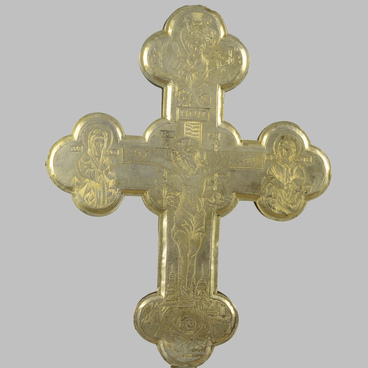
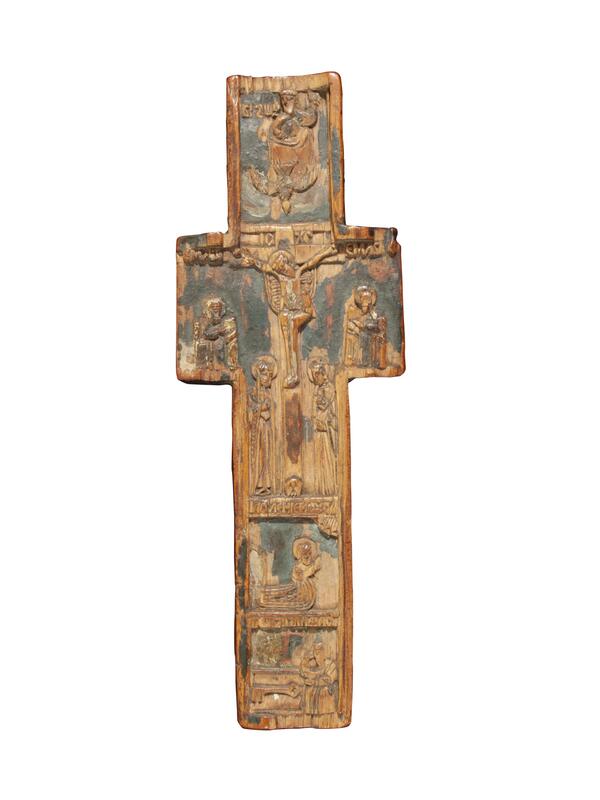
The four-pointed cross has two sides. On the front, in the very center, there is an image of the Crucifixion with saints, an image of Sabaoth with a dove and images of gospel subjects. On the reverse side is the Most Holy Theotokos with a Child in her arms, St. Anthony of the Caves and St. Theodosius of the Caves. The upper scene features the narrative of the Annunciation, and the lower scene includes the images of the holy martyrs Catherine and Barbara, as well as St. Nicholas the Wonderworker.
The finest carving demonstrates the brilliant technique of an 18th-century miniature painter. When creating his work, the artisan primarily focused on the best examples of Athos and Kyiv, thereby combining the traditions of the two famous schools.
The item is distinguished by the lack of excessive elements in the images of the saints, the thoroughness with which the details (angles, facial expressions, and folds) are rendered, and the slightly elongated silhouettes, typical for the products made in the workshops of the Kyiv-Pechersk Lavra. The work lacks the strictness and restraint in the depiction of the righteous that was characteristic of the carvings made by the Athos artisans. The cross is distinguished by the technique of painting with colored pigments used by the artisan.
The tradition of creating miniature carved crucifixes and icons came to the Slavic lands from Byzantine monasteries. In the 18th–19th centuries, the largest and most important carving centers were on Mount Athos and in Kyiv, where artisans made both highly artistic works from precious materials and inexpensive mass products.
Small carved crosses, “panagias” (icons of the Mother of God) and the icons with numerous many miniature scenes created by Athos and Kyiv-Pechersk monks amazed with the virtuoso technique of execution. Those products were sold to different countries, including Russia, and often became examples for local carvers.
At first, this type of work was done in monasteries, but already in the second half of the 18th century, crosses and icons began to be created by city artisans, who were members of the icon-painting workshop. Probably, one of those Ukrainian guild masters made the relic from the collection of the Radishchev Art Museum.
The four-pointed cross has two sides. On the front, in the very center, there is an image of the Crucifixion with saints, an image of Sabaoth with a dove and images of gospel subjects. On the reverse side is the Most Holy Theotokos with a Child in her arms, St. Anthony of the Caves and St. Theodosius of the Caves. The upper scene features the narrative of the Annunciation, and the lower scene includes the images of the holy martyrs Catherine and Barbara, as well as St. Nicholas the Wonderworker.
The finest carving demonstrates the brilliant technique of an 18th-century miniature painter. When creating his work, the artisan primarily focused on the best examples of Athos and Kyiv, thereby combining the traditions of the two famous schools.
The item is distinguished by the lack of excessive elements in the images of the saints, the thoroughness with which the details (angles, facial expressions, and folds) are rendered, and the slightly elongated silhouettes, typical for the products made in the workshops of the Kyiv-Pechersk Lavra. The work lacks the strictness and restraint in the depiction of the righteous that was characteristic of the carvings made by the Athos artisans. The cross is distinguished by the technique of painting with colored pigments used by the artisan.