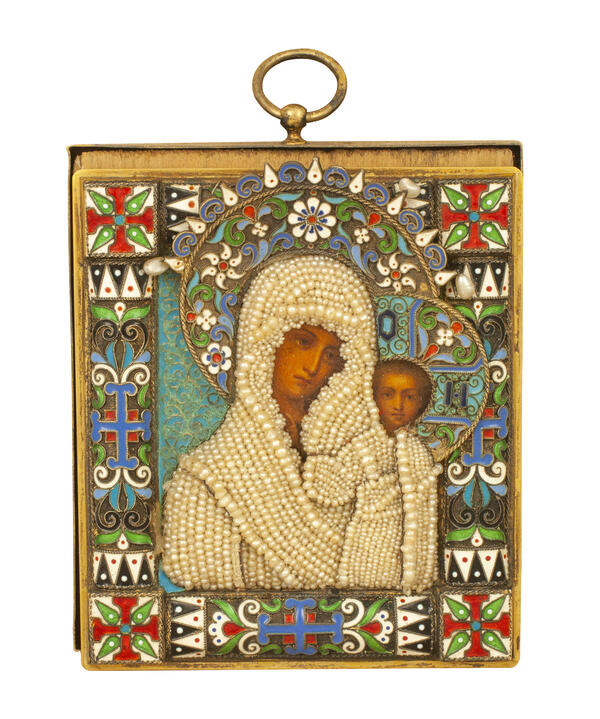
In 2001, the Radishchev Art Museum received a brightly decorated small icon dedicated to Our Lady of Kazan, one of the most revered miracle-working icons of the Russian Orthodox Church.
Legend has it that the icon was miraculously found in Kazan during the reign of Ivan the Terrible. After a terrible fire in 1579, the Virgin Mary appeared to the ten-year-old girl Matrona several times in a dream, indicating the underground place where the icon was to be found. When the adults finally listened to the girl, they really discovered the icon, which led to immediate cases of miraculous healing.
The Convent of the Mother of God was subsequently built on the site where the icon had been found in the ashes. Matrona became the first nun there and took the name of Mavra.
The iconography of this image is considered to be a simpler version of the Hodegetria — the Guide. The main difference is that the Theotokos is depicted up to her shoulders, and she holds the Baby Jesus who stands upright and holds His right hand in a blessing gesture. According to legend, the prototype of Our Lady of Kazan was kept in the Blachernae Church in Constantinople.
In Old Rus, the miracle-working Kazan icon was especially revered. This image protected the Russian army during difficult wars more than once, both in the 17th and in the 20th centuries.
The icon from the collection of the Radishchev Art Museum was created by an unknown icon painter in the 19th century. Most likely, it is a special type of icon designed specifically to be covered by a revetment so the image includes only faces and hands.
Around the late 1880s, a luxurious miniature revetment was made for the icon in Moscow, at the famous jewelry firm of Pavel Akimovich Ovchinnikov. The decorations covered the entire paint layer of the icon board. Only several significant elements remained open — the so-called “lichnoye pismo” (the faces and hands) — for which slots are made.
To make the icon, the artisan used various materials: silver, colored enamel, freshwater pearls, zinc plate, fabric and wood. The revetment was created using unique and highly complex Byzantine techniques: the finest chasing, engraved enamel, filigree enamel — a kind of cloisonné enamel, as well as embroidering with small freshwater pearls.
Legend has it that the icon was miraculously found in Kazan during the reign of Ivan the Terrible. After a terrible fire in 1579, the Virgin Mary appeared to the ten-year-old girl Matrona several times in a dream, indicating the underground place where the icon was to be found. When the adults finally listened to the girl, they really discovered the icon, which led to immediate cases of miraculous healing.
The Convent of the Mother of God was subsequently built on the site where the icon had been found in the ashes. Matrona became the first nun there and took the name of Mavra.
The iconography of this image is considered to be a simpler version of the Hodegetria — the Guide. The main difference is that the Theotokos is depicted up to her shoulders, and she holds the Baby Jesus who stands upright and holds His right hand in a blessing gesture. According to legend, the prototype of Our Lady of Kazan was kept in the Blachernae Church in Constantinople.
In Old Rus, the miracle-working Kazan icon was especially revered. This image protected the Russian army during difficult wars more than once, both in the 17th and in the 20th centuries.
The icon from the collection of the Radishchev Art Museum was created by an unknown icon painter in the 19th century. Most likely, it is a special type of icon designed specifically to be covered by a revetment so the image includes only faces and hands.
Around the late 1880s, a luxurious miniature revetment was made for the icon in Moscow, at the famous jewelry firm of Pavel Akimovich Ovchinnikov. The decorations covered the entire paint layer of the icon board. Only several significant elements remained open — the so-called “lichnoye pismo” (the faces and hands) — for which slots are made.
To make the icon, the artisan used various materials: silver, colored enamel, freshwater pearls, zinc plate, fabric and wood. The revetment was created using unique and highly complex Byzantine techniques: the finest chasing, engraved enamel, filigree enamel — a kind of cloisonné enamel, as well as embroidering with small freshwater pearls.