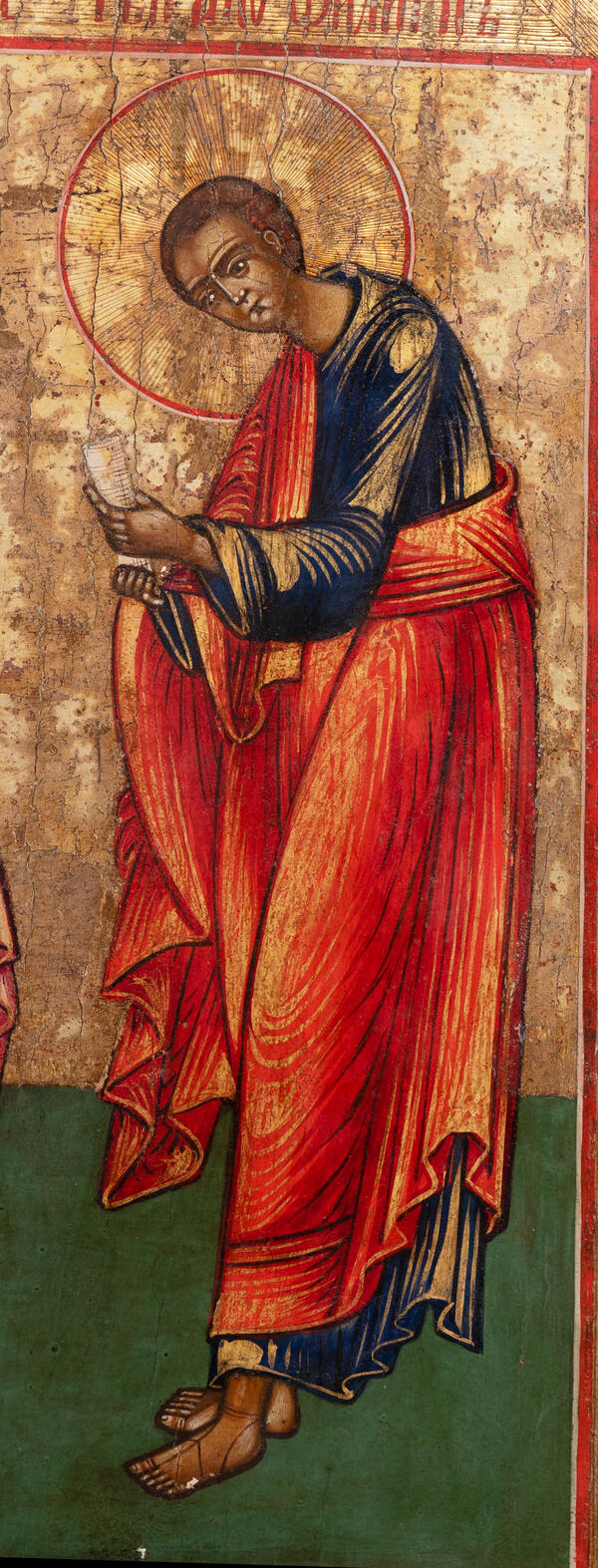
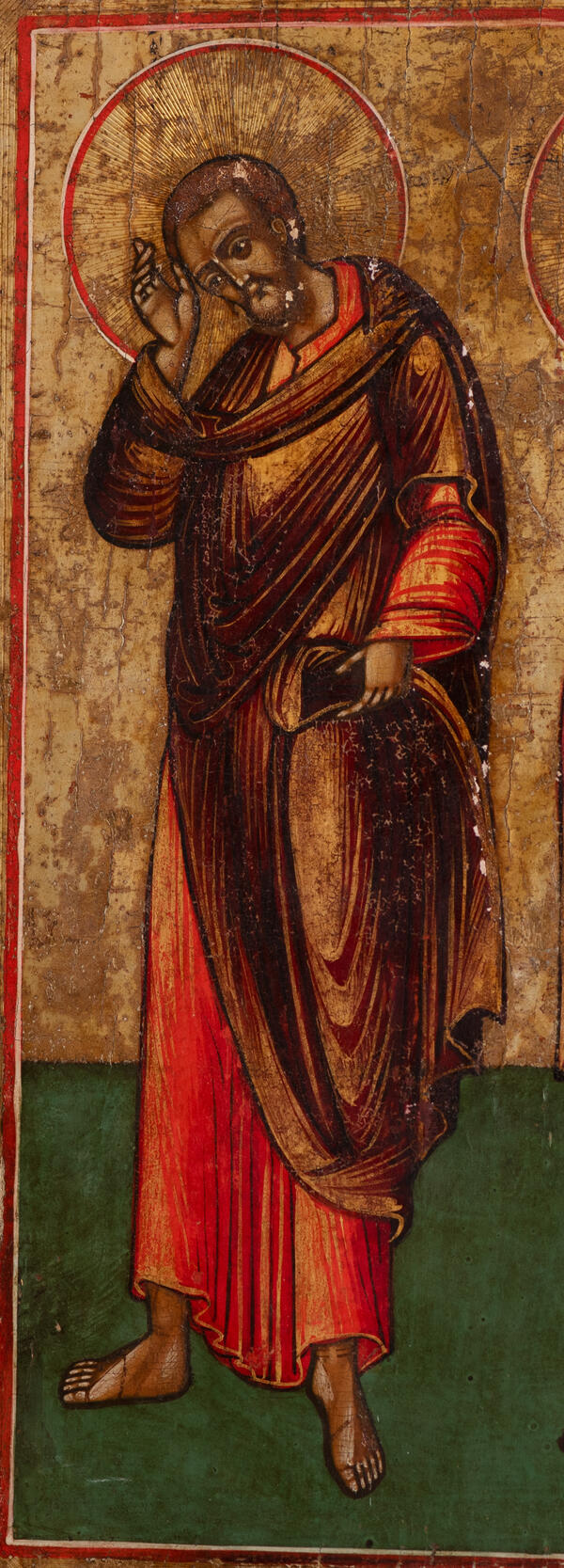
The displayed composition is difficult to interpret. It is likely that the three apostles are united by their great faith in Christ, which dominated their service. The apostles are depicted full length, facing left in a three-quarter turn. On the left, there is James the Apostle, a man with a short beard who is wearing a red chiton and a cherry himation. He holds a book in his left hand and touches his head with his right hand. In the center, there is Simon the Apostle, who has a round beard with streaks of gray and is wearing a dark green chiton and a lilac himation. In his right hand, he holds a rolled-up scroll containing God’s covenants. In some icons, Simon was portrayed as an elderly man with gray hair. On the right, there is Philip the Apostle, depicted as a young man without a beard, wearing a dark blue chiton and a red himation. He also holds a rolled-up scroll in his hand and wears sandals on his feet.
The background of the image is gilded, and the earth is green. This icon reflects the distinctive features of Russian iconography: clear silhouettes, rhythm, harmony of forms, and balance of colors. Interspersed with each other, the colors form a harmonious composition.
The earliest icon depicting Philip the Apostle dates back to the 10th century and can be found in the Saint Catherine’s Monastery on Mount Sinai. According to the Gospel of John, Philip was from Bethsaida. He was chosen to follow Jesus as the third disciple, after Andrew and Peter, who were from the same town. James, son of Zebedee, was the eldest of the 12 apostles, and the only one whose death was described in the Gospel. In Byzantine and Russian art, James is depicted as a man with sunken temples and cheeks. One of the earliest images of the apostle can be seen in the scenes of “The Multiplication of the Loaves, ” “The Prayer of the Cup, ” and “The Kiss of Judas, ” in the mosaics of the Basilica of Sant’Apollinare Nuovo in Ravenna, Italy, which were created around 526 AD. As a witness to the Transfiguration of Jesus on Mount Tabor, James is also depicted in the corresponding composition.
Simon the Apostle was from the town of Cana in
Galilee. He was the son of Saint Joseph. Jesus performed his first miracle in
Simon’s home: during a feast that was held there, the wine ran out. When the Virgin
Mary noticed it, Jesus turned water into wine at Her request.