The image of Jesus Christ is depicted on a white cloth, decorated with floral motifs and a gold border at the bottom. The cloth, which occupies the entire centerpiece, emphasizes the large image of the Savior’s face, highlighted by a golden halo and a red cross. The Savior’s face is characterized by delicate features. He is depicted with a forked beard and long hair with two strands on the left and three on the right.
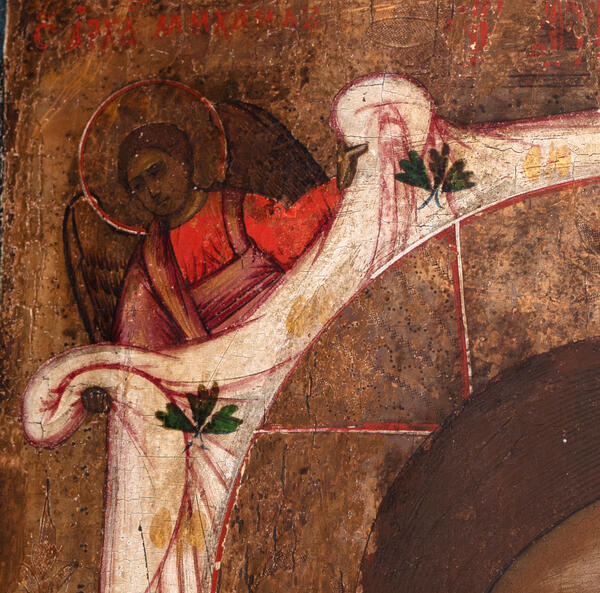
Icon of the Savior Not Made by Hands
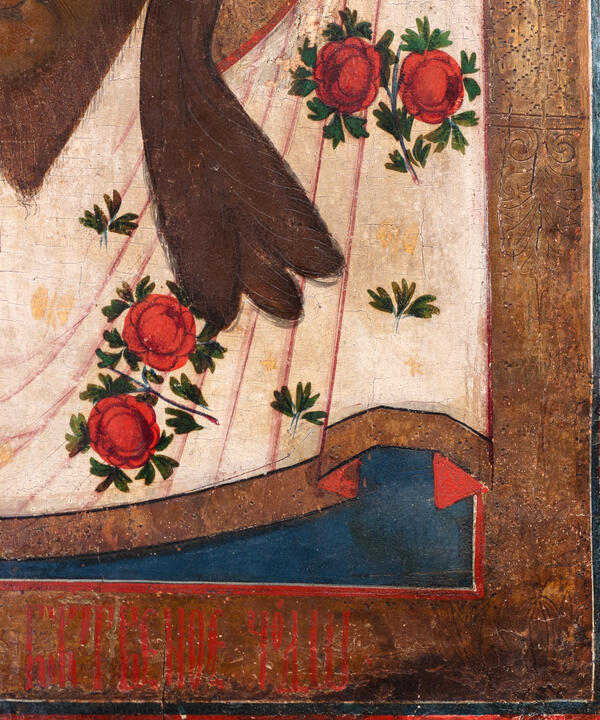
The image of Jesus Christ is depicted on a white cloth, decorated with floral motifs and a gold border at the bottom. The cloth, which occupies the entire centerpiece, emphasizes the large image of the Savior’s face, highlighted by a golden halo and a red cross. The Savior’s face is characterized by delicate features. He is depicted with a forked beard and long hair with two strands on the left and three on the right.
Unlike in Byzantium, where images of the Mandylion were mainly found in miniatures and church wall paintings, in ancient Russian art, there were many icons with the image of Jesus on a cloth. This image was most commonly found in icons from the 17th century, especially from its second half.
The development of such iconography reached its prime in the works of the Armory artists. Perhaps, they were inspired by the work of the Moscow icon painter Simon Ushakov. He developed a new concept of the Icon of the Savior Not Made by Hands. His 1658 icon of the Savior is displayed at the State Tretyakov Gallery, along with the oldest surviving icon of this type, created in the 12th century. According to legend, this image was painted on canvas based on the original shrine brought from Byzantium by Saint Theodore, the first bishop and enlightener of Suzdal. In Russia, the Icon of the Savior Not Made by Hands. was revered as the true image of Christ that appeared immediately after Christ was baptized.
Vetka icons are characterized by their developed decorative style and the use of saturated local colors, dominated by the traditional “southern” wine-red, combined with a contrasting white or golden background.
There are several iconographic types of the Icon
not Made by Hands: apart from the “Not-Made-by-Hands Cloth, ” there is the
“Not-Made-by-Hands Brick, ” and the “Not-Made-by-Hands Roof Tile.” Legend has it
that such images appeared on tiles and bricks that were used to hide the niche
containing the Icon of the Savior Not Made by Hands.