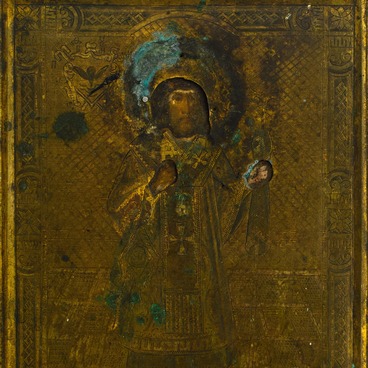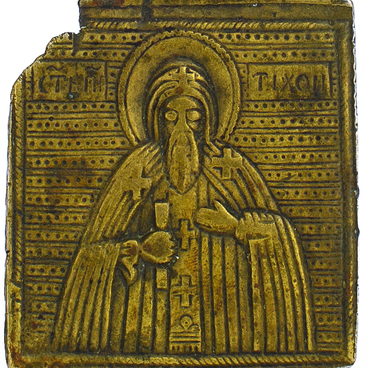


Icons that consisted of two parts — a board with the painted image of a saint and a revetment made of tin or foil — became widespread in the late 19th century. On the wooden board under the revetment, masters painted only the faces and hands of the saints. The rest of the image was printed on a thin metal sheet fixed on top of the board. Such icons were in great demand, especially among the common people, due to their affordability.
One of these icons is the “Christ Pantocrator” from the collection of the Museum Complex of Kuybyshev. It was created at the end of the 19th century. Jesus Christ is represented as “Pantocrator”, the Heavenly Judge and King. This is one of the six canonical iconographic types of depicting the Son of God. Others include the images Savior Not Made by Hands, Savior on the Throne, Christ in Majesty, Christ Emmanuel and Blessed Silence.
Usually in Pantocrator icons, the Almighty is depicted in half-length. Jesus Christ holds the Gospel in His left hand and blesses the world with His right hand.
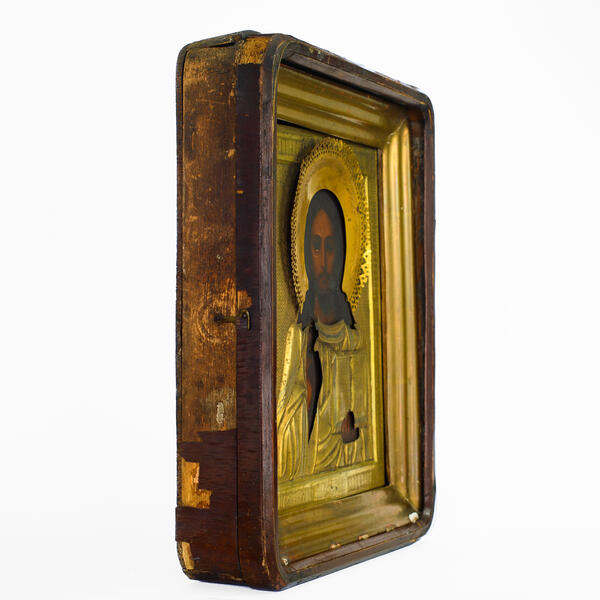
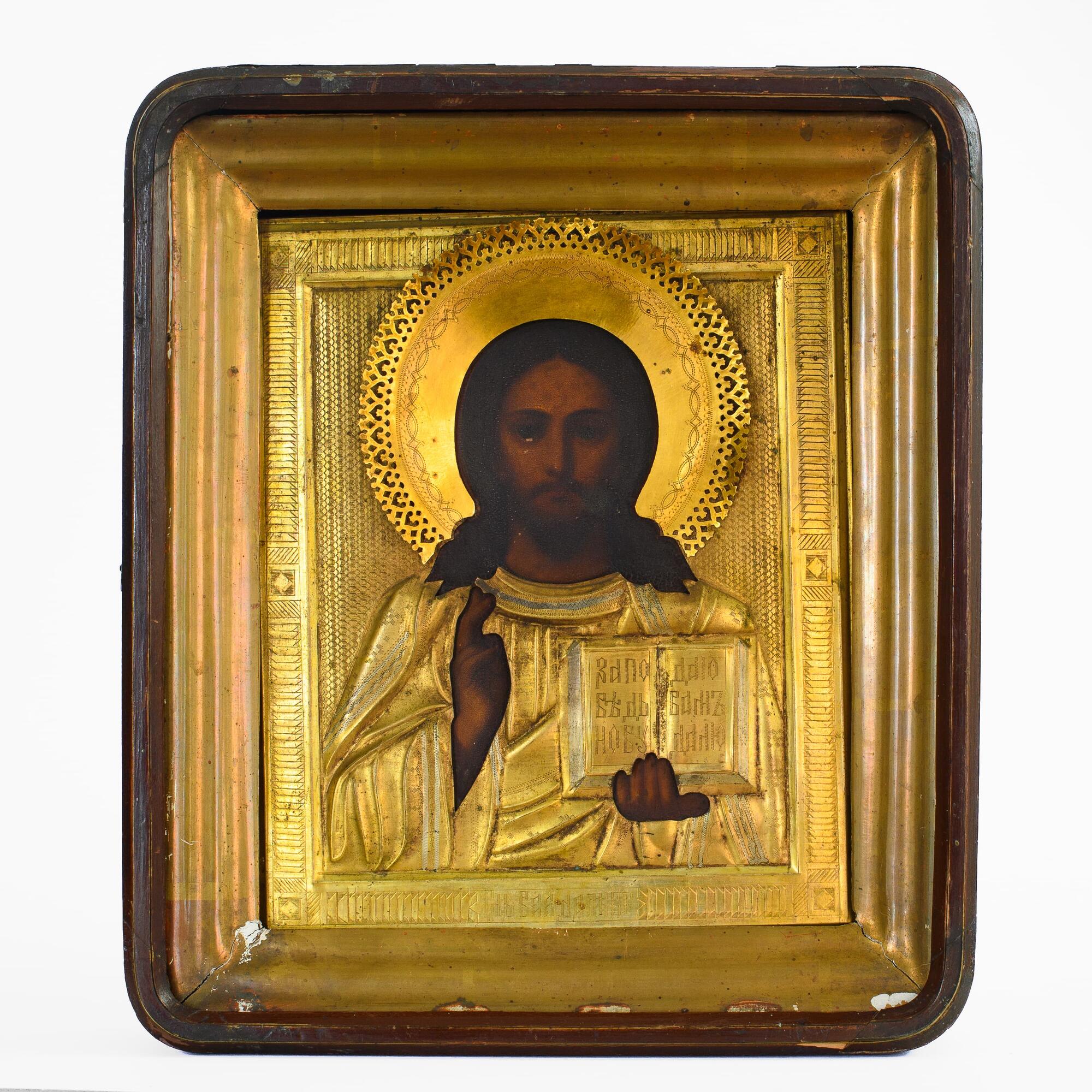
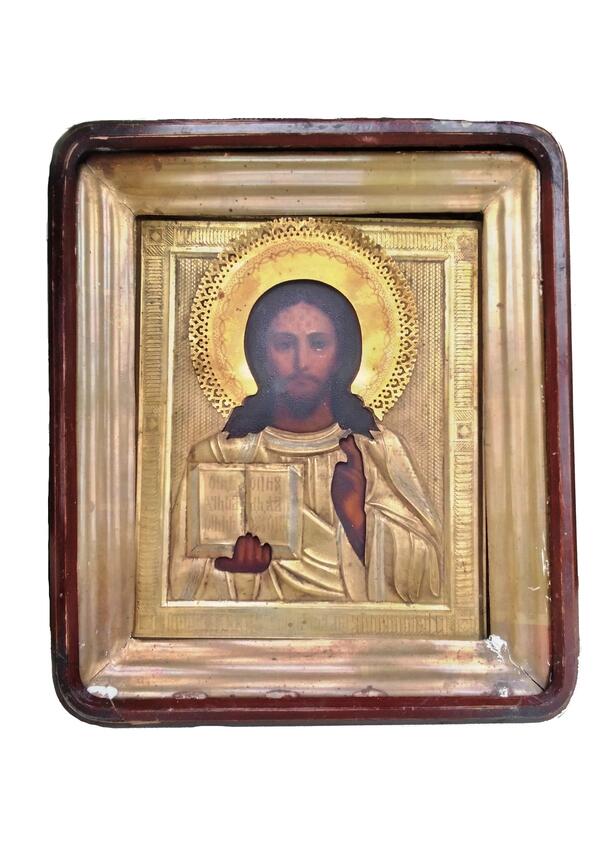
The icon “Christ Pantocrator” from the Kuybyshev collection consists of three parts: the wooden board with the painted image, the revetment and the icon case.
The image is painted on a rectangular board, which is covered in the center with a thin layer of levkas — a special primer that is applied to the board before painting. The face and hands of the Savior are painted in oil in a realistic manner. The right hand is raised in a gesture of blessing. The fingers of the left hand are folded to hold the Gospel.
The revetment is made of a copper sheet by stamping. It was also gilded. On the rectangular central part is a relief image of a figure in a chiton (a long shirt without sleeves) and a himation (a cape). There are slits in the revetment, through which one can see the painted face and hands. All other details of the image of the Savior are depicted on the revetment.
The open Gospel above the left hand is silvered. The himation is decorated with an engraved geometric ornament, along the edges is a patterned border with two narrow silver-plated stripes. The neck of the chiton is voluminous, decorated with an engraved serrated ornament with a silver-plated stripe in the center. The patterned crown of the Savior is overlaid.
The central part is engraved with a scaly ornament. It is bordered by a frame, the margins of which are decorated with floral ornaments. The name of the icon is engraved in the lower field in the center. The icon is inserted into a case (kiot) with a frame. The body of the case has a mahogany wood finish.
One of these icons is the “Christ Pantocrator” from the collection of the Museum Complex of Kuybyshev. It was created at the end of the 19th century. Jesus Christ is represented as “Pantocrator”, the Heavenly Judge and King. This is one of the six canonical iconographic types of depicting the Son of God. Others include the images Savior Not Made by Hands, Savior on the Throne, Christ in Majesty, Christ Emmanuel and Blessed Silence.
Usually in Pantocrator icons, the Almighty is depicted in half-length. Jesus Christ holds the Gospel in His left hand and blesses the world with His right hand.
The icon “Christ Pantocrator” from the Kuybyshev collection consists of three parts: the wooden board with the painted image, the revetment and the icon case.
The image is painted on a rectangular board, which is covered in the center with a thin layer of levkas — a special primer that is applied to the board before painting. The face and hands of the Savior are painted in oil in a realistic manner. The right hand is raised in a gesture of blessing. The fingers of the left hand are folded to hold the Gospel.
The revetment is made of a copper sheet by stamping. It was also gilded. On the rectangular central part is a relief image of a figure in a chiton (a long shirt without sleeves) and a himation (a cape). There are slits in the revetment, through which one can see the painted face and hands. All other details of the image of the Savior are depicted on the revetment.
The open Gospel above the left hand is silvered. The himation is decorated with an engraved geometric ornament, along the edges is a patterned border with two narrow silver-plated stripes. The neck of the chiton is voluminous, decorated with an engraved serrated ornament with a silver-plated stripe in the center. The patterned crown of the Savior is overlaid.
The central part is engraved with a scaly ornament. It is bordered by a frame, the margins of which are decorated with floral ornaments. The name of the icon is engraved in the lower field in the center. The icon is inserted into a case (kiot) with a frame. The body of the case has a mahogany wood finish.