

Among the icons found by the expedition of the Tretyakov Gallery in the walls of a ruined church near the city of Murom in the middle of the last century, there were some images of local saints. Together they made up the Deesis, the main tier of the iconostasis in the tradition of the Russian Orthodox Church.
In this series of icons, Christ Pantocrator was flanked not only by the main saints, the Mother of God, John the Baptist, and the archangels but also by the princes of Murom: Peter, Fyodor and Michael (Mikhail), canonized by the Cathedral in 1547.
Prince Michael was the nine-year-old son of the holy noble prince Constantine (Konstantin), the baptizer of the Murom land, and the holy noble princess Irina of Murom. According to legend, the locals adhered to ancient beliefs for a long time and were still pagans in the 12th century. Therefore, Constantine, a descendant of Holy Equal-to-the-Apostles Prince Vladimir, had to apply a lot of effort so that the local people would believe in Jesus.
There are two versions of the feat of St. Michael. One says that in 1192, Prince Constantine, together with his sons, gathered an army in Kyiv and laid siege to Murom. Not wanting the painful death of the pagans locked in the fortress, Prince Constantine sent his son Michael to convince the people of Murom to accept peace without resistance. However, the besieged did not believe in the sincerity of Constantine’s intentions and killed the young envoy.
According to another version, set forth by St. Demetrius of Rostov, the Blessed Prince Constantine with his sons and the squad entered the battle against the people of Murom near the city and won. However, his son Michael died during the battle.
Prince Constantine did not force the pagans to accept Christianity but he kept thinking about their enlightenment. He built a temple in Murom in honor of the Annunciation of the Most Holy Theotokos, buried his son there, and soon erected another church in the name of Saint Boris and Saint Gleb.
However, the local pagans were persuaded of the truth of Christianity by the fact that Constantine went out to meet an angry mob that wanted to kill him, all alone, holding the miraculous icon of the Virgin in his hands. Seeing such courage, the people of Murom gave up their struggle and chose to be baptized.
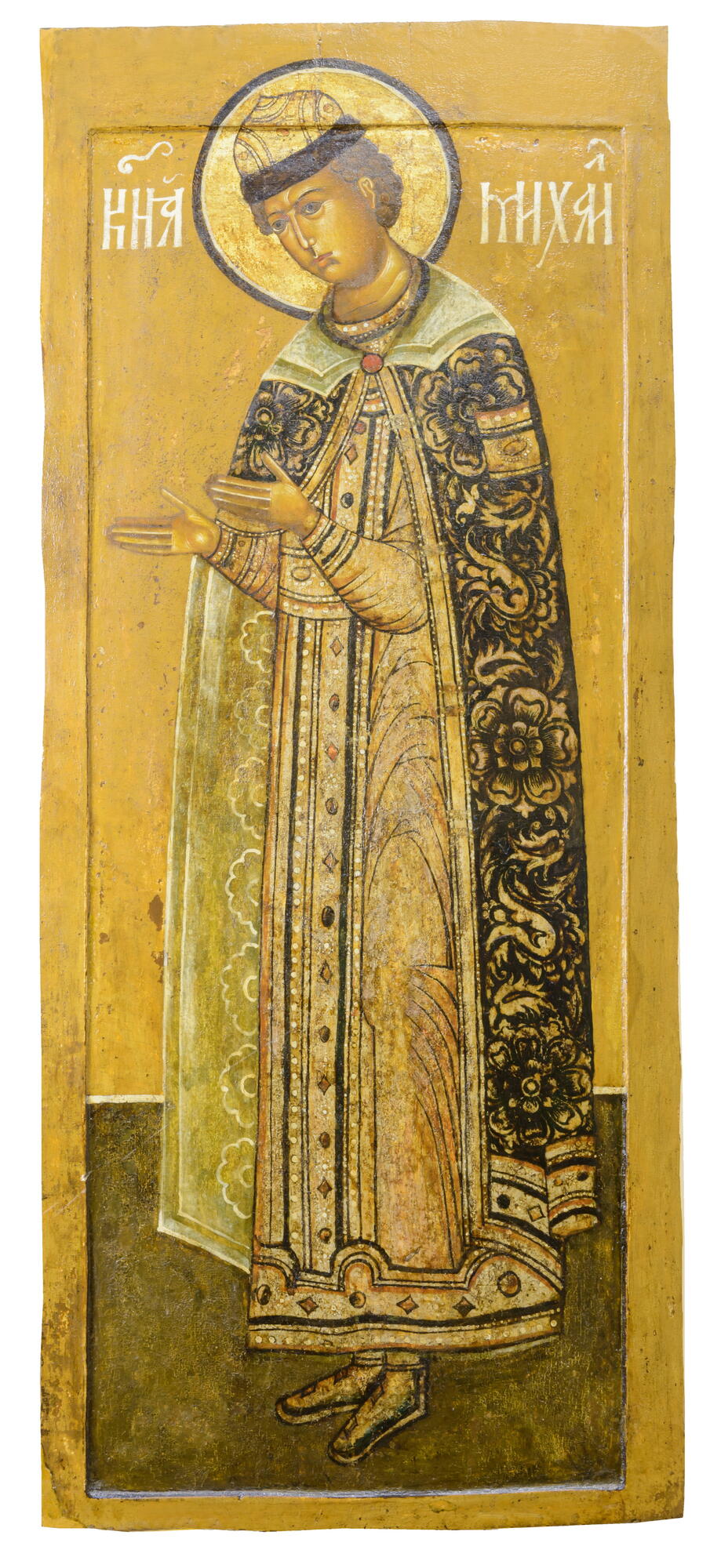
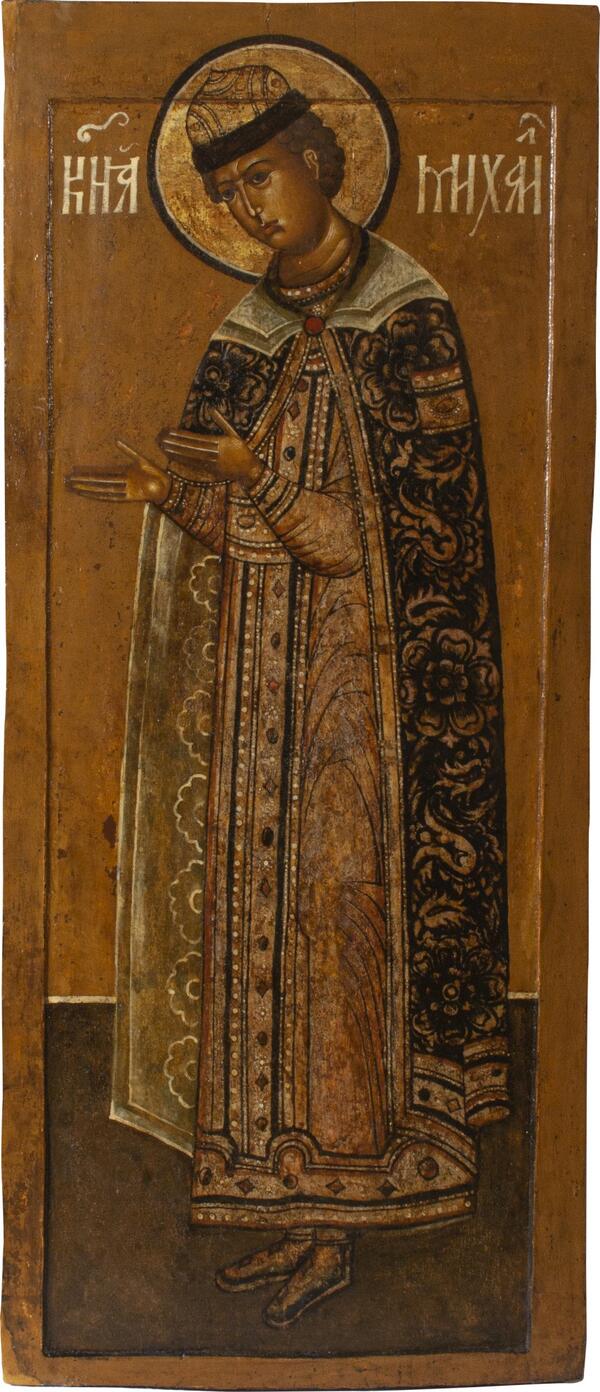
In the icon, the young prince Michael is shown in expensive clothes — a long dalmatic, that is, a tunic, and an elegant cloak, reminiscent of a coat with folding sleeves. His curly head is crowned with a fur-trimmed brocade round cap.
Michael’s figure is depicted in three-quarter view, his face is bowed, and his hands are outstretched in prayer. The look of the young man is meek, strict and sad.
In this series of icons, Christ Pantocrator was flanked not only by the main saints, the Mother of God, John the Baptist, and the archangels but also by the princes of Murom: Peter, Fyodor and Michael (Mikhail), canonized by the Cathedral in 1547.
Prince Michael was the nine-year-old son of the holy noble prince Constantine (Konstantin), the baptizer of the Murom land, and the holy noble princess Irina of Murom. According to legend, the locals adhered to ancient beliefs for a long time and were still pagans in the 12th century. Therefore, Constantine, a descendant of Holy Equal-to-the-Apostles Prince Vladimir, had to apply a lot of effort so that the local people would believe in Jesus.
There are two versions of the feat of St. Michael. One says that in 1192, Prince Constantine, together with his sons, gathered an army in Kyiv and laid siege to Murom. Not wanting the painful death of the pagans locked in the fortress, Prince Constantine sent his son Michael to convince the people of Murom to accept peace without resistance. However, the besieged did not believe in the sincerity of Constantine’s intentions and killed the young envoy.
According to another version, set forth by St. Demetrius of Rostov, the Blessed Prince Constantine with his sons and the squad entered the battle against the people of Murom near the city and won. However, his son Michael died during the battle.
Prince Constantine did not force the pagans to accept Christianity but he kept thinking about their enlightenment. He built a temple in Murom in honor of the Annunciation of the Most Holy Theotokos, buried his son there, and soon erected another church in the name of Saint Boris and Saint Gleb.
However, the local pagans were persuaded of the truth of Christianity by the fact that Constantine went out to meet an angry mob that wanted to kill him, all alone, holding the miraculous icon of the Virgin in his hands. Seeing such courage, the people of Murom gave up their struggle and chose to be baptized.
In the icon, the young prince Michael is shown in expensive clothes — a long dalmatic, that is, a tunic, and an elegant cloak, reminiscent of a coat with folding sleeves. His curly head is crowned with a fur-trimmed brocade round cap.
Michael’s figure is depicted in three-quarter view, his face is bowed, and his hands are outstretched in prayer. The look of the young man is meek, strict and sad.