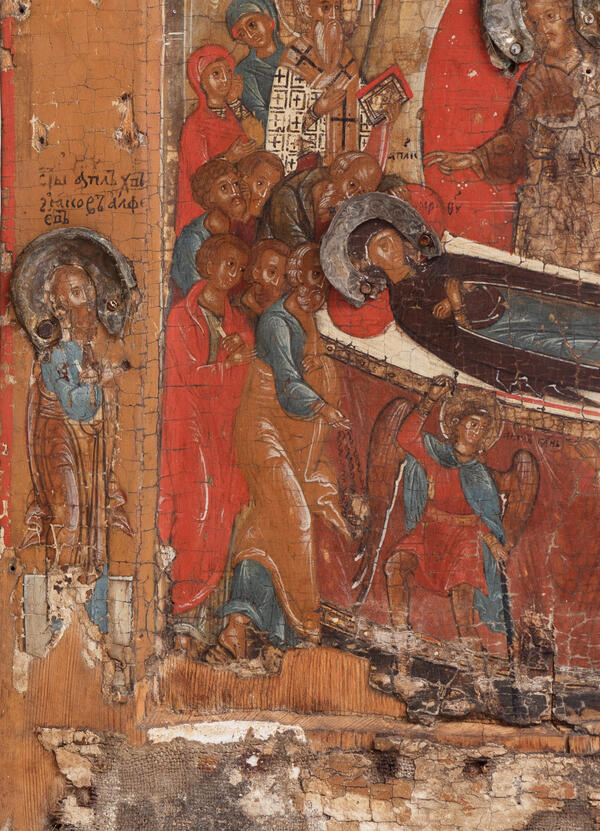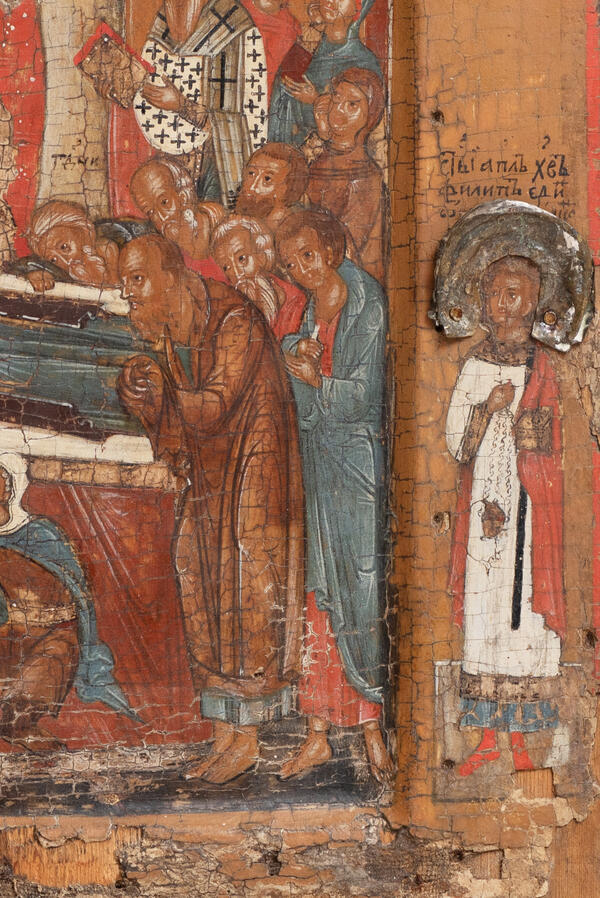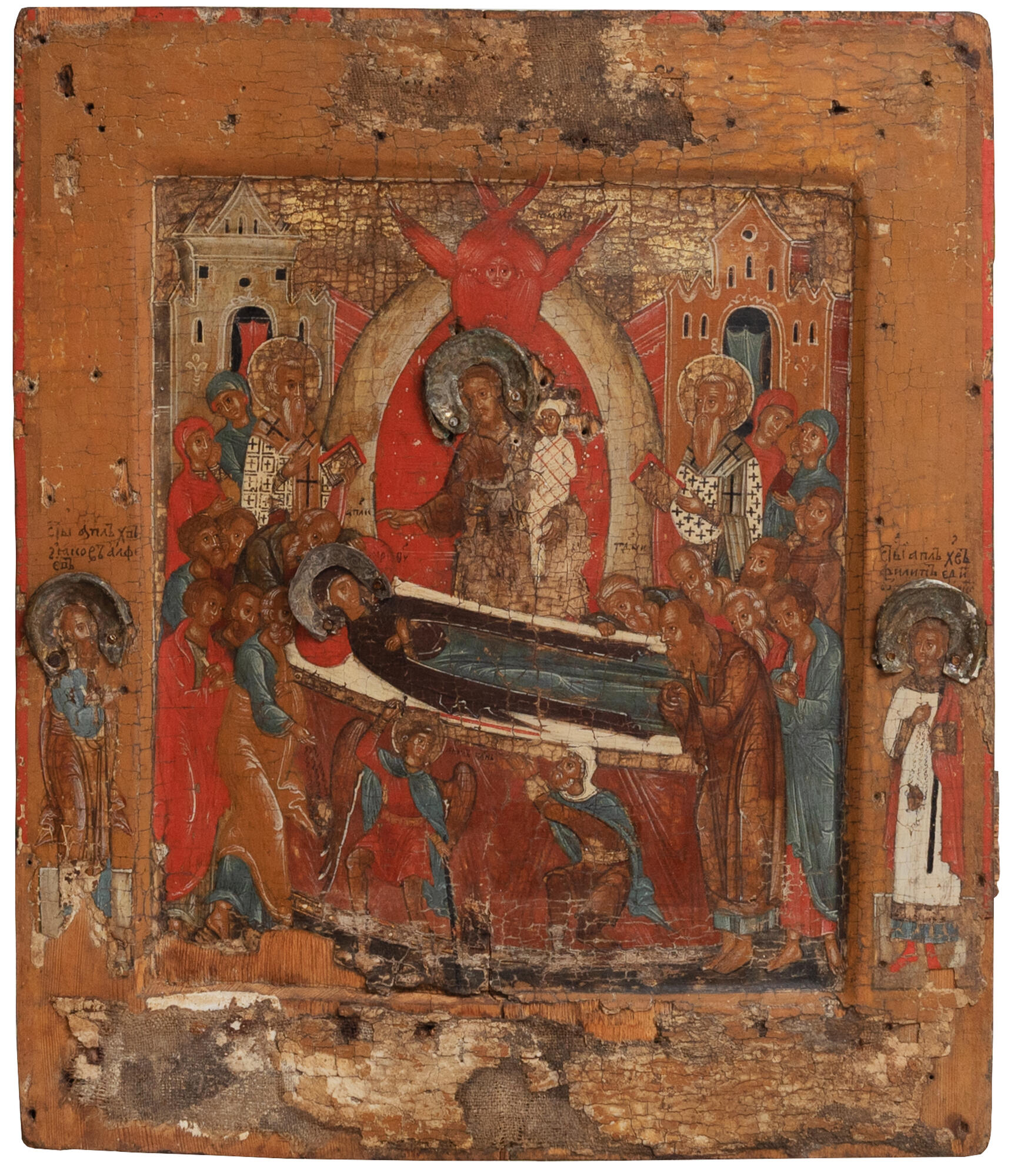


The legend of the Dormition of Our Lady dates back to ancient apocryphal texts, the most famous of which is considered to be the Word of John the Theologian composed in the 5th century, at earliest. In the center of the composition is a bed with the deceased Mother of God in a blue chiton and dark cherry maphorion. Behind the bed is Jesus Christ holding on His left hand the soul of the Mother of God in the form of a swaddled figure of a baby, his right hand extended towards Mary in a gesture of blessing. The icon is distinguished by an unusual form of double gloriole. The figure of Christ himself is surrounded by an almond-shaped gloriole of bright red color. This gloriole (mandorla) only appears in scenes of the Dormition in the late 12th century.
Around the bed are twelve grieving apostles, and two saint bishops with Gospels in their hands. The iconographer succeeded in conveying their emotions: deep earthly sorrow, which contrasts with the Divine light surrounding the Savior. In the lower part of the icon, an angel is presented at the bed with a sword near the Jewish priest named Athonios.
In the 15th century icons of the Dormition were widely spread in Russia, depicting the miracle of an angel cutting off the hands of the impious Jew Athonios (in some sources — Jephonias), who is shown in the foreground, in front of the bed. According to legend, Athonios ran to the funeral procession to throw the body of the Mother of God off the bier, and an angel cut off his hands for this attempt. Perhaps the popularity of the plot at that time and in the 16th century was due to the fight against heretical movements. For the first time this plot is recorded on a fresco of the Church of Panagia Mavriotissa in Kastoria (the turn of the 12th–13th centuries), and in Old Russian art — on frescoes of the Snetogorsky Convent and the Church of the Dormition of Our Lady on Volotovo Field.
The chambers in the background of the icon indicate
that the action takes place in the house of the Mother of God on the Mount of
Sion in Jerusalem, the same place where the descent of the Holy Spirit upon the
Apostles took place. The depiction of the chambers became widespread from the
beginning of the 12th century, but is particularly common in
painting of the 13th century. The characteristic features of this
iconographic Dormition include the fact that the apostles have no halos, and
there is no scene of the transfer of the soul of the Mother of God to angels
flying towards Christ.