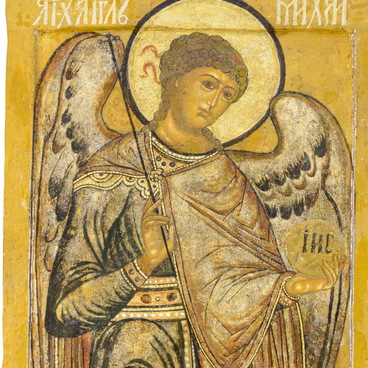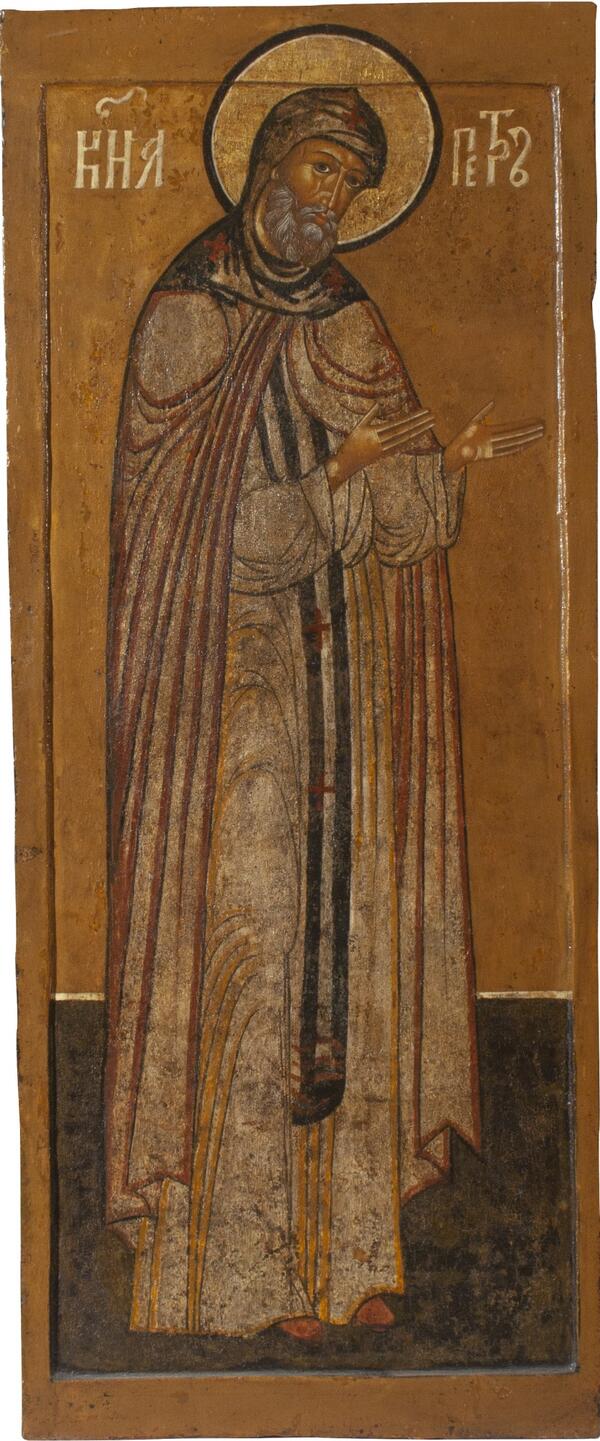
The icon depicting St. Peter of Murom is part of the Deesis tier — this is the name of the main tier of the iconostasis found by the expedition of the State Tretyakov Gallery. The expedition took place in 1965 in the Vladimir region under the guidance of the famous art critic Nadezhda Vsevolodovna Rozanova. The iconostasis was discovered in an abandoned church in the village of Tuchkovo, Selivanovskiy district, not far from the city of Murom.
This stone church with the main altar in the name of the Vladimir icon of the Mother of God was built at the expense of the villager Platon Gerasimov in 1880–1881 instead of the wooden building that had burned down. The latter had been known in Tuchkovo since 1630. Most likely it was for this church, erected in honor of the Council of the Archangel Michael, that the surviving iconostasis was created, since the years of its creation are a better match for the icon.
During the construction of the Vladimir church, the iconostasis was renewed, and a corresponding inscription was made on the back of one of the works: “These icons were all renewed in 1877 by the city of Vladimir painter N.I. Lapotnikov”, and after that they were placed in a new temple containing two chapels, one with the name of the wooden church — Archangel Michael. The practice of transferring icons from a dilapidated church to a new one, usually consecrated in the name of the same saint or feast, existed both in Old Rus and in modern times.
This iconostasis mostly had Russian and local saints in the main tier, which included the image of the Saint Prince Peter of Murom, glorified by one of the ancient literary works — “The Tale of Peter and Fevronia of Murom”.
The veneration of Russian saints, which began in the 11th century, was established only four centuries later, during the period of their official canonization. Since that time, the introduction of images of church and secular figures of Russian history into the composition of the Deesis has been widely practiced. Nevertheless, the image of St. Peter of Murom as part of the Deesis is considered a rarity; it makes the compositional and semantic structure of the iconostasis look original, emphasizing the local spiritual tradition.
The saint is depicted in a monk’s attire: the colors of the vestments — iridescent silver-ocher and red-brown hues — convey the state of his spiritual enlightenment.
This stone church with the main altar in the name of the Vladimir icon of the Mother of God was built at the expense of the villager Platon Gerasimov in 1880–1881 instead of the wooden building that had burned down. The latter had been known in Tuchkovo since 1630. Most likely it was for this church, erected in honor of the Council of the Archangel Michael, that the surviving iconostasis was created, since the years of its creation are a better match for the icon.
During the construction of the Vladimir church, the iconostasis was renewed, and a corresponding inscription was made on the back of one of the works: “These icons were all renewed in 1877 by the city of Vladimir painter N.I. Lapotnikov”, and after that they were placed in a new temple containing two chapels, one with the name of the wooden church — Archangel Michael. The practice of transferring icons from a dilapidated church to a new one, usually consecrated in the name of the same saint or feast, existed both in Old Rus and in modern times.
This iconostasis mostly had Russian and local saints in the main tier, which included the image of the Saint Prince Peter of Murom, glorified by one of the ancient literary works — “The Tale of Peter and Fevronia of Murom”.
The veneration of Russian saints, which began in the 11th century, was established only four centuries later, during the period of their official canonization. Since that time, the introduction of images of church and secular figures of Russian history into the composition of the Deesis has been widely practiced. Nevertheless, the image of St. Peter of Murom as part of the Deesis is considered a rarity; it makes the compositional and semantic structure of the iconostasis look original, emphasizing the local spiritual tradition.
The saint is depicted in a monk’s attire: the colors of the vestments — iridescent silver-ocher and red-brown hues — convey the state of his spiritual enlightenment.