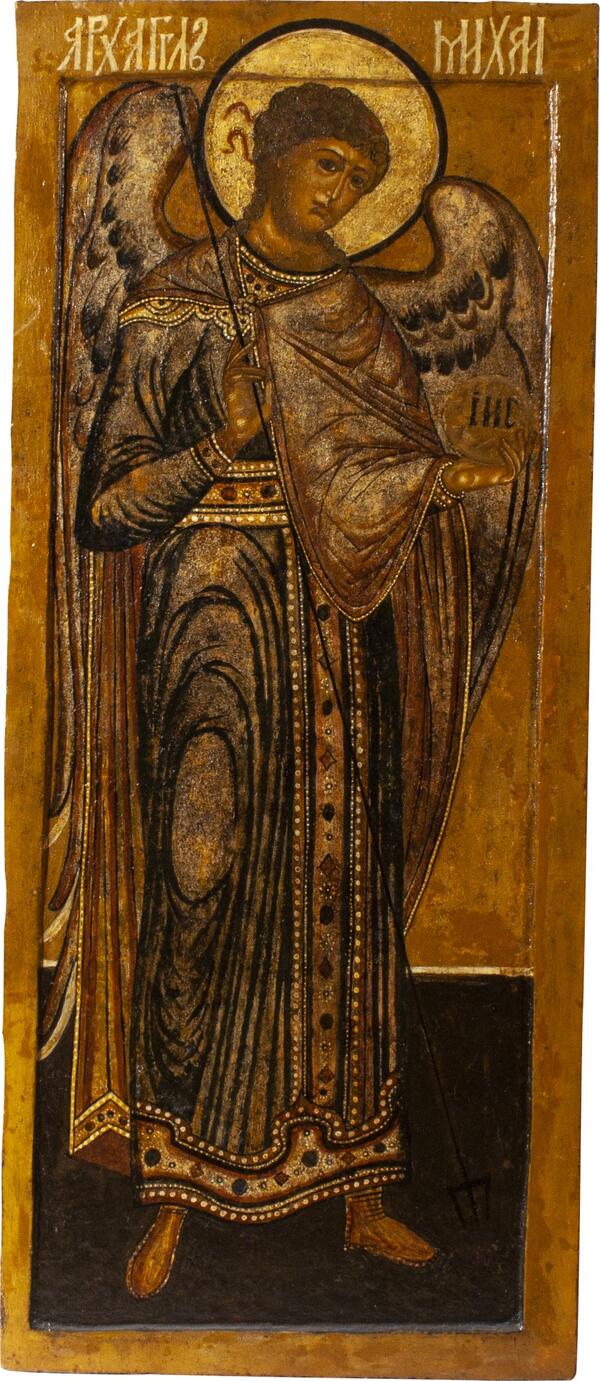
The image of the Archangel Michael was part of the iconostasis discovered by the expedition of the Tretyakov Gallery in 1965 in one of the abandoned churches of the Murom region.
The high Russian iconostasis is a wall of icons that separates the sanctuary from the rest of the church. It embodies the history of mankind from the creation of the world, and also symbolizes the timeless essence of the Christian Church.
Since the 15th century, the iconostasis has been an obligatory part of the interior decoration in every Orthodox church. The icons were inserted into the “tyabla” (wooden bars) and arranged in a strict order. The traditional iconostasis includes five tiers of icons: the Sovereign tier, the Deesis, the Twelve Great Feasts, the Old Testament Prophets and the Patriarchs.
The bottom Sovereign tier features saints, especially the locally revered ones. The Deesis, which also used to include the image of the Archangel Michael from the museum’s collection, symbolizes the Church’s prayer to Christ. The third tier — the Twelve Great Feasts — depicts the Gospel events, and includes the twelve feasts. The fourth tier of icons features the Old Testament Prophets. In the upper fifth tier, the images of the forefathers — from Adam to Moses — flank the Old Testament Trinity in the middle.
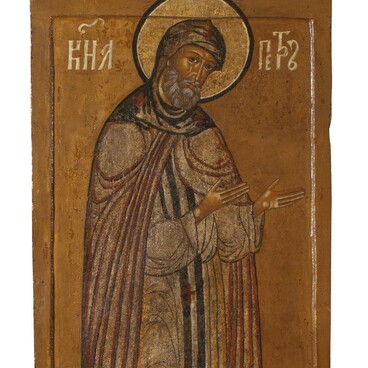
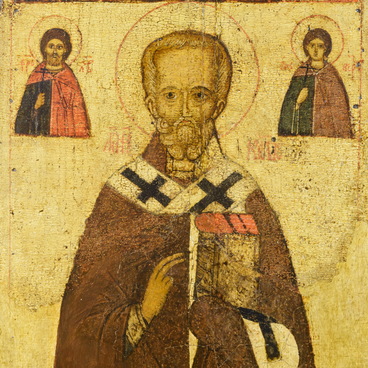
The Murom iconostasis has not been completely preserved. Only the Patriarchs, the Prophets and the Deesis tiers have survived to our time. The Deesis is distinguished by the prevalence of Russians and a noticeable number of local saints.
The central part of the Deesis usually consists of five images: Christ Pantocrator, flanked by the icons of Theotokos and Saint John the Baptist, as well as the archangels Michael and Gabriel.
Michael is one of the seven Archangels. He is called “the leader of the heavenly host”, which means the “supreme commander” in Greek. He is considered the commander of angels and true believers; he defeated Satan. The eternal enemy of evil, the Archangel guards the sky from the devil’s army.
According to the iconographic tradition, the Archangel Michael is depicted as a beautiful young man with wings and a halo. His gaze is intense and unblinking. His figure is depicted in three-quarter view; Michael holds a staff in one hand and a “zertsalo” (a transparent sphere) in the other.
He wears a dalmatic (a long wide-sleeved tunic richly decorated at the hem and shoulders) and a lor (a belt embroidered with jewels). There is a cloak on Michael’s shoulders — it is fastened with a fibula clasp. The hem of the cloak forms a complex fold. The archangel’s festive raiment emphasizes his eternal presence in front of the throne of the King of Heaven.
The high Russian iconostasis is a wall of icons that separates the sanctuary from the rest of the church. It embodies the history of mankind from the creation of the world, and also symbolizes the timeless essence of the Christian Church.
Since the 15th century, the iconostasis has been an obligatory part of the interior decoration in every Orthodox church. The icons were inserted into the “tyabla” (wooden bars) and arranged in a strict order. The traditional iconostasis includes five tiers of icons: the Sovereign tier, the Deesis, the Twelve Great Feasts, the Old Testament Prophets and the Patriarchs.
The bottom Sovereign tier features saints, especially the locally revered ones. The Deesis, which also used to include the image of the Archangel Michael from the museum’s collection, symbolizes the Church’s prayer to Christ. The third tier — the Twelve Great Feasts — depicts the Gospel events, and includes the twelve feasts. The fourth tier of icons features the Old Testament Prophets. In the upper fifth tier, the images of the forefathers — from Adam to Moses — flank the Old Testament Trinity in the middle.
The Murom iconostasis has not been completely preserved. Only the Patriarchs, the Prophets and the Deesis tiers have survived to our time. The Deesis is distinguished by the prevalence of Russians and a noticeable number of local saints.
The central part of the Deesis usually consists of five images: Christ Pantocrator, flanked by the icons of Theotokos and Saint John the Baptist, as well as the archangels Michael and Gabriel.
Michael is one of the seven Archangels. He is called “the leader of the heavenly host”, which means the “supreme commander” in Greek. He is considered the commander of angels and true believers; he defeated Satan. The eternal enemy of evil, the Archangel guards the sky from the devil’s army.
According to the iconographic tradition, the Archangel Michael is depicted as a beautiful young man with wings and a halo. His gaze is intense and unblinking. His figure is depicted in three-quarter view; Michael holds a staff in one hand and a “zertsalo” (a transparent sphere) in the other.
He wears a dalmatic (a long wide-sleeved tunic richly decorated at the hem and shoulders) and a lor (a belt embroidered with jewels). There is a cloak on Michael’s shoulders — it is fastened with a fibula clasp. The hem of the cloak forms a complex fold. The archangel’s festive raiment emphasizes his eternal presence in front of the throne of the King of Heaven.