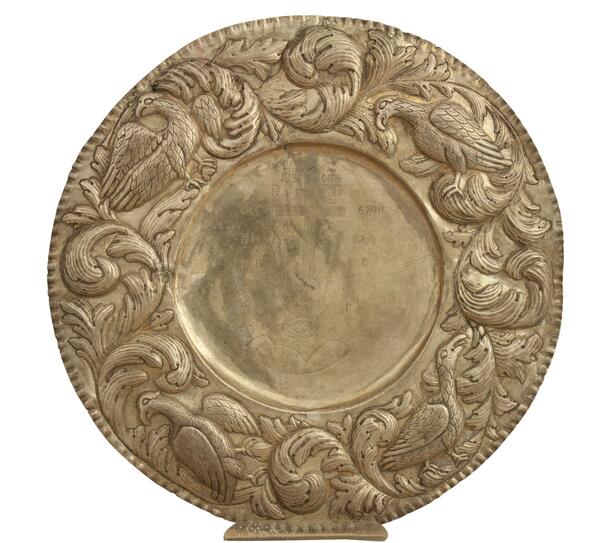
A “diskos” is the Greek name of the plate (paten) used during the Divine Liturgy. It entered the collection of the Radishchev Art Museum in Saratov from the Vvedenskaya Church. The liturgical vessel is a small round plate with a low leg and a round base. The flat wide edge is raised above the central part. Traditionally, the diskos was made of silver since it was not subject to oxidation.
Archaeologists discovered the oldest utensils of this kind in a 4th–century find. As a rule, a diskos was decorated with engraving, carving, chasing, less often with enamel and jewels.
Like any religious object, the diskos has various symbolic meanings. For example, from the point of view of its structure, its two parts symbolize the two natures of Christ — divine and human — as well as the unity of the heavenly and earthly Churches.
During the Divine Liturgy, the diskos is of great importance — it is a reminder of the dish from which Jesus Christ took bread during the Last Supper, broke it, and gave to his disciples. In addition, it symbolizes the Bethlehem manger where the newborn Savior was placed. Therefore, the central part of the vessel traditionally features an image of a lying baby surrounded by angels.
In addition, the diskos, on which the Lamb lies, can symbolize the church, the circle of the universe with the Sun of Truth (Christ) as its center, or the Holy Sepulcher. The latter meaning was embodied in the engraving on the vessel from the museum.
In the central mirror part of the diskos there is an image of the eight-pointed Cross of Golgotha. At its base is the skull of Adam and the instruments of the Passion of Christ. The wide rim of the diskos is decorated with an engraved pattern of a winding stem of a traditional acanthus and an eagle repeated four times at different angles.
This bird is often found in works of Christian art as a symbol of John the Evangelist and the height of his teaching, written down in the Gospel. In addition, the eagle is the image of the soul that seeks God — as opposed to the snake, which symbolizes the devil.
The diskos, on which the body of Christ lies, is one of the great sacred objects; therefore, only clergy have the right to handle it during the Divine Liturgy.
Archaeologists discovered the oldest utensils of this kind in a 4th–century find. As a rule, a diskos was decorated with engraving, carving, chasing, less often with enamel and jewels.
Like any religious object, the diskos has various symbolic meanings. For example, from the point of view of its structure, its two parts symbolize the two natures of Christ — divine and human — as well as the unity of the heavenly and earthly Churches.
During the Divine Liturgy, the diskos is of great importance — it is a reminder of the dish from which Jesus Christ took bread during the Last Supper, broke it, and gave to his disciples. In addition, it symbolizes the Bethlehem manger where the newborn Savior was placed. Therefore, the central part of the vessel traditionally features an image of a lying baby surrounded by angels.
In addition, the diskos, on which the Lamb lies, can symbolize the church, the circle of the universe with the Sun of Truth (Christ) as its center, or the Holy Sepulcher. The latter meaning was embodied in the engraving on the vessel from the museum.
In the central mirror part of the diskos there is an image of the eight-pointed Cross of Golgotha. At its base is the skull of Adam and the instruments of the Passion of Christ. The wide rim of the diskos is decorated with an engraved pattern of a winding stem of a traditional acanthus and an eagle repeated four times at different angles.
This bird is often found in works of Christian art as a symbol of John the Evangelist and the height of his teaching, written down in the Gospel. In addition, the eagle is the image of the soul that seeks God — as opposed to the snake, which symbolizes the devil.
The diskos, on which the body of Christ lies, is one of the great sacred objects; therefore, only clergy have the right to handle it during the Divine Liturgy.