From the middle of the 16th century, the icons of Russian saints became widespread. There were changes in the composition of iconostases — altar partitions, consisting of several tiers of images designed to separate the main space of the church, where the sacraments take place, from the common space, where the parishioners stand. The composition of the iconostasis began to include images of not only church, but also secular figures of Russian history.
Along with the universally recognized and respected saints, each locality also venerated its own, especially loved ones. Often these were princes who became famous for state and charitable deeds, military feats or untimely sad death.
The first such saints were Boris and Gleb, the sons of Grand Prince Vladimir Svyatoslavich, who baptized Russia in 988. After the death of their father, a tough and bloody struggle for the throne began. Boris and Gleb, having the opportunity to seize power by force, refused to murder their relatives. But their half-brother Svyatopolk did not waver and villainously killed the princes. Those accepted death with humility and truly Christian meekness.
The passion-bearing princes Boris and Gleb, baptized as Roman and David, became the first Russian saints canonized by both the Russian and Constantinople Churches. Regarding the date when they were canonized as saints, historians have not yet come to a consensus. According to various versions, it happened between 1020 and 1115.
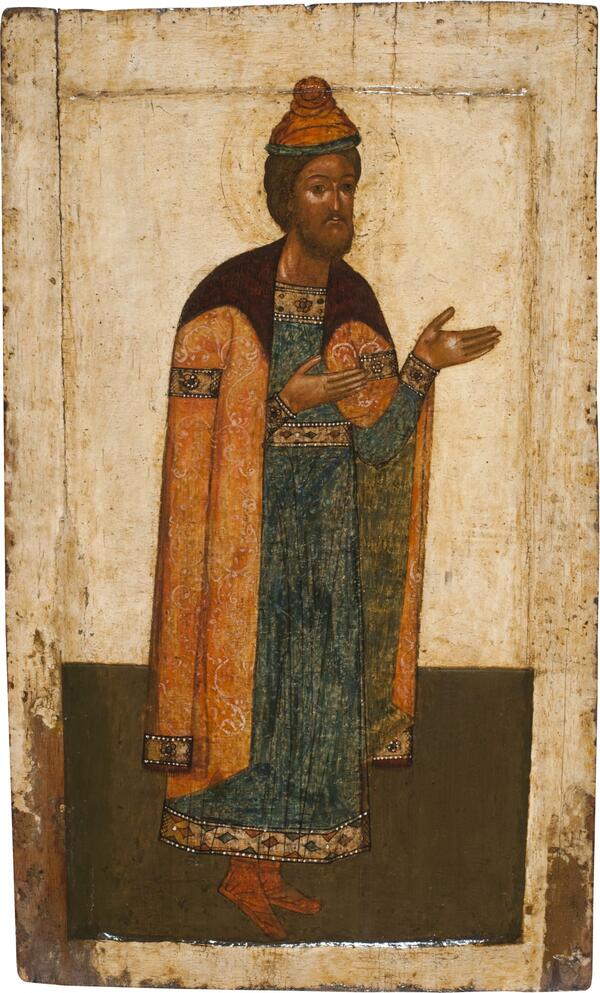
The image of Prince Boris from the museum collection, created by an unknown icon painter of the 16th century, apparently, was part of the Deesis tier of the high iconostasis. The main tier of images in the temple is called the Deesis. Most likely, an icon of the Holy Prince Gleb was also painted, but has not been preserved. This is evidenced by the way the figure is depicted — in three-quarter view — with arms outstretched in a traditional prayer gesture. Most often, the images of the holy brothers were painted together.
Saint Prince Boris is depicted in full length. He wears a long dalmatic tunic with exquisite patterns and an elegant cloak with folding sleeves, his head is crowned with a hat trimmed with fur.
The coloring of the icon is based on bright colors, at the same time it is distinguished by the softness of color transitions. The figure of the saint, made in dark blue, green, red and orange colors, stands out in a clear silhouette against a light background. His face is concentrated, and his gaze is strict and sad.
The icon painter sought to emphasize the special gentleness of Boris’s nature, thus illustrating the idea of sacrifice.
Along with the universally recognized and respected saints, each locality also venerated its own, especially loved ones. Often these were princes who became famous for state and charitable deeds, military feats or untimely sad death.
The first such saints were Boris and Gleb, the sons of Grand Prince Vladimir Svyatoslavich, who baptized Russia in 988. After the death of their father, a tough and bloody struggle for the throne began. Boris and Gleb, having the opportunity to seize power by force, refused to murder their relatives. But their half-brother Svyatopolk did not waver and villainously killed the princes. Those accepted death with humility and truly Christian meekness.
The passion-bearing princes Boris and Gleb, baptized as Roman and David, became the first Russian saints canonized by both the Russian and Constantinople Churches. Regarding the date when they were canonized as saints, historians have not yet come to a consensus. According to various versions, it happened between 1020 and 1115.
The image of Prince Boris from the museum collection, created by an unknown icon painter of the 16th century, apparently, was part of the Deesis tier of the high iconostasis. The main tier of images in the temple is called the Deesis. Most likely, an icon of the Holy Prince Gleb was also painted, but has not been preserved. This is evidenced by the way the figure is depicted — in three-quarter view — with arms outstretched in a traditional prayer gesture. Most often, the images of the holy brothers were painted together.
Saint Prince Boris is depicted in full length. He wears a long dalmatic tunic with exquisite patterns and an elegant cloak with folding sleeves, his head is crowned with a hat trimmed with fur.
The coloring of the icon is based on bright colors, at the same time it is distinguished by the softness of color transitions. The figure of the saint, made in dark blue, green, red and orange colors, stands out in a clear silhouette against a light background. His face is concentrated, and his gaze is strict and sad.
The icon painter sought to emphasize the special gentleness of Boris’s nature, thus illustrating the idea of sacrifice.