A chalice is a vessel for Christian worship. It is used in the liturgy for the consecration of wine and for the sacrament of Communion. Usually the chalice looks like a deep bowl on a long foot with a round base that is large in diameter. Often the foot has a thickening in the shape of an apple.
The first chalices were made of wood, which was subsequently banned, since this natural material could not keep the vessel clean. Then glass chalices were used. For the last seventeen centuries, chalices, like other liturgical vessels, were most often made of gold, silver, and bronze, they were decorated with enamel and precious stones.
The chalice has a great symbolic meaning, reminding believers of the cup of wine that Jesus Christ gave to his disciples at the Last Supper.
In the church, the vessel for Communion is kept along with other sacred objects on the altar or in a special safe. Usually there are several chalices in Orthodox churches. On major holidays, when many priests serve and there is a long line of people wishing to receive communion, the largest chalice is used, from which the Blood of Christ is poured into smaller ones.
In 1930, the collection of the Radishchev Art Museum received a large number of religious items from the Church and Art Department of the Governorate Museum. Among them was a silver chalice of the early 19th century.
According to the maker’s marks on the rim and on the casing, the chalice was made in 1820 by an unknown jeweler in one of the workshops, where the famous artisan Mikhail Mikhailovich Karpinsky, an employee of the Moscow Assay Office, worked.
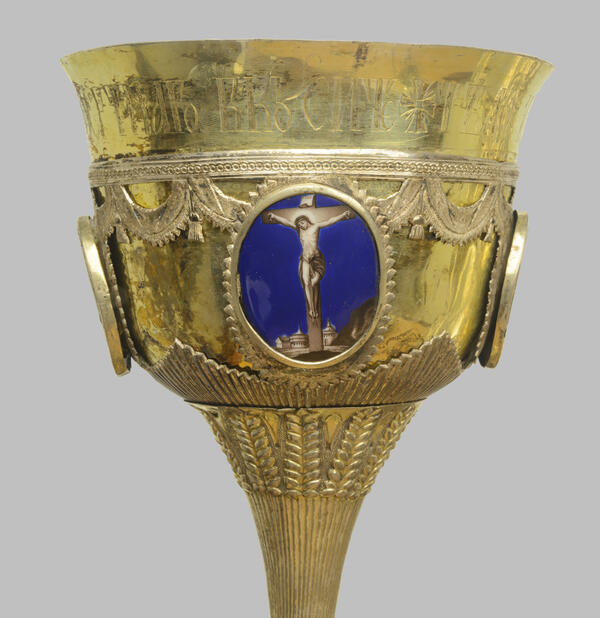
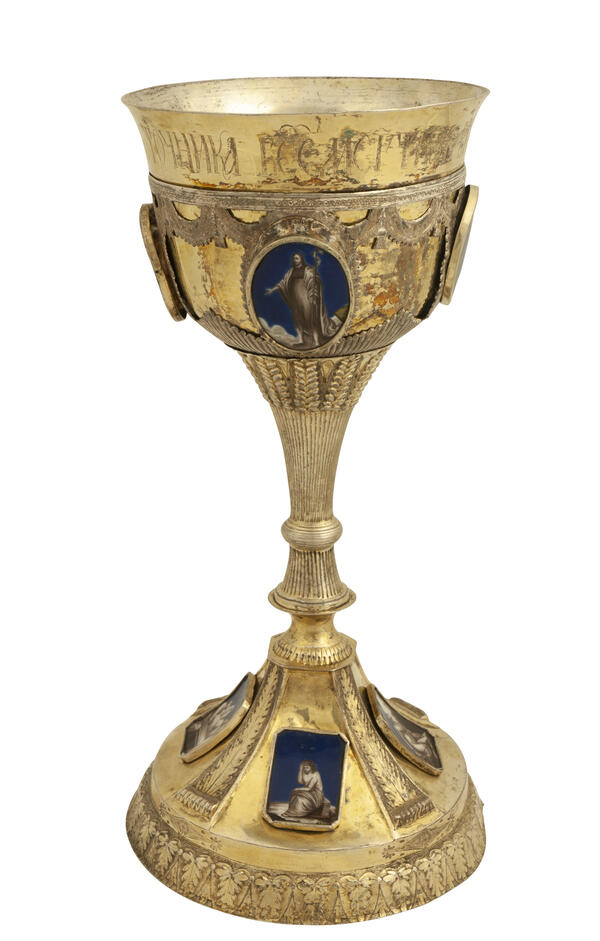
The silver chalice from the collection of the Radishchev Art Museum is a bowl on a high foot in a gilded openwork casing, decorated with four fragments — miniature inserts — of artistic enamel depicting the scene of the Crucifixion, as well as full-length saints: the Mother of God, the Savior with a sphere, and John the Baptist. Along the crown follows a verse from the liturgy of the faithful.
The foot of the chalice at the top and in the middle part has a decorative relief of chased stripes and ears of corn. The lower part of the leg is cut, the edges are cut off and decorated with oblong stylized plants. The side of the base is decorated with a circular repeating grape leaf pattern. The smooth edges of the base feature enamels with gospel scenes: “Prayer of the Chalice”, “Carrying the Cross”, “The Entombment”, and “Christ in Prison”. These images are made in the style of Western icon paintings of the 17th–18th centuries.
The first chalices were made of wood, which was subsequently banned, since this natural material could not keep the vessel clean. Then glass chalices were used. For the last seventeen centuries, chalices, like other liturgical vessels, were most often made of gold, silver, and bronze, they were decorated with enamel and precious stones.
The chalice has a great symbolic meaning, reminding believers of the cup of wine that Jesus Christ gave to his disciples at the Last Supper.
In the church, the vessel for Communion is kept along with other sacred objects on the altar or in a special safe. Usually there are several chalices in Orthodox churches. On major holidays, when many priests serve and there is a long line of people wishing to receive communion, the largest chalice is used, from which the Blood of Christ is poured into smaller ones.
In 1930, the collection of the Radishchev Art Museum received a large number of religious items from the Church and Art Department of the Governorate Museum. Among them was a silver chalice of the early 19th century.
According to the maker’s marks on the rim and on the casing, the chalice was made in 1820 by an unknown jeweler in one of the workshops, where the famous artisan Mikhail Mikhailovich Karpinsky, an employee of the Moscow Assay Office, worked.
The silver chalice from the collection of the Radishchev Art Museum is a bowl on a high foot in a gilded openwork casing, decorated with four fragments — miniature inserts — of artistic enamel depicting the scene of the Crucifixion, as well as full-length saints: the Mother of God, the Savior with a sphere, and John the Baptist. Along the crown follows a verse from the liturgy of the faithful.
The foot of the chalice at the top and in the middle part has a decorative relief of chased stripes and ears of corn. The lower part of the leg is cut, the edges are cut off and decorated with oblong stylized plants. The side of the base is decorated with a circular repeating grape leaf pattern. The smooth edges of the base feature enamels with gospel scenes: “Prayer of the Chalice”, “Carrying the Cross”, “The Entombment”, and “Christ in Prison”. These images are made in the style of Western icon paintings of the 17th–18th centuries.