

The carved bone cross entered the Radishchev Museum as part of the collection of A.P. Bogolyubov in 1885. Alexey Petrovich Bogolyubov was a famous landscape painter and public figure, who founded the first Russian provincial art museum in Saratov. The city was considered the birthplace of his famous grandfather, Alexander Nikolaevich Radishchev, the author of the famous “Journey from St. Petersburg to Moscow”.
Bogolyubov donated works of Russian and foreign artists, which he had collected over many years, to the museum. Among them were religious objects, which most often had a memorial significance for the founder. Unfortunately, the origin of the carved bone cross is unknown — the artist purposefully collected rarities for his museum long before its opening.
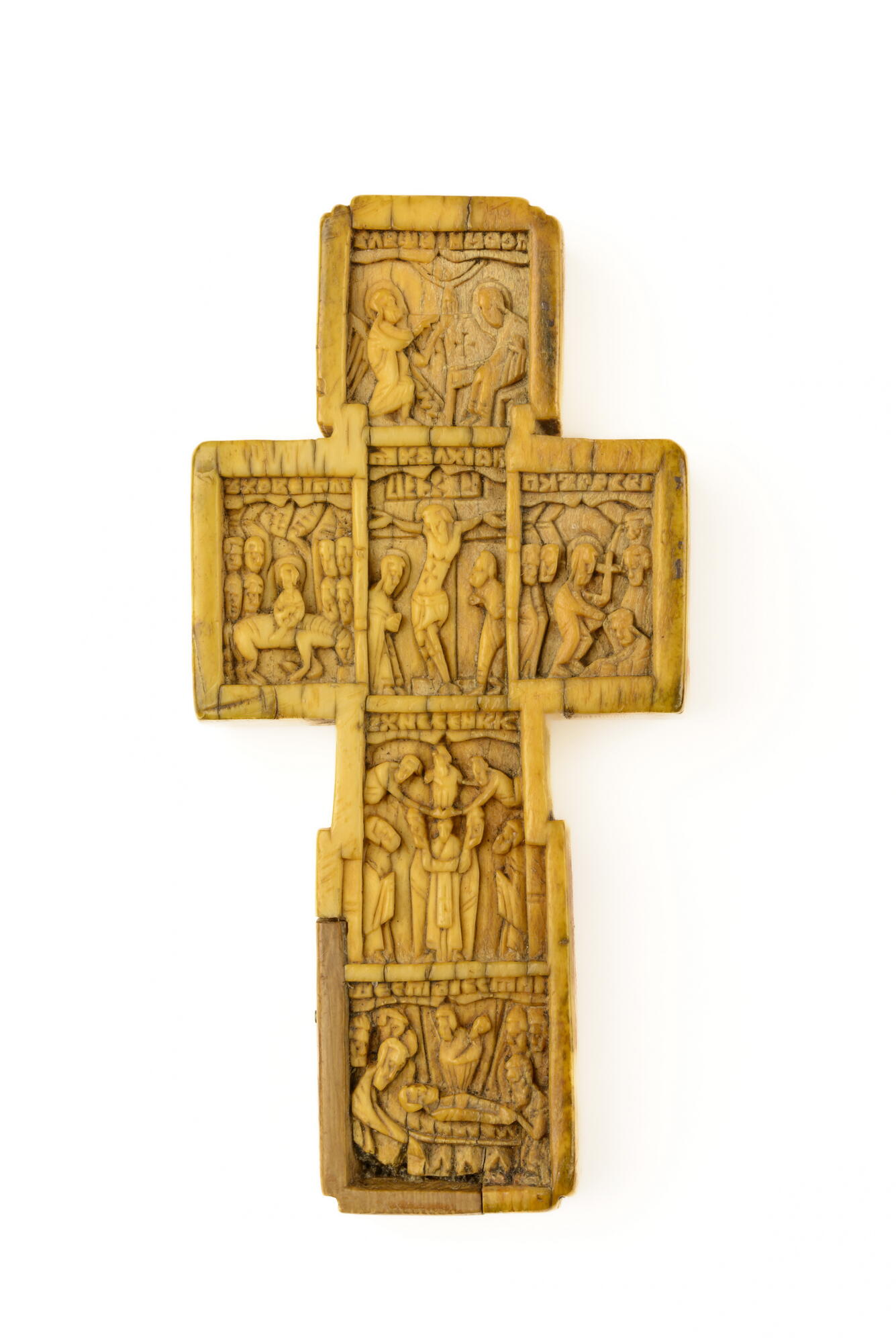
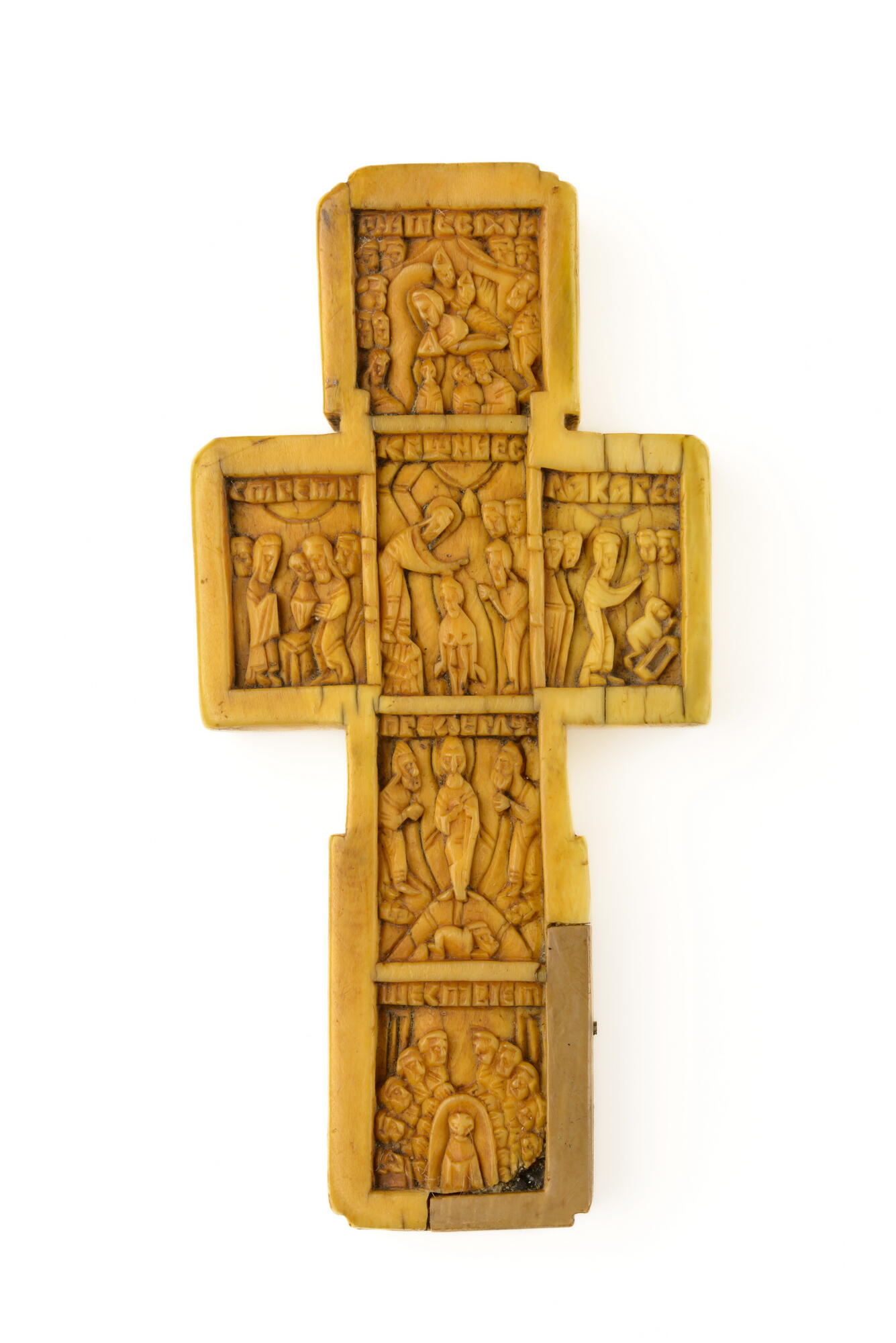
The pectoral cross of the Saratov museum is decorated on both sides with carved compositions of the festive cycle. The Twelve Feasts are the twelve most important annual church events, second only to Easter, which are connected with the Gospel and the history of the Church.
On the front side of the cross are the following feasts, celebrated in the Orthodox calendar: “Annunciation”, “Entrance to Jerusalem”, “Crucifixion”, “Resurrection — Descent into Hell”, “Ascension”, “Assumption of the Most Holy Theotokos”. On the other side — “The Nativity of Christ”, “Meeting of the Lord”, “The Baptism of the Lord”, “The Resurrection of Lazarus”, “Transfiguration”, “Descent of the Holy Spirit”. The compositions are enclosed in smooth frames, inside which, at the top, above keel-shaped — semicircular — ends, there are accompanying inscriptions.
This type of carving appeared in Russian arts and crafts in the middle of the 15th century. The location and iconography of the compositions of the cross is a simplified version of the Byzantine scheme, adapted in Moscow.
The work is special in that there are minor protrusions in its upper and lower parts that are not correlated with the location of the scenes. Narrative scenes are densely arranged and the figures of saints are generalized because of the miniature size of the carving. The high level of execution testifies to the professionalism of the artisan and presumably points to the Moscow school.
Bogolyubov donated works of Russian and foreign artists, which he had collected over many years, to the museum. Among them were religious objects, which most often had a memorial significance for the founder. Unfortunately, the origin of the carved bone cross is unknown — the artist purposefully collected rarities for his museum long before its opening.
The pectoral cross of the Saratov museum is decorated on both sides with carved compositions of the festive cycle. The Twelve Feasts are the twelve most important annual church events, second only to Easter, which are connected with the Gospel and the history of the Church.
On the front side of the cross are the following feasts, celebrated in the Orthodox calendar: “Annunciation”, “Entrance to Jerusalem”, “Crucifixion”, “Resurrection — Descent into Hell”, “Ascension”, “Assumption of the Most Holy Theotokos”. On the other side — “The Nativity of Christ”, “Meeting of the Lord”, “The Baptism of the Lord”, “The Resurrection of Lazarus”, “Transfiguration”, “Descent of the Holy Spirit”. The compositions are enclosed in smooth frames, inside which, at the top, above keel-shaped — semicircular — ends, there are accompanying inscriptions.
This type of carving appeared in Russian arts and crafts in the middle of the 15th century. The location and iconography of the compositions of the cross is a simplified version of the Byzantine scheme, adapted in Moscow.
The work is special in that there are minor protrusions in its upper and lower parts that are not correlated with the location of the scenes. Narrative scenes are densely arranged and the figures of saints are generalized because of the miniature size of the carving. The high level of execution testifies to the professionalism of the artisan and presumably points to the Moscow school.


