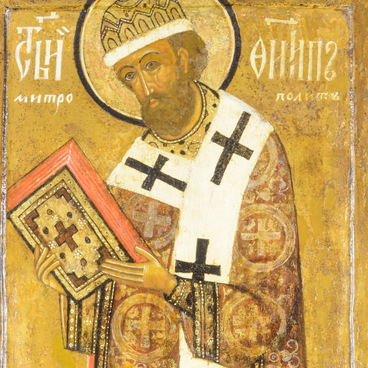
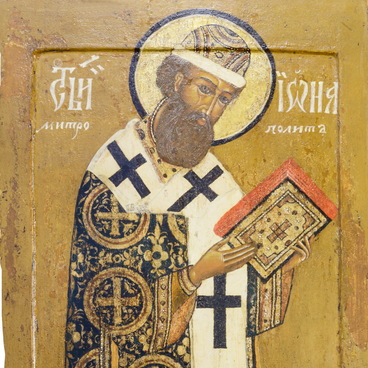
The iconostasis, found by employees of the Tretyakov Gallery during an expedition to the Vladimir region in 1965, included the images painted by an unknown artist in the last quarter of the 17th century. Among them was the icon of St. Peter, Metropolitan of Kyiv and All Russia. This icon, along with other monuments of ecclesiastical art, was part of the Deesis tier of the iconostasis. This is the name of the main tier of icons in the altar partition separating the most sacred place of the temple from the common hall with parishioners.
The Deesis tier — from the Greek “prayer” — is formed around the image of Christ and symbolizes the second coming of the Savior. The saints standing on either side of Him bowed before God in petition for humanity.
The Murom iconostasis was unusual in that its main tier mainly included Russian saints in general and local saints in particular. For example, apart from Christ Pantocrator, the Mother of God and other main images, the Russian metropolitans Peter, Alexis, Jonah and Philip, who stood at the origins of the creation of the Russian state, were also depicted there.
Saint Peter was born in Volhynia in the second half of the 13th century. At the age of twelve, he entered the monastery, where he fulfilled his duties, studied sacred books and icon painting. In the rank of hieromonk, Peter left the monastery. At first, he secluded himself on the river Rata in a modest cell. Soon a temple grew up around it, where many believers came for Peter’s instructions, including princes and the current Metropolitan Maxim. And when he died in 1305, it was Peter who was elected the first Russian Metropolitan of All Russia.
In 1325, during the reign of Ivan Danilovich Kalita, Peter moved the center of the Russian metropolis from Vladimir to Moscow, thereby contributing to the rise of the young capital. By this, he laid a solid foundation for peace and the future greatness of Russia.
In 1325, Metropolitan Peter blessed Ivan Kalita to build the main Moscow church in the name of the Assumption of the Most Holy Theotokos. The Assumption Cathedral became the first stone church in Moscow.
Metropolitan Peter died on December 21, 1326.
The icon features St. Peter as an old man with a full beard. He bows his head and holds the Gospel in his hands. The Metropolitan wears the liturgical clothes of a bishop — a sakkos — with golden crosses embroidered in circles, an omophorion and a white klobuk — a hat — with golden pendants. Russian metropolitans started wearing such vestments after St. Peter.
The Deesis tier — from the Greek “prayer” — is formed around the image of Christ and symbolizes the second coming of the Savior. The saints standing on either side of Him bowed before God in petition for humanity.
The Murom iconostasis was unusual in that its main tier mainly included Russian saints in general and local saints in particular. For example, apart from Christ Pantocrator, the Mother of God and other main images, the Russian metropolitans Peter, Alexis, Jonah and Philip, who stood at the origins of the creation of the Russian state, were also depicted there.
Saint Peter was born in Volhynia in the second half of the 13th century. At the age of twelve, he entered the monastery, where he fulfilled his duties, studied sacred books and icon painting. In the rank of hieromonk, Peter left the monastery. At first, he secluded himself on the river Rata in a modest cell. Soon a temple grew up around it, where many believers came for Peter’s instructions, including princes and the current Metropolitan Maxim. And when he died in 1305, it was Peter who was elected the first Russian Metropolitan of All Russia.
In 1325, during the reign of Ivan Danilovich Kalita, Peter moved the center of the Russian metropolis from Vladimir to Moscow, thereby contributing to the rise of the young capital. By this, he laid a solid foundation for peace and the future greatness of Russia.
In 1325, Metropolitan Peter blessed Ivan Kalita to build the main Moscow church in the name of the Assumption of the Most Holy Theotokos. The Assumption Cathedral became the first stone church in Moscow.
Metropolitan Peter died on December 21, 1326.
The icon features St. Peter as an old man with a full beard. He bows his head and holds the Gospel in his hands. The Metropolitan wears the liturgical clothes of a bishop — a sakkos — with golden crosses embroidered in circles, an omophorion and a white klobuk — a hat — with golden pendants. Russian metropolitans started wearing such vestments after St. Peter.