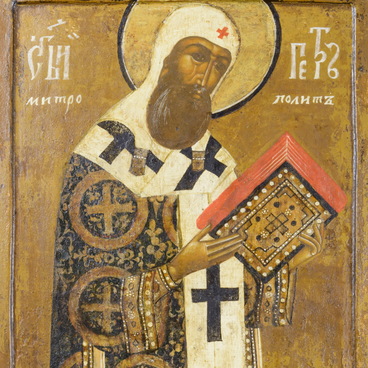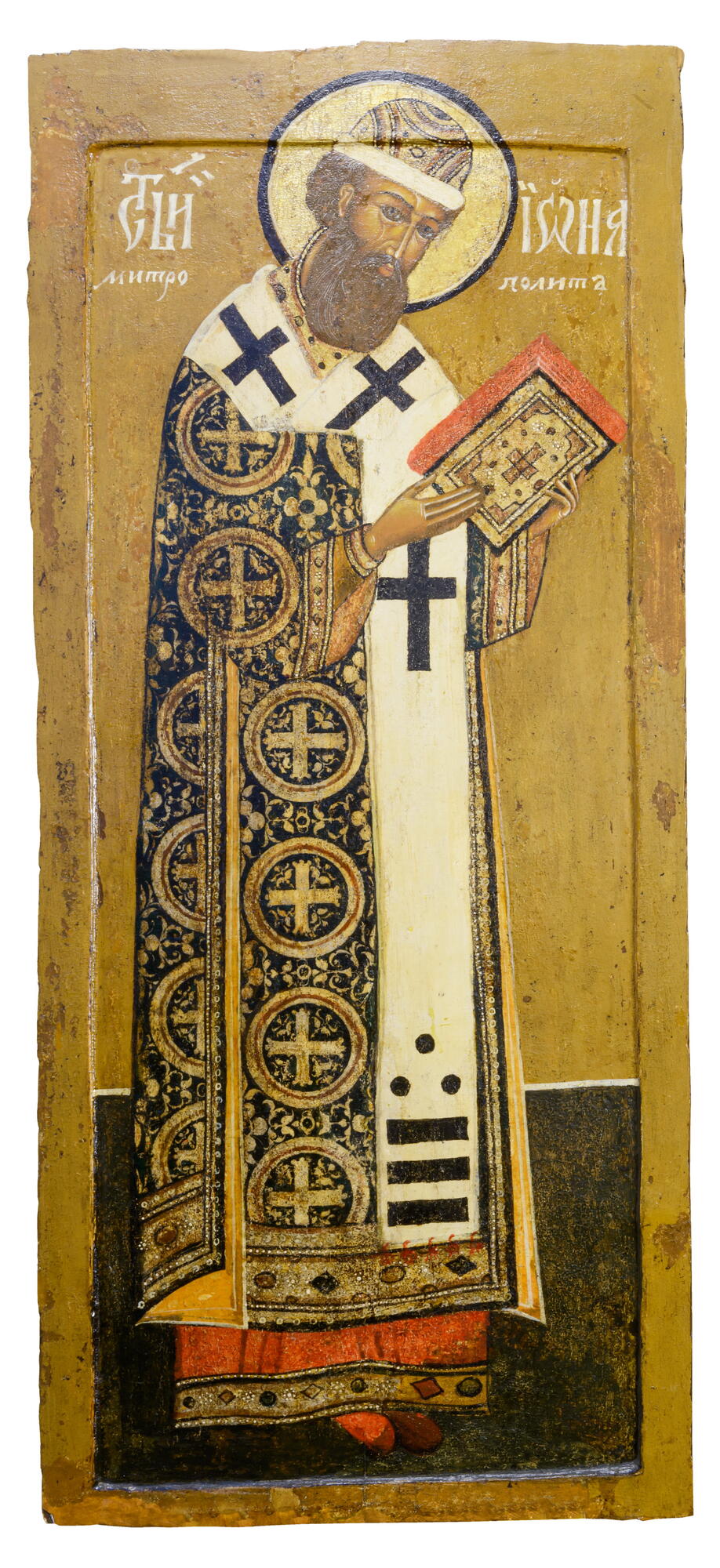


Jonah, Metropolitan of Moscow and All Russia (as well as Metropolitans Alexis and Philip) belonged to the category of especially revered saints in the vicinity of Murom. The images of these saints were included in the main — Deesis — tier of the iconostasis, found by one of the expeditions of the Tretyakov Gallery in the middle of the last century and transferred to the Saratov Museum.
Usually the Deesis tier includes the main close associates of God flanking the central figure of Christ: the Mother of God, John the Baptist, the apostles, and archangels. The tier also contains the images of saints most revered by the creators of the church building.
Saint Jonah was born in the last quarter of the 14th century near Soligalich in the Kostroma region. From an early age, he strove for monasticism and obedience, so by the age of twelve he was tonsured in one of the Galich monasteries. After a while, he moved to the Simonov Monastery in Moscow and was soon made Bishop of Ryazan and Murom, where he converted many pagans to Christianity.
After the death of Metropolitan Photius, Jonah was twice elected head of the church, but Constantinople chose other candidates: first Bishop Gerasim of Smolensk, then Isidore, a Bulgarian by birth. The first was burned at the stake by the Lithuanian prince Svidrigailo on suspicion of treason. The second was imprisoned in the Chudov Monastery, since Isidore, who had just returned from Italy from the Florentine Cathedral, accepted the proposal of the Pope to unite the Orthodox and Catholic churches under the rule of the latter.
Since everyone in Russia was against such an alliance, then, without the consent of the Patriarch of Constantinople, the virtuous Jonah was elected and consecrated metropolitan by the authority of the council of Russian bishops and the Grand Duke. This happened in 1448 and meant the assertion of the Russian Church’s autonomy.
Jonah, while still the bishop of Ryazan, took part in the struggle between Prince Vasily the Dark and Dmitry Shemyaka, whom he denounced and excommunicated for wrong deeds.
The saint was among those defending Moscow during the invasion of the Nogai Khan in the middle of the 15th century — he went around the walls of the city in a procession with a prayer.
The metropolitan’s main task was the defense of Orthodoxy and the independence of the Russian Church, in which he was very successful and for which he was canonized almost a hundred years after his death.
Usually the Deesis tier includes the main close associates of God flanking the central figure of Christ: the Mother of God, John the Baptist, the apostles, and archangels. The tier also contains the images of saints most revered by the creators of the church building.
Saint Jonah was born in the last quarter of the 14th century near Soligalich in the Kostroma region. From an early age, he strove for monasticism and obedience, so by the age of twelve he was tonsured in one of the Galich monasteries. After a while, he moved to the Simonov Monastery in Moscow and was soon made Bishop of Ryazan and Murom, where he converted many pagans to Christianity.
After the death of Metropolitan Photius, Jonah was twice elected head of the church, but Constantinople chose other candidates: first Bishop Gerasim of Smolensk, then Isidore, a Bulgarian by birth. The first was burned at the stake by the Lithuanian prince Svidrigailo on suspicion of treason. The second was imprisoned in the Chudov Monastery, since Isidore, who had just returned from Italy from the Florentine Cathedral, accepted the proposal of the Pope to unite the Orthodox and Catholic churches under the rule of the latter.
Since everyone in Russia was against such an alliance, then, without the consent of the Patriarch of Constantinople, the virtuous Jonah was elected and consecrated metropolitan by the authority of the council of Russian bishops and the Grand Duke. This happened in 1448 and meant the assertion of the Russian Church’s autonomy.
Jonah, while still the bishop of Ryazan, took part in the struggle between Prince Vasily the Dark and Dmitry Shemyaka, whom he denounced and excommunicated for wrong deeds.
The saint was among those defending Moscow during the invasion of the Nogai Khan in the middle of the 15th century — he went around the walls of the city in a procession with a prayer.
The metropolitan’s main task was the defense of Orthodoxy and the independence of the Russian Church, in which he was very successful and for which he was canonized almost a hundred years after his death.