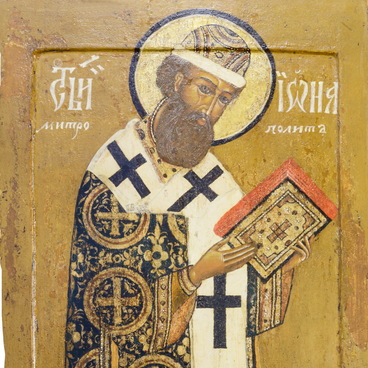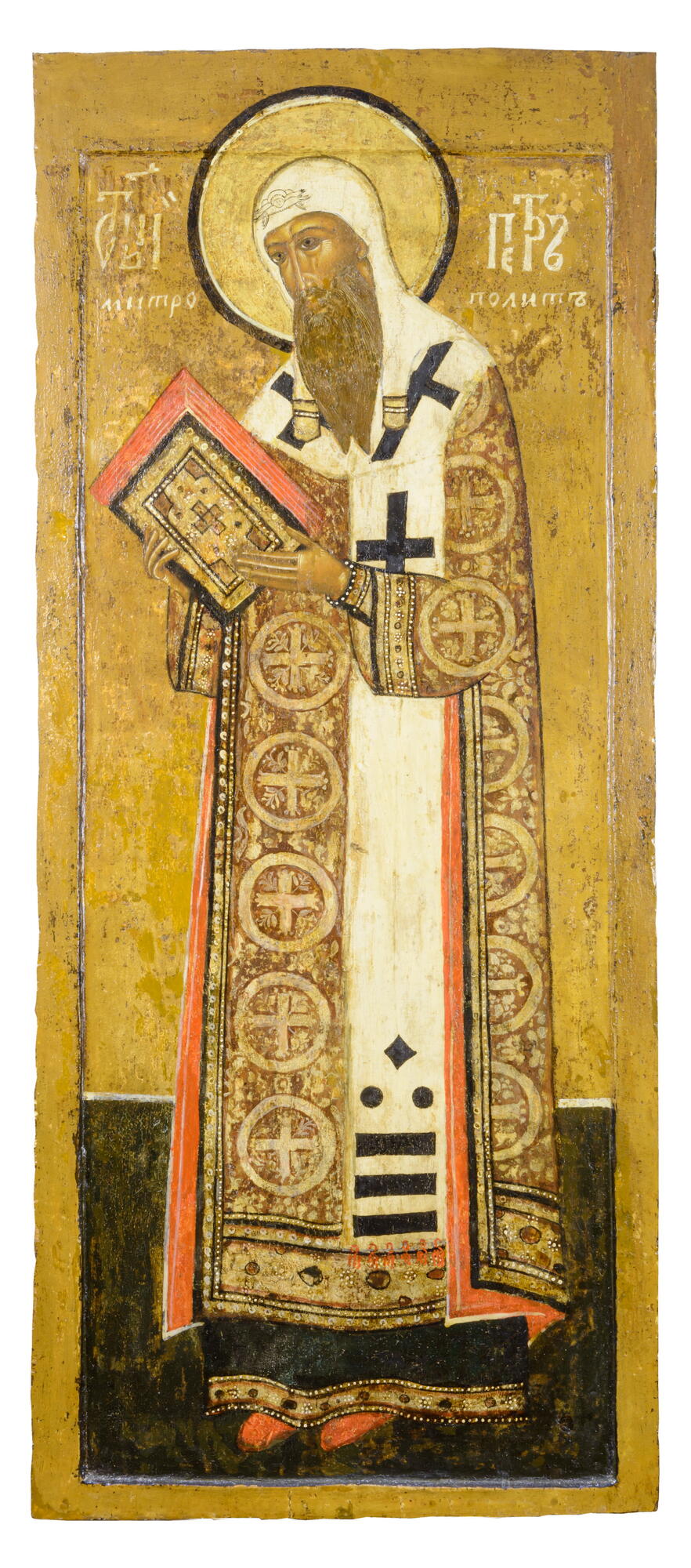


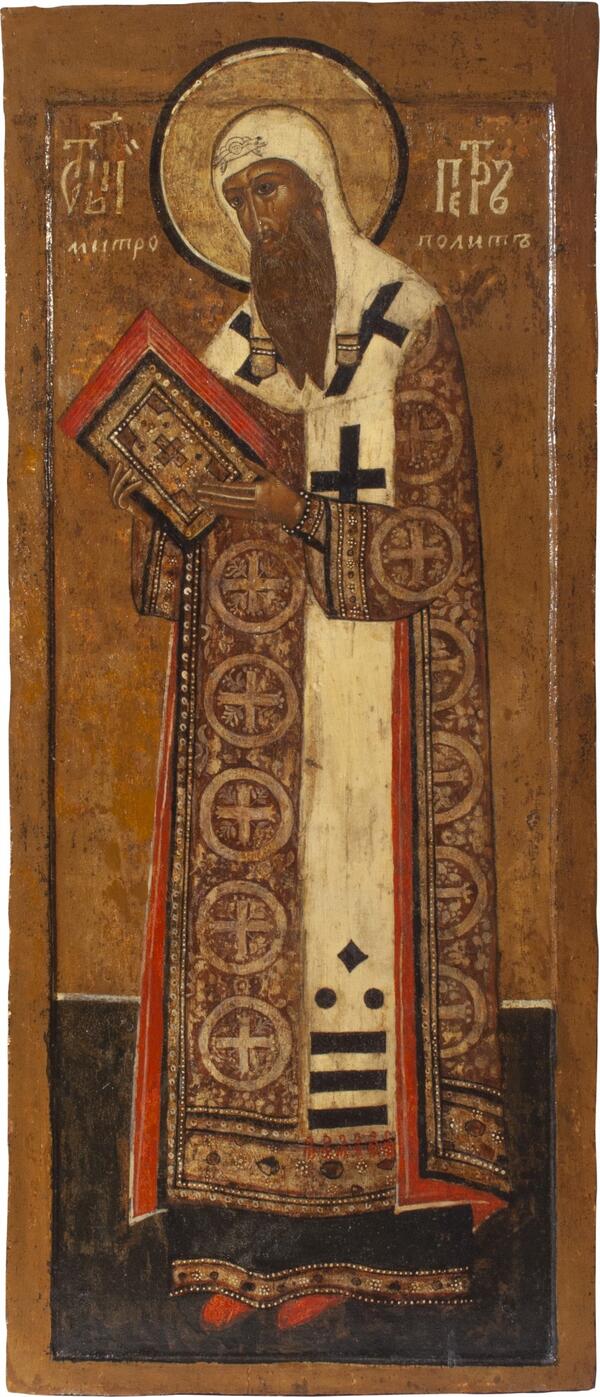
This icon depicting Alexis, Metropolitan of Moscow and All Russia, was discovered in an abandoned stone church built at the end of the 19th century, not far from the city of Murom. Research shows that it came from an older burnt wooden church that used to be located on the same site.
Saint Alexis — at baptism his name was Eleutherius — was born in Moscow in 1292. His father Fyodor Byakont, a noble boyar, moved there from Chernigov that was devastated by the Horde. According to the saint’s hagiography, when Eleutherius was an adolescent, he was catching birds and fell asleep, and in a dream he heard a voice that gave him a monastic name and announced that he would become a “catcher of men.”
At the age of twenty, Alexis was tonsured at the Moscow Epiphany Monastery. After years of service, he became a metropolitan governor in Vladimir, and then Metropolitan Theognost chose Alexis as his successor and ordained him a bishop of Vladimir.
In 1353, Theognost and Grand Duke Simeon the Proud sent an embassy to the Patriarch of Constantinople with a request to confirm Alexis as the next Russian metropolitan, which was done the following year.
A monk by vocation, Alexis had the gift of a ruler, politician and diplomat. He had a persistent, energetic and firm character, and was famous for his intelligence and education. He was highly influential in the church as well as in national affairs.
In the testament of Grand Duke Simeon the Proud, the Metropolitan was given the role of adviser to Simeon’s younger brothers Andrey and Ivan. After the death of the latter, Alexis became regent for his young son Dmitry of Moscow, later named Donskoy.
The saint actively supported the princes in their struggle against Lithuania and Tver. He defended the unity of the Russian Church and opposed attempts to form separate metropolitan archdioceses in the Russian territories that became part of the Grand Duchy of Lithuania and Poland.
Under Metropolitan Alexis, many churches resumed their work and many new churches were built. First, he founded the Chudov Monastery in the Moscow Kremlin and the Spaso-Andronikov Monastery, built in gratitude for salvation from drowning in the Black Sea.
The icon features Saint Alexis as a wise elderly man, with a pointed slightly gray beard, holding the Gospel in his hands. He wears a sakkos, an omophorion, and a klobuk with golden pendants — the traditional clothes of Russian metropolitans, which have been worn since the time of St. Peter.
Saint Alexis — at baptism his name was Eleutherius — was born in Moscow in 1292. His father Fyodor Byakont, a noble boyar, moved there from Chernigov that was devastated by the Horde. According to the saint’s hagiography, when Eleutherius was an adolescent, he was catching birds and fell asleep, and in a dream he heard a voice that gave him a monastic name and announced that he would become a “catcher of men.”
At the age of twenty, Alexis was tonsured at the Moscow Epiphany Monastery. After years of service, he became a metropolitan governor in Vladimir, and then Metropolitan Theognost chose Alexis as his successor and ordained him a bishop of Vladimir.
In 1353, Theognost and Grand Duke Simeon the Proud sent an embassy to the Patriarch of Constantinople with a request to confirm Alexis as the next Russian metropolitan, which was done the following year.
A monk by vocation, Alexis had the gift of a ruler, politician and diplomat. He had a persistent, energetic and firm character, and was famous for his intelligence and education. He was highly influential in the church as well as in national affairs.
In the testament of Grand Duke Simeon the Proud, the Metropolitan was given the role of adviser to Simeon’s younger brothers Andrey and Ivan. After the death of the latter, Alexis became regent for his young son Dmitry of Moscow, later named Donskoy.
The saint actively supported the princes in their struggle against Lithuania and Tver. He defended the unity of the Russian Church and opposed attempts to form separate metropolitan archdioceses in the Russian territories that became part of the Grand Duchy of Lithuania and Poland.
Under Metropolitan Alexis, many churches resumed their work and many new churches were built. First, he founded the Chudov Monastery in the Moscow Kremlin and the Spaso-Andronikov Monastery, built in gratitude for salvation from drowning in the Black Sea.
The icon features Saint Alexis as a wise elderly man, with a pointed slightly gray beard, holding the Gospel in his hands. He wears a sakkos, an omophorion, and a klobuk with golden pendants — the traditional clothes of Russian metropolitans, which have been worn since the time of St. Peter.