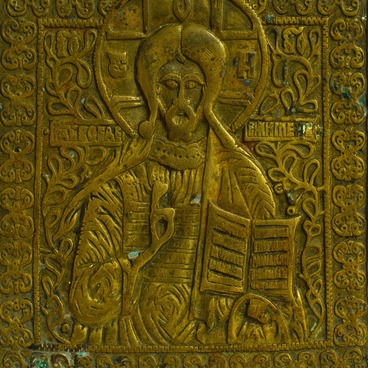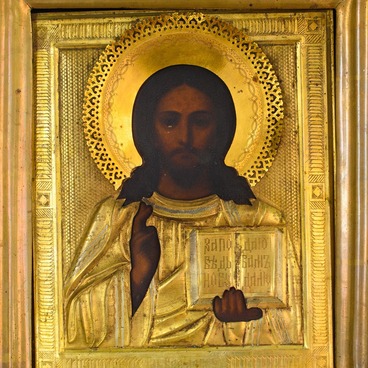
When icon-painting workshops at churches and monasteries could not meet the popular demand for icons, the printing industry came to the rescue. By the late 19th century, more icons that required the revetment began to be produced. Creating such an image, the artists painted only the face and hands on the board, leaving the rest of it bare. However, in some cases the icon could be covered with paint — red or black, hence such images were called krasnushki (from Russian “krasny” — red) or chernushki (from “cherny” — black).
Other details of the saint’s appearance — their attire, attributes and a halo over the head — all this was lithographically applied to the revetment (the so-called flat printing on tin). The revetment covered the board with the painted image, which was visible through special slots. The cheapest icons were decorated with a foil revetment and were dubbed “under-foil” ones. A slightly more expensive version was stamped and had a brass coating. The most expensive were the icons printed on thin silver sheets.
However, any of these images cost much less than an icon painted in a special center at the monastery, since it took much less time and skill to create it. So printed icons were in great demand among the common people.
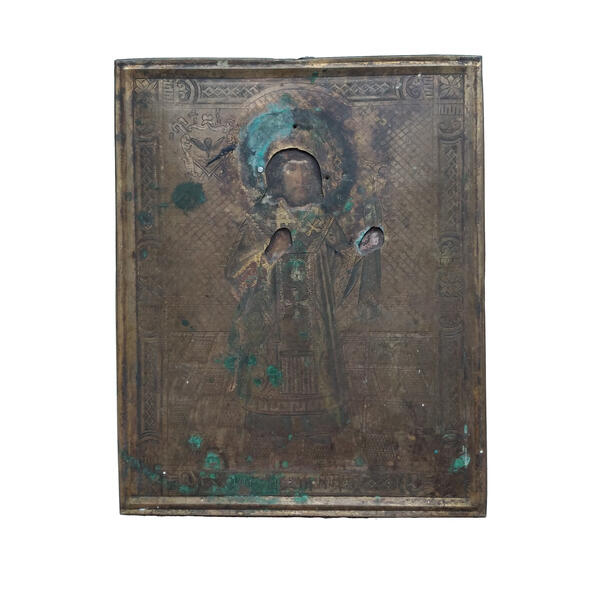
One of these images is the icon “St. Theodosius of Chernihiv” from the collection of the Museum Complex of Kuybyshev. The icon was created in the early 20th century. Neither the artist nor the place of its production are known.
St. Theodosius of Uglich, Archbishop of Chernihiv, a famous church figure of the 17th century, is one of the most revered Chernihiv saints. The saint’s authority among the faithful was great not only during his lifetime, but also much later. For example, Orthodox Christians believe that it was Theodosius of Uglich who saved Chernihiv from the horrible consequences of the Chernobyl nuclear power plant accident in 1986.
Only the face of St. Theodosius of Chernihiv, as well as his hands are painted in oil on the wooden board. The board is covered with a thin layer of levkas — a type of gesso made of animal and vegetable fats and chalk. The artist used ocher paints and captured the likeness of the saint. The saint’s face is rendered in a realistic manner. The rest of the icon is covered with a revetment.
The right hand holding the cross is depicted conditionally. The paint layer on the left hand is completely lost, and the left half of the face is also damaged. The rest of the image is printed on a tin revetment.
Other details of the saint’s appearance — their attire, attributes and a halo over the head — all this was lithographically applied to the revetment (the so-called flat printing on tin). The revetment covered the board with the painted image, which was visible through special slots. The cheapest icons were decorated with a foil revetment and were dubbed “under-foil” ones. A slightly more expensive version was stamped and had a brass coating. The most expensive were the icons printed on thin silver sheets.
However, any of these images cost much less than an icon painted in a special center at the monastery, since it took much less time and skill to create it. So printed icons were in great demand among the common people.
One of these images is the icon “St. Theodosius of Chernihiv” from the collection of the Museum Complex of Kuybyshev. The icon was created in the early 20th century. Neither the artist nor the place of its production are known.
St. Theodosius of Uglich, Archbishop of Chernihiv, a famous church figure of the 17th century, is one of the most revered Chernihiv saints. The saint’s authority among the faithful was great not only during his lifetime, but also much later. For example, Orthodox Christians believe that it was Theodosius of Uglich who saved Chernihiv from the horrible consequences of the Chernobyl nuclear power plant accident in 1986.
Only the face of St. Theodosius of Chernihiv, as well as his hands are painted in oil on the wooden board. The board is covered with a thin layer of levkas — a type of gesso made of animal and vegetable fats and chalk. The artist used ocher paints and captured the likeness of the saint. The saint’s face is rendered in a realistic manner. The rest of the icon is covered with a revetment.
The right hand holding the cross is depicted conditionally. The paint layer on the left hand is completely lost, and the left half of the face is also damaged. The rest of the image is printed on a tin revetment.