When the law on secularization of church possessions (their withdrawal in favor of the state) was adopted in 1764, the Tobolsk Bishop’s House lost many of its own gifted icon painters and carvers. Thus, the icon-painting art in Siberia experienced a difficult time.
Artists at monasteries continued to create images in some numbers and icons with the faces of saints painted by professionals were brought from other regions, but there were not enough of them to meet the demand. Therefore, everyone who had artistic talent took up icon painting.
The self-taught masters (“bogomaz” — from the Russian “Bog” meaning “God” and “mazat” meaning “to paint”) painted spinning wheels and chests, they also created holy images, focusing on folk preferences. Based on the tastes of the majority of costumers — peasants — the artists created simple and understandable compositions, not always following the iconographic canons. So, for example, in artisanal icons, the attire of saints respected in Orthodox Christianity looked like the clothes of the common people.
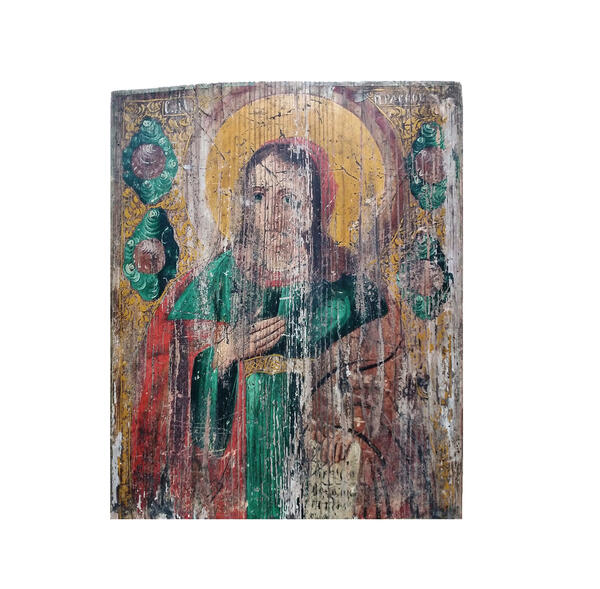
The icon “Holy Martyr Paraskeva (Friday)” from the collection of the Museum Complex of Kuybyshev was also painted by an unknown non-professional master. It was created at the beginning of the 20th century.
The image is painted on a rectangular board. The artisan applied oil paints on a thin layer of gesso. The entire icon is occupied by a knee-length image of Saint Paraskeva in a small turn to the right.
Paraskeva Friday was considered the patroness of weddings, home, women’s labor, travelers and trade.
The right hand of the martyr rests on her chest in a gesture of prayer, in her left one she holds a scroll with a prayer. The saint is depicted in a bright green shirt and a chiton with a red neckpiece. The chiton is girdled under the chest with a yellow patterned belt. Paraskeva’s head and shoulders are covered with a bright red maphorion, a scarf or a cloak with a hood.
Judging by the style of painting, it can be assumed that the icon from the Kuybyshev collection originates from Siberia. The works of that region were characterized by a combination of styles of various iconographic schools.
Artists at monasteries continued to create images in some numbers and icons with the faces of saints painted by professionals were brought from other regions, but there were not enough of them to meet the demand. Therefore, everyone who had artistic talent took up icon painting.
The self-taught masters (“bogomaz” — from the Russian “Bog” meaning “God” and “mazat” meaning “to paint”) painted spinning wheels and chests, they also created holy images, focusing on folk preferences. Based on the tastes of the majority of costumers — peasants — the artists created simple and understandable compositions, not always following the iconographic canons. So, for example, in artisanal icons, the attire of saints respected in Orthodox Christianity looked like the clothes of the common people.
The icon “Holy Martyr Paraskeva (Friday)” from the collection of the Museum Complex of Kuybyshev was also painted by an unknown non-professional master. It was created at the beginning of the 20th century.
The image is painted on a rectangular board. The artisan applied oil paints on a thin layer of gesso. The entire icon is occupied by a knee-length image of Saint Paraskeva in a small turn to the right.
Paraskeva Friday was considered the patroness of weddings, home, women’s labor, travelers and trade.
The right hand of the martyr rests on her chest in a gesture of prayer, in her left one she holds a scroll with a prayer. The saint is depicted in a bright green shirt and a chiton with a red neckpiece. The chiton is girdled under the chest with a yellow patterned belt. Paraskeva’s head and shoulders are covered with a bright red maphorion, a scarf or a cloak with a hood.
There is a round yellow halo around her head, which is trimmed by red piping. The name of the saint is written on both sides of the halo. The empty space inside the icon frame is decorated with floral ornaments. To the left and right of the figure of Paraskeva Friday are medallions, which are surrounded by green leaves. Lush red roses are visible inside them. Along the edge of the board, the artist depicted a light green frame.
Judging by the style of painting, it can be assumed that the icon from the Kuybyshev collection originates from Siberia. The works of that region were characterized by a combination of styles of various iconographic schools.