When the need for a large number of icons in the late 19th century arose, the lithographic industry offered its services. Printed images began to appear quickly and in huge quantities, their cost was low, and they were available everywhere. Professional icon painters continued to paint icons in oil on wood, but it was increasingly difficult for them to compete with images of saints produced by factories. Then, in order to avoid going bankrupt, icon-painting workshops began to create more and more icons depicting only the face and hands of the saint. The remaining elements of the image were printed on tin plates — revetments — and attached to the icon with nails.
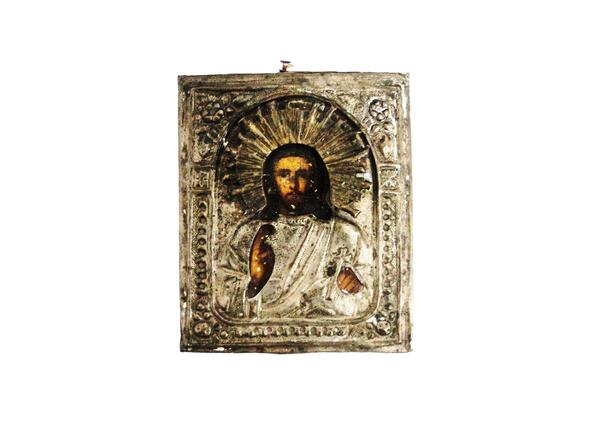
One of these icons — “Christ Pantocrator” — is housed in the collection of the Museum Complex of Kuybyshev. The iconographic type Savior Almighty, or Christ Pantocrator (in Greek) is one of the most common images of the Son of God.
Traditionally, in such icons, Jesus is depicted sitting on a throne with the Gospel in His left hand and with His right hand blessing the whole world. The pages of the Gospel show the text of a prayer which changes depending on the place of the icon’s creation. Often the image is reduced to a half-length one, and in the Savior’s left hand, instead of the New Testament, is the symbol of the Kingship of Jesus Christ — the orb.
The image is painted on a rectangular board. Its middle part is covered with a thin layer of levkas — a type of gesso consisting of animal or fish fats, linseed oil and chalk. The face and hands of the Savior are painted over this layer.
The right hand of the Savior is canonically raised in a gesture of blessing, the fingers of the left hand are folded — they lie on the orb depicted on the revetment. The other elements that complement the image of the Savior are also printed on the tin revetment, which is nailed on top of the wooden board.
The revetment (called a riza or oklad) is made of a metal sheet by stamping. It shows the vestment of Christ — a chiton, which is covered with a himation. Around the face of the Savior is an overlayed radiant crown with a jagged edge — the halo. It is fixed to the slots of the revetment with metal strings. The margins of the icon are made in the form of a frame with a geometric pattern. In the upper corners is a stylized floral ornament, in the lower corners — a foliated and floral one.
One of these icons — “Christ Pantocrator” — is housed in the collection of the Museum Complex of Kuybyshev. The iconographic type Savior Almighty, or Christ Pantocrator (in Greek) is one of the most common images of the Son of God.
Traditionally, in such icons, Jesus is depicted sitting on a throne with the Gospel in His left hand and with His right hand blessing the whole world. The pages of the Gospel show the text of a prayer which changes depending on the place of the icon’s creation. Often the image is reduced to a half-length one, and in the Savior’s left hand, instead of the New Testament, is the symbol of the Kingship of Jesus Christ — the orb.
The image from the museum’s collection was created presumably in the late 19th — early 20th century by unknown masters. It consists of two elements — the painted wooden board and a metal revetment.
The image is painted on a rectangular board. Its middle part is covered with a thin layer of levkas — a type of gesso consisting of animal or fish fats, linseed oil and chalk. The face and hands of the Savior are painted over this layer.
The right hand of the Savior is canonically raised in a gesture of blessing, the fingers of the left hand are folded — they lie on the orb depicted on the revetment. The other elements that complement the image of the Savior are also printed on the tin revetment, which is nailed on top of the wooden board.
The revetment (called a riza or oklad) is made of a metal sheet by stamping. It shows the vestment of Christ — a chiton, which is covered with a himation. Around the face of the Savior is an overlayed radiant crown with a jagged edge — the halo. It is fixed to the slots of the revetment with metal strings. The margins of the icon are made in the form of a frame with a geometric pattern. In the upper corners is a stylized floral ornament, in the lower corners — a foliated and floral one.