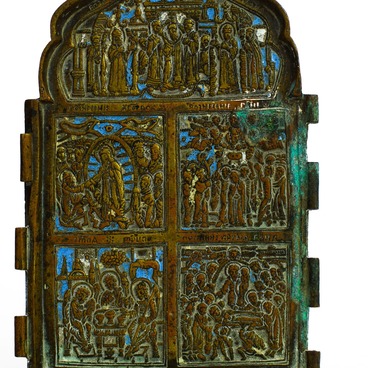
Three-part folding icons — “triptychs” — are among the most common folding icons. The design of such an image was borrowed from Byzantium. Usually the side panels of the icon were half the size of the middle one, could be completely closed and sometimes fastened with a small lock.
Folding icons were made of a variety of materials: copper, bronze, wood (Karelian birch, linden or cypress). They were covered with enamels, decorated with precious stones, bone carving, and so on. Most likely, these icons were inspired by the Royal Doors, which close the entrance to the altar in the church.
The most popular type of triptychs was “Deesis” — an image in which Jesus Christ is depicted in the center, flanked by the figures of the Virgin and John the Baptist. There are also countless types of iconographic representations of the Virgin. The common people especially loved icons and images of the Joy of All Who Sorrow type.
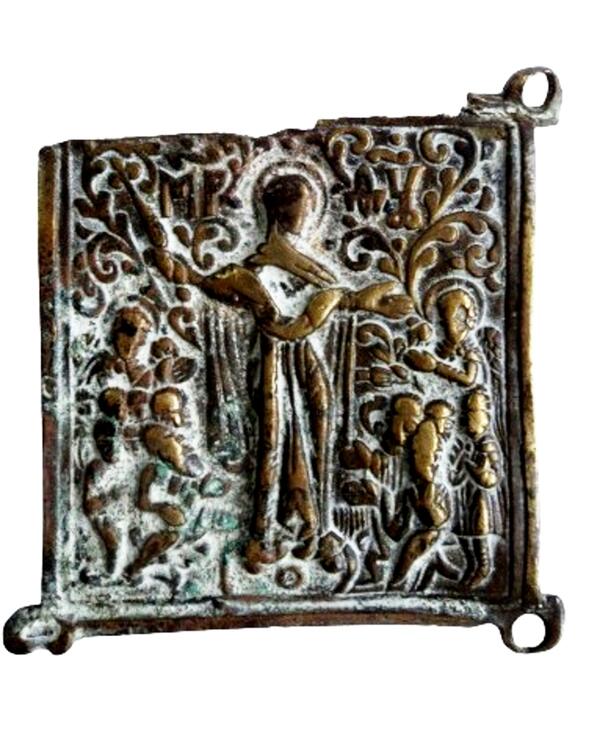
The Museum Complex of Kuybyshev houses the central panel of a triptych, which depicts the icon “Joy of All Who Sorrow”. The artifact was cast in the 19th century from a copper alloy, but it is impossible to establish the place and time of its production more precisely.
The central part of the folding icon is a thin cast metal plate close to a square in shape. In the corners are hinges for fastening the side panels, one of the hinges is missing.
On the panel itself is a relief image of the Theotokos “Joy of All Who Sorrow”. The Virgin is depicted in the center of the composition in full length with a slight turn to the left. She is dressed in a chiton (a kind of shirt), covered with a cape on top, which is called a himation. Her head is covered with a maphorion — a scarf. A halo is depicted above her head as a symbol of holiness. The hands of the Virgin are spread apart. In her right hand she holds a rod, which emphasizes that the Virgin Mary is the Queen of Heaven. In the icon, the Mother of God is surrounded by those who are sick, offended, hungry and suffering. Behind them are angels who reach out to people and point them to the Mother of Christ.
Folding icons were made of a variety of materials: copper, bronze, wood (Karelian birch, linden or cypress). They were covered with enamels, decorated with precious stones, bone carving, and so on. Most likely, these icons were inspired by the Royal Doors, which close the entrance to the altar in the church.
The most popular type of triptychs was “Deesis” — an image in which Jesus Christ is depicted in the center, flanked by the figures of the Virgin and John the Baptist. There are also countless types of iconographic representations of the Virgin. The common people especially loved icons and images of the Joy of All Who Sorrow type.
The Museum Complex of Kuybyshev houses the central panel of a triptych, which depicts the icon “Joy of All Who Sorrow”. The artifact was cast in the 19th century from a copper alloy, but it is impossible to establish the place and time of its production more precisely.
The central part of the folding icon is a thin cast metal plate close to a square in shape. In the corners are hinges for fastening the side panels, one of the hinges is missing.
On the panel itself is a relief image of the Theotokos “Joy of All Who Sorrow”. The Virgin is depicted in the center of the composition in full length with a slight turn to the left. She is dressed in a chiton (a kind of shirt), covered with a cape on top, which is called a himation. Her head is covered with a maphorion — a scarf. A halo is depicted above her head as a symbol of holiness. The hands of the Virgin are spread apart. In her right hand she holds a rod, which emphasizes that the Virgin Mary is the Queen of Heaven. In the icon, the Mother of God is surrounded by those who are sick, offended, hungry and suffering. Behind them are angels who reach out to people and point them to the Mother of Christ.