

Small icons worn around the neck came to Rus even before Christianity became the state religion. It is believed that the first miniature icon was worn by Grand Duchess Olga, who converted to the Christian faith in 954 in Constantinople. A legend has it that Olga gave that image to her grandson Vladimir, who, 34 years later, in 988, baptized Russia.
Pectoral crosses and images have always played a special role for believers. Pectoral icons (worn on the chest) were endowed with a special meaning, made it possible to feel the power of faith and to pray wherever the person was.
Pectoral images were chosen with trepidation, selected with diligence and respect. The believer wore the image of the saint who was a swift intercessor, strengthened faith and instilled confidence in the wearer that the saint would help them.
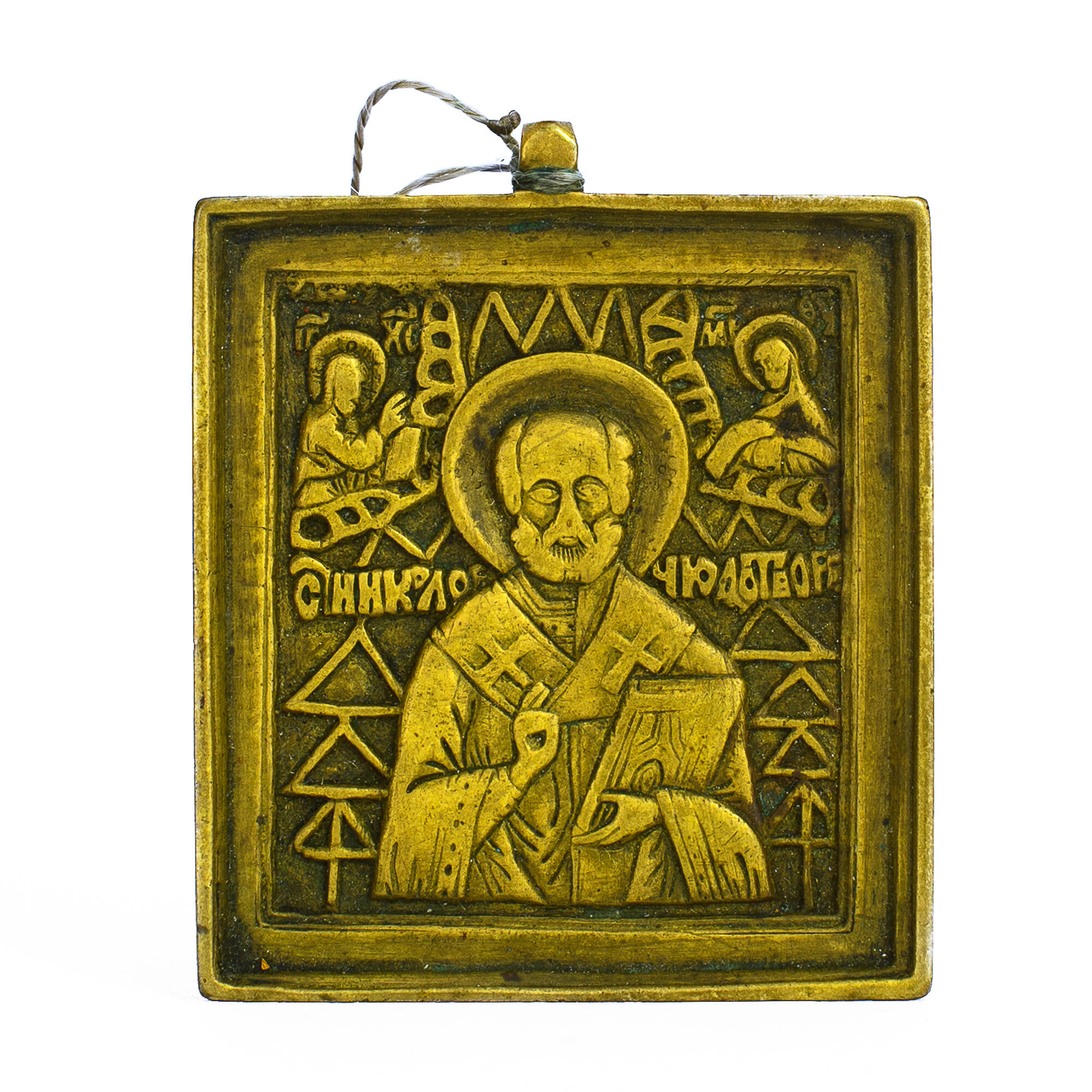
The Museum Complex of Kuybyshev houses an image of Nicholas the Wonderworker, made presumably in the late 19th — early 20th century that was worn around the neck.
Nicholas the Wonderworker, or Nicholas of Myra, is especially revered among all other Christian saints. He lived at the turn of the 4th century in the city of Myra in Lycia, hence he was called Nicholas of Myra. During his lifetime, he became known for many miracles and feats glorifying the Lord. People began to notice even more miracles after his death.
Most of all, Nicholas the Wonderworker protects travelers, sailors, all the deprived and suffering, as well as cattle breeders and farmers. He is also considered the guardian of the “earthly waters”. The common people in Russia and elsewhere call the saint Mikola, or Nikola.
The pectoral icon “Nicholas the Wonderworker” from the museum’s collection is made of copper alloy by stamping. The central part of the image is located in a small recess. It features a half-length image of St. Nicholas the Wonderworker in episcopal vestments. His right hand is raised in a blessing gesture, and he holds the open Gospel in his left. The name of the icon is written in the center on both sides of the saint.
Pectoral crosses and images have always played a special role for believers. Pectoral icons (worn on the chest) were endowed with a special meaning, made it possible to feel the power of faith and to pray wherever the person was.
Pectoral images were chosen with trepidation, selected with diligence and respect. The believer wore the image of the saint who was a swift intercessor, strengthened faith and instilled confidence in the wearer that the saint would help them.
The Museum Complex of Kuybyshev houses an image of Nicholas the Wonderworker, made presumably in the late 19th — early 20th century that was worn around the neck.
Nicholas the Wonderworker, or Nicholas of Myra, is especially revered among all other Christian saints. He lived at the turn of the 4th century in the city of Myra in Lycia, hence he was called Nicholas of Myra. During his lifetime, he became known for many miracles and feats glorifying the Lord. People began to notice even more miracles after his death.
Most of all, Nicholas the Wonderworker protects travelers, sailors, all the deprived and suffering, as well as cattle breeders and farmers. He is also considered the guardian of the “earthly waters”. The common people in Russia and elsewhere call the saint Mikola, or Nikola.
The pectoral icon “Nicholas the Wonderworker” from the museum’s collection is made of copper alloy by stamping. The central part of the image is located in a small recess. It features a half-length image of St. Nicholas the Wonderworker in episcopal vestments. His right hand is raised in a blessing gesture, and he holds the open Gospel in his left. The name of the icon is written in the center on both sides of the saint.
In icons, St. Nicholas the Wonderworker is often accompanied by images of Jesus Christ and the Mother of God. Just like in the presented artifact: in the upper left corner, in a small ornamental frame, the Savior is depicted with the Gospel in His hands. On the right, in the same frame, there is an image of the Mother of God holding an omophorion — part of the bishop’s liturgical vestments.


