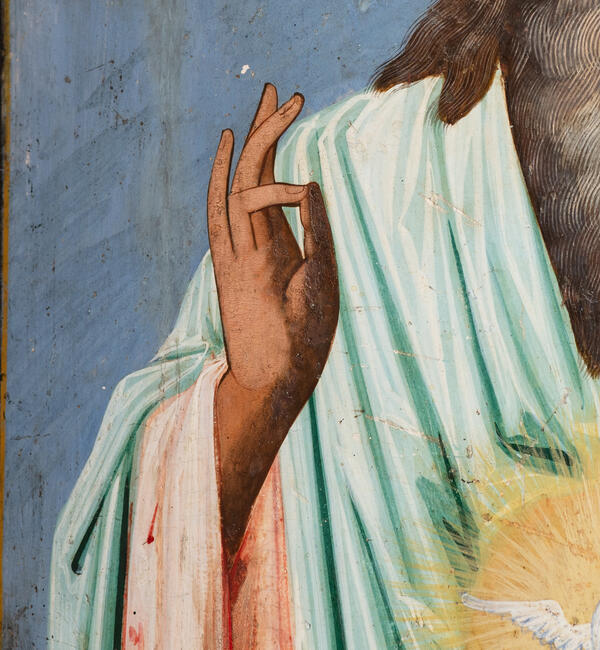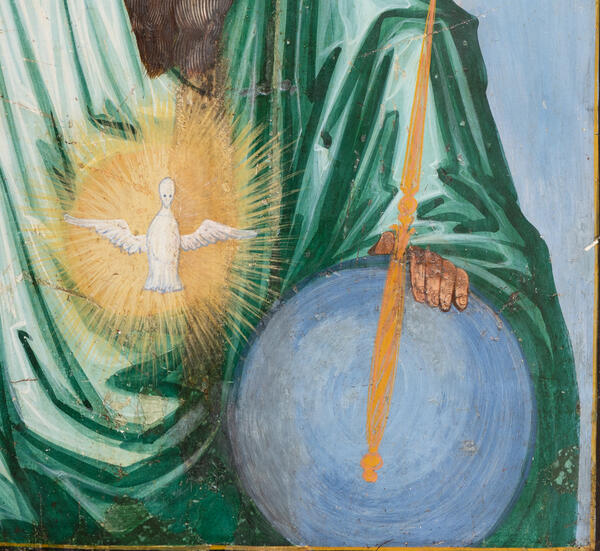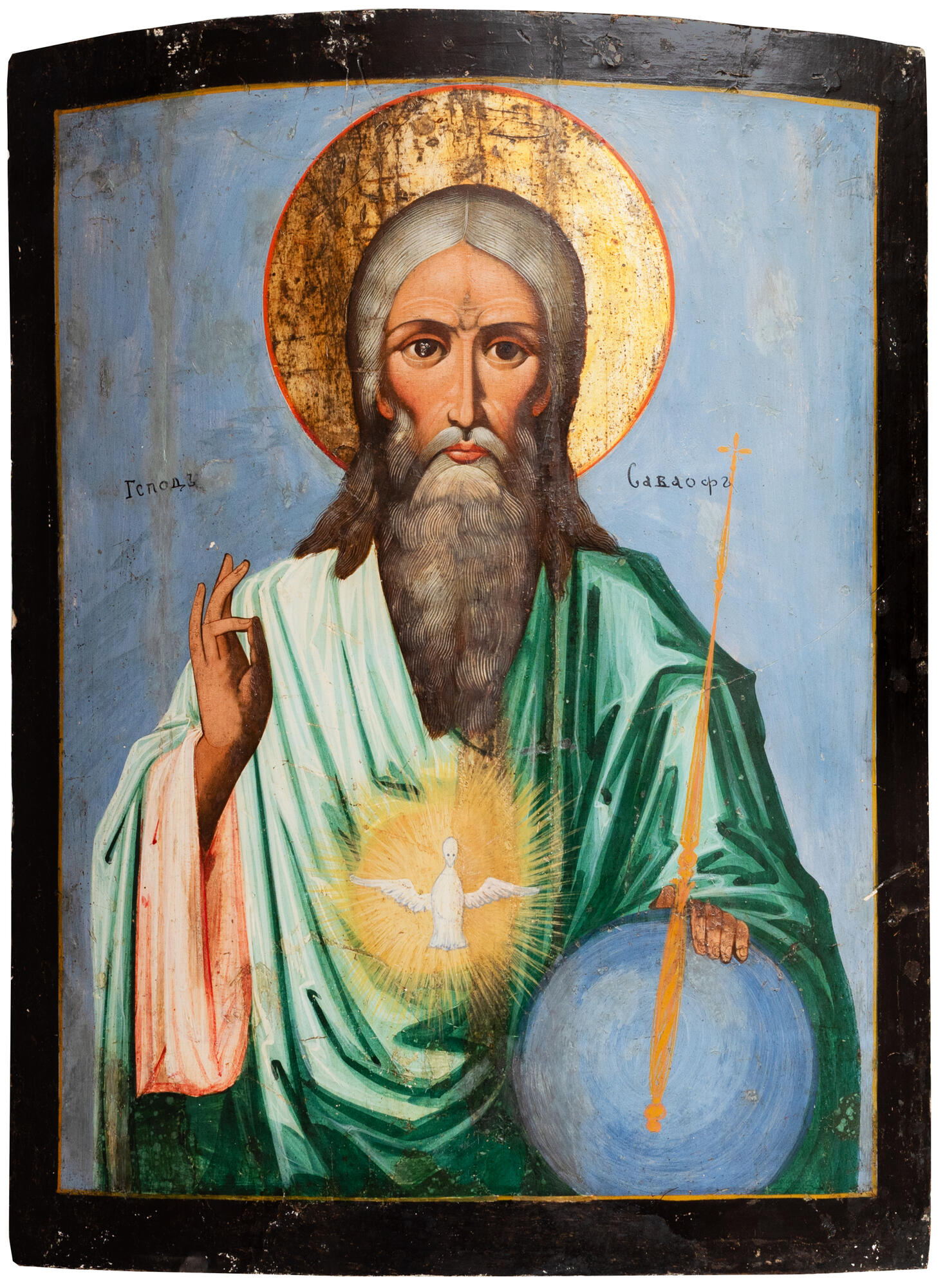


This icon is a frontal half-length image of Lord Sabaoth dressed in a pink chiton and green himation. In His left hand, He holds a dark blue orb and scepter, and with His right hand, He makes a blessing gesture. Against the background of the gloriole on His chest, the Holy Spirit is depicted as a dove. This image belongs to the Don school of icon painting and was created by the artists of Zimovnikovskaya village. It used to belong to the family of Cossack Lazarev in Krasnoyarskaya village.
Any depictions of Lord Sabaoth, or God the Father, are not considered canon and contradict the Christian tradition. These images were forbidden by the seventh ecumenical council in 787. In Byzantine art, there was no iconography of Lord Sabaoth. In Russia, the Council of Moscow banned the images of God the Father in the 17th century. It stated in an official decree, “the image of Lord Sabaoth shall no longer be depicted.” The priests substantiated their decision by explaining that nobody had seen Lord Sabaoth and knew what He looked like. Only the Virgin Mary and Jesus Christ had been seen “in the flesh.”
After the images of Lord Sabaoth were officially banned, several other popular subjects were placed on the forbidden list. Nevertheless, the prohibition was often ignored. Images accompanied by the inscription “Lord Sabaoth” have been known in Russia since the 16th century. The iconography is based on the images of the Ancient of Days, identified with Jesus Christ. This is a symbolic image of the Savior as a gray-haired old man. He is usually depicted wearing white robes, with His hands raised in a blessing gesture or holding a scroll, an orb, and sometimes a book. The folds of the chiton are usually painted in pink, the himation is green, and His hair falls over his shoulders.
Sabaoth is one of the names of God in Jewish and
Christian traditions. It can be translated as “Lord of Hosts”, with “hosts”
meaning either the angels or the nation of Israel. Unlike other names for God
found in the Bible, Sabaoth emphasizes His power and strength. Other names for
God mentioned in the Bible include Yahweh (or Jehovah), Elohim (a plural word
meaning “gods”), and Adonai.