In the icon “Our Lady of Pechersk with Saints”, the Virgin Mary is depicted with two founders of the Kiev-Pechersk Lavra — Anthony and Theodosius. Both of these saints are dressed in traditional monastic robes and are holding long scrolls with prayers.
Anthony, a Russian Orthodox monk, is revered by the Church as the “father of Russian monasticism.” He is known for his strict ascetic lifestyle and his dedication to prayer. Information about him is somewhat contradictory, but according to legend, he took monastic vows and spent some time on Mount Athos before coming to Kiev. It is believed that he brought the blessings of the Holy Mountain with him.
Theodosius was the first abbot of the monastery and was greatly respected by both the monastic community and the lay population for his gentle nature, humility, and patience in teaching Christian values. During his tenure as abbot, the Studite statute was received from Constantinople and adopted at the monastery. Later, it spread to other Russian monasteries as well.
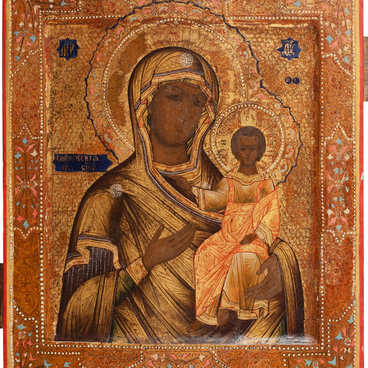
According to the “Legend of the Foundation of the Svensky Monastery”, compiled in the 16th century, the original icon of “Our Lady of Pechersk (Sven)” was an important image from the Dormition Cathedral in the Kiev-Pechersk Lavra. In 1288, at the request of Prince Roman Mikhailovich of Chernigov, who had become blind, the icon was “released” to him by the Archimandrite and the brethren of Kiev. Legend has it that after the icon was found on the banks of the Sven River (a left tributary of the Desna), the prince regained his sight miraculously. In honor of this healing, he founded the Svensky Monastery of Dormition where the shrine was located for many centuries.
Based on information from the Legend, most researchers believe that “Our Lady of Sven” was painted around 1288 and was a copy of the ancient shrine from the Dormition Cathedral in the Kiev-Pechersk Lavra, created for Prince Roman Mikhailovich. This icon can likely be traced back to the Byzantine icon of the Virgin Mary with the Child Jesus. This icon is believed to be a reproduction of one of the miraculous icons from the Church of Blachernae in Constantinople.
This assumption is supported by a story from the
Kiev-Pechersk patericon about artists who were sent there by the Saint Mary of Blachernae.
They brought an icon, relics of saints, and gold. Based on the style of this
icon, researchers believe that it is the Pechersk Panachranta (all-immaculate)
image. The solemn and austere style of this icon is characteristic of
monumental art such as mosaics and frescoes.