After the reform of Catherine the Great of 1764, when most of monasterial possessions throughout Russia were confiscated, church art declined in Siberia, as in some other regions. The number of professional icon painters sharply decreased. There were not enough icons for believers. Therefore, images created by folk masters became widespread.
The self-taught painters (“bogomaz” — a non-professional icon painter) did not always know the rules of depicting certain saints. They tried to paint bright and colorful icons which were more decorative than what the canon prescribes. The compositions of folk icons were not distinguished by the complexity of the plot — the figures of the saints were drawn simply, often there were foliated and floral patterns featured on their clothes, similar to the ornaments on peasant household items.
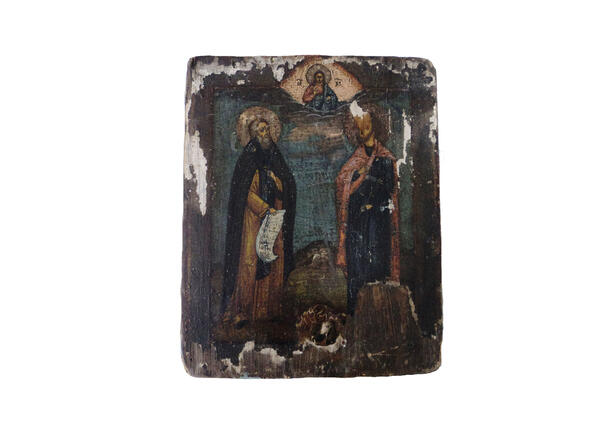
The Museum Complex of Kuybyshev houses such an icon created by an unknown folk master — “Saint Sergius the Wonderworker of Radonezh and the Right-Believing Prince Saint Andrew of Smolensk.” It was painted in the 19th century.
First, levkas (gesso) — a special mixture of chalk and fish or animal fats and linseed oil — was applied to the wooden board. On top of this gesso, two full-length male figures are painted with tempera (powdered pigments ground in distilled water).
On the left is St. Sergius of Radonezh, one of the most beloved and revered saints in Russia, hermit and wonderworker. He founded the Trinity Lavra near Moscow. St. Sergius is depicted in the vestments of a hieroschemamonk: a cape with a koukoulion and a walnut-colored cassock. In the saint’s right hand is an unfolded scroll, and his left hand with a rosary is pressed to his chest in a gesture of prayer.
On the right is the figure of the Right-Believing Prince Andrew of Smolensk. The saint is dressed in clothes corresponding to his title: a red princely cloak and a black-and-blue belted chiton. His right hand rests on his chest in a prayer; in his left hand which is slightly lowered is an eight-pointed cross.
The figures of the saints stand on the ground; a mountain is depicted between them. The background of the icon is blue; hence, the saints seem to be in heaven.
In the center of the upper part is a half-length image of the Savior Almighty in a blue cloak (a himation) and a red shirt — a chiton.
Around the perimeter of the icon is a frame with wide brown margins. The lower part of the icon is damaged. On all the ends of the board, one can see traces of nails, which suggests that the icon initially had a revetment.
The self-taught painters (“bogomaz” — a non-professional icon painter) did not always know the rules of depicting certain saints. They tried to paint bright and colorful icons which were more decorative than what the canon prescribes. The compositions of folk icons were not distinguished by the complexity of the plot — the figures of the saints were drawn simply, often there were foliated and floral patterns featured on their clothes, similar to the ornaments on peasant household items.
The Museum Complex of Kuybyshev houses such an icon created by an unknown folk master — “Saint Sergius the Wonderworker of Radonezh and the Right-Believing Prince Saint Andrew of Smolensk.” It was painted in the 19th century.
First, levkas (gesso) — a special mixture of chalk and fish or animal fats and linseed oil — was applied to the wooden board. On top of this gesso, two full-length male figures are painted with tempera (powdered pigments ground in distilled water).
On the left is St. Sergius of Radonezh, one of the most beloved and revered saints in Russia, hermit and wonderworker. He founded the Trinity Lavra near Moscow. St. Sergius is depicted in the vestments of a hieroschemamonk: a cape with a koukoulion and a walnut-colored cassock. In the saint’s right hand is an unfolded scroll, and his left hand with a rosary is pressed to his chest in a gesture of prayer.
On the right is the figure of the Right-Believing Prince Andrew of Smolensk. The saint is dressed in clothes corresponding to his title: a red princely cloak and a black-and-blue belted chiton. His right hand rests on his chest in a prayer; in his left hand which is slightly lowered is an eight-pointed cross.
The figures of the saints stand on the ground; a mountain is depicted between them. The background of the icon is blue; hence, the saints seem to be in heaven.
In the center of the upper part is a half-length image of the Savior Almighty in a blue cloak (a himation) and a red shirt — a chiton.
Around the perimeter of the icon is a frame with wide brown margins. The lower part of the icon is damaged. On all the ends of the board, one can see traces of nails, which suggests that the icon initially had a revetment.