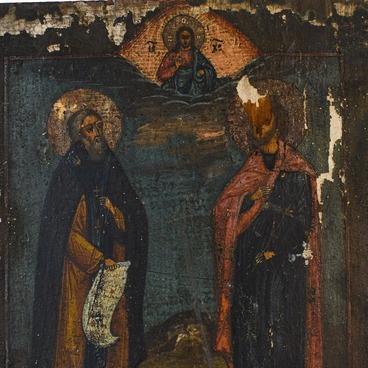
In the Russian Orthodox icon-painting tradition, one type of iconographic depictions was the so-called “lub” icons. They were a vivid example of lubok — a type of folk art. Such images were created in villages by local craftsmen (“bogomaz” — from the Russian “Bog” meaning “God” and “mazat” meaning “to paint”). They were painted on a thin solid board or a piece of bark (in Russian “lub” — a special type of board).
This type of icons almost always had a revetment, hence, only faces and hands were painted on the board: they were visible through the slots in the revetment. The rest of the image remained either bare or covered with paint of the same color.
The icon of the Most Holy Theotokos of Smolensk from the collection of the Museum Complex of Kuybyshev belongs to the “lub” type. It was created at the beginning of the 20th century by an unknown Siberian folk master. The image is painted in oil on a rectangular board. The icon is a half-length image of the Virgin with the Christ Child sitting on her left arm. The right hand of the Mother of God rests on her chest.
The Virgin Mary wears a maphorion — a cloak with a hood, a traditional attribute of such icons. Its purple, crimson color symbolizes that the Mother of God is the Queen of Heaven. The head of the Virgin is slightly tilted towards Jesus, while she herself is slightly turned to the left.
The Divine Infant sitting on the arm of the Virgin is depicted frontally. The right hand of the Son of God is raised in a blessing gesture.
The style of the presented image corresponds to the canons of Russian icon painting. The icon is dominated by a dark ocher color with faint highlights.
Initially, judging by some of its features the icon had a revetment. First, only the faces and hands of the saints, as well as the feet of the Christ Child are depicted — those parts of the icon that are visible through the slots of the precious revetment. Second, nails and traces of them were left on the board. Third, the Mother of God and the Baby Jesus do not have halos which are usually painted over their heads. This means that special crowns were attached on top of the revetment, which, unfortunately, is not part of the museum’s collection.
It is believed that the very first Smolensk Icon of the Mother of God was painted by the Apostle and Evangelist Luke. According to legend, with that icon, the Greek emperor Constantine blessed his daughter, Princess Anna, who embarked on a journey to marry Prince Vsevolod, the son of Yaroslav the Wise. For this reason, the icon became known as “Hodegetria”, or Our Lady of the Way. In Rus, the “Hodegetria” iconographic type was one of the most common, and numerous copies of the original icon were created. The Mother of God of Smolensk is the most solemn version of a Hodegetria image.
This type of icons almost always had a revetment, hence, only faces and hands were painted on the board: they were visible through the slots in the revetment. The rest of the image remained either bare or covered with paint of the same color.
The icon of the Most Holy Theotokos of Smolensk from the collection of the Museum Complex of Kuybyshev belongs to the “lub” type. It was created at the beginning of the 20th century by an unknown Siberian folk master. The image is painted in oil on a rectangular board. The icon is a half-length image of the Virgin with the Christ Child sitting on her left arm. The right hand of the Mother of God rests on her chest.
The Virgin Mary wears a maphorion — a cloak with a hood, a traditional attribute of such icons. Its purple, crimson color symbolizes that the Mother of God is the Queen of Heaven. The head of the Virgin is slightly tilted towards Jesus, while she herself is slightly turned to the left.
The Divine Infant sitting on the arm of the Virgin is depicted frontally. The right hand of the Son of God is raised in a blessing gesture.
The style of the presented image corresponds to the canons of Russian icon painting. The icon is dominated by a dark ocher color with faint highlights.
Initially, judging by some of its features the icon had a revetment. First, only the faces and hands of the saints, as well as the feet of the Christ Child are depicted — those parts of the icon that are visible through the slots of the precious revetment. Second, nails and traces of them were left on the board. Third, the Mother of God and the Baby Jesus do not have halos which are usually painted over their heads. This means that special crowns were attached on top of the revetment, which, unfortunately, is not part of the museum’s collection.
It is believed that the very first Smolensk Icon of the Mother of God was painted by the Apostle and Evangelist Luke. According to legend, with that icon, the Greek emperor Constantine blessed his daughter, Princess Anna, who embarked on a journey to marry Prince Vsevolod, the son of Yaroslav the Wise. For this reason, the icon became known as “Hodegetria”, or Our Lady of the Way. In Rus, the “Hodegetria” iconographic type was one of the most common, and numerous copies of the original icon were created. The Mother of God of Smolensk is the most solemn version of a Hodegetria image.