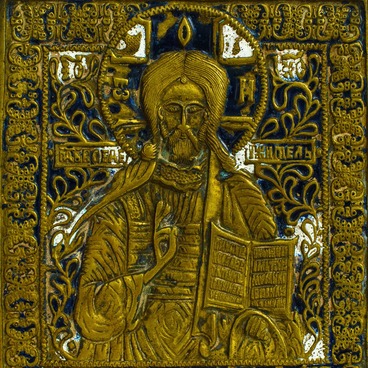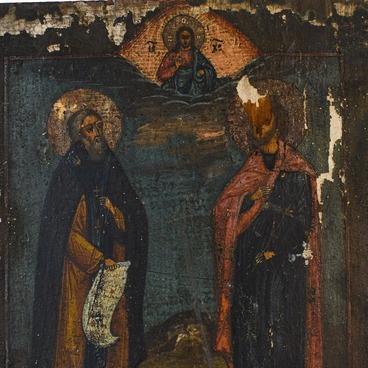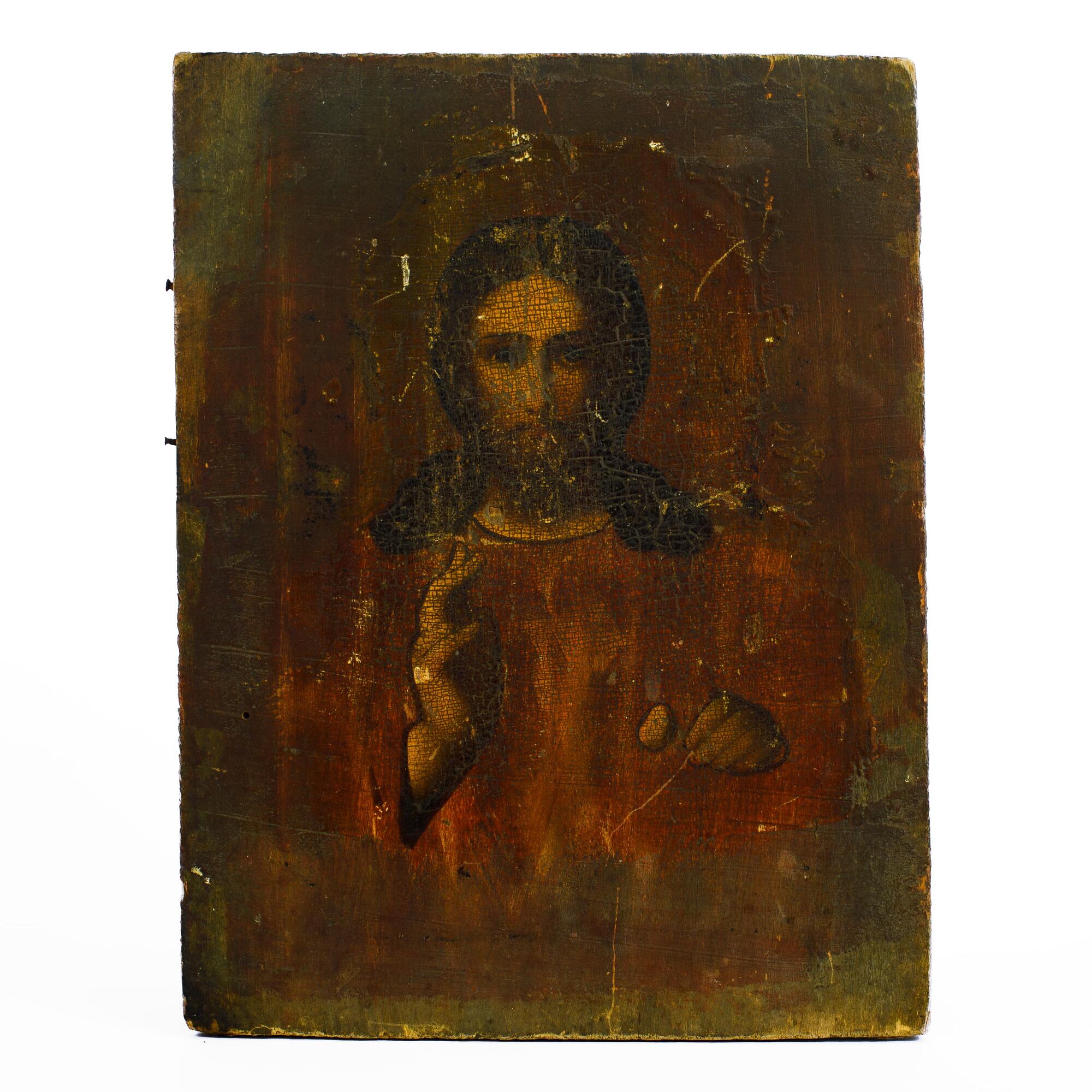


The icon “Christ Pantocrator” from the collection of the Museum Complex of Kuybyshev was painted by an unknown folk master in the early 20th century. In images of this type (designed to be covered by a revetment), the artist depicted only the faces and hands of the saint and legs of the Christ Child, if it was an icon of the Mother of God with the Divine Infant. These parts were visible through the slots of the revetment. The rest of the board either remained unpainted, or was covered with paint of the same color.
All other details of the image were printed on the revetment. The most affordable revetment was made of tin or foil. It was then nailed to the board.
Icons with stamped revetments appeared in the late 19th century, when the shortage of religious artifacts became the most noticeable. It took a long time to create images at monasteries and icon painting centers. They were very expensive. People needed cheaper icons of saints. Then a solution was found: the artists painted an unfinished image of the saint on a board, and tin revetments were produced at factories. Such a production process was much faster than that of canonical icons painted according to church rules, and the price of the product was significantly lower, so tin images of saints were in great demand among the common people.
The icon from the museum’s collection is painted in oil on a solid board. The middle part of the icon on the front side is covered with a thin layer of levkas (gesso) — a special mixture of animal fat, chalk and linseed oil. The image of Christ Pantocrator is painted over this gesso.
Christ Pantocrator, or Savior Almighty, is a half-length image of Jesus Christ. Traditionally, He is depicted with the Gospel in His left hand, and with His right hand He blesses this world. Sometimes in the left hand, instead of the Gospel, is the orb as a symbol of the Kingship of Jesus Christ.
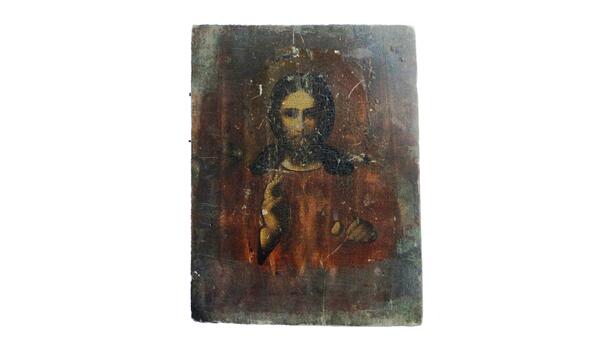
The face and hands are visible through the slots in the revetment. The figure and hair are outlined in red and dark brown. The right hand of the Savior is raised in a blessing gesture, the fingers of the left hand are folded as if they are placed on something — most likely, they are supposed to lie on the orb depicted on the revetment. The face is painted professionally, in a realistic manner. The hands are drawn and painted much simpler. The icon’s revetment has been lost. There were traces of nails on the edges, with which the revetment was attached to the icon.
All other details of the image were printed on the revetment. The most affordable revetment was made of tin or foil. It was then nailed to the board.
Icons with stamped revetments appeared in the late 19th century, when the shortage of religious artifacts became the most noticeable. It took a long time to create images at monasteries and icon painting centers. They were very expensive. People needed cheaper icons of saints. Then a solution was found: the artists painted an unfinished image of the saint on a board, and tin revetments were produced at factories. Such a production process was much faster than that of canonical icons painted according to church rules, and the price of the product was significantly lower, so tin images of saints were in great demand among the common people.
The icon from the museum’s collection is painted in oil on a solid board. The middle part of the icon on the front side is covered with a thin layer of levkas (gesso) — a special mixture of animal fat, chalk and linseed oil. The image of Christ Pantocrator is painted over this gesso.
Christ Pantocrator, or Savior Almighty, is a half-length image of Jesus Christ. Traditionally, He is depicted with the Gospel in His left hand, and with His right hand He blesses this world. Sometimes in the left hand, instead of the Gospel, is the orb as a symbol of the Kingship of Jesus Christ.
The face and hands are visible through the slots in the revetment. The figure and hair are outlined in red and dark brown. The right hand of the Savior is raised in a blessing gesture, the fingers of the left hand are folded as if they are placed on something — most likely, they are supposed to lie on the orb depicted on the revetment. The face is painted professionally, in a realistic manner. The hands are drawn and painted much simpler. The icon’s revetment has been lost. There were traces of nails on the edges, with which the revetment was attached to the icon.