George the Victorious is one of the most famous and revered saints in Russia. He was born into a Christian family and preached Christianity from childhood. George was distinguished by great physical strength, intelligence and beauty; he was in the service of the Emperor Diocletian. When the persecution of Christians began, a sad fate befell many adherents. George, as a Christian, was captured and after seven days of torture, was killed. He never renounced his faith in Jesus.
In Orthodox Christianity, the Holy Great Martyr George, who is called the Victorious, is considered the patron saint of the army, animal husbandry, and farming. Believers pray to him for the protection of the house from fires and natural disasters, and for the safety of a soldier who has left for service. They also appeal to George when livestock is sick or when there is a threat of drought.
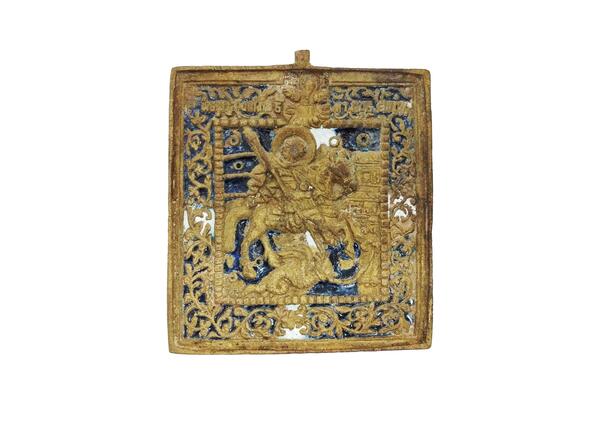
The icon “Saint George the Victorious”, presented in the collection of the Museum Complex of Kuybyshev, was cast from copper in the late 19th century. It resembles a square in shape. The central part (which is also called the icon’s srednik) is framed by a contour relief frame. The figure of St. George is depicted inside. He is astride the horse and dressed in military attire. There is a halo above his head. With his right hand, George holds a spear that pierces the snake. The image of George piercing a snake is the most common of all iconographic depictions of the saint. The icon reflects a miraculous event that occurred after the death of George.
According to legend, a snake settled in a lake with drinking water near Beirut. It allowed people to take water in the lake on the condition that every month a young girl or a boy would be fed to it. When there was only one girl left in the village — the daughter of the ruler, the parents were forced to give her to the snake. When the girl was tearfully waiting for her death, Saint George appeared in front of her and pierced the snake with a spear.
This classic plot is fully revealed in the icon from the Kuybyshev collection. In the center is St. George piercing a snake. In the lower right corner one can see the captive girl — her hands are tied with a rope, the edge of which is tied to the snake’s neck. This is the ruler’s daughter, sacrificed to be fed to the snake. She watches George’s triumph. In the background, the outlines of the city are visible — this is the city of Beirut.
At the top in the center is the image of Jesus Christ.
The upper part of the frame along the perimeter features the name of the icon. The empty recesses in the central part and frame are filled with blue and white enamel. At the top of the icon is a fragment of a metal attachment.
In Orthodox Christianity, the Holy Great Martyr George, who is called the Victorious, is considered the patron saint of the army, animal husbandry, and farming. Believers pray to him for the protection of the house from fires and natural disasters, and for the safety of a soldier who has left for service. They also appeal to George when livestock is sick or when there is a threat of drought.
The icon “Saint George the Victorious”, presented in the collection of the Museum Complex of Kuybyshev, was cast from copper in the late 19th century. It resembles a square in shape. The central part (which is also called the icon’s srednik) is framed by a contour relief frame. The figure of St. George is depicted inside. He is astride the horse and dressed in military attire. There is a halo above his head. With his right hand, George holds a spear that pierces the snake. The image of George piercing a snake is the most common of all iconographic depictions of the saint. The icon reflects a miraculous event that occurred after the death of George.
According to legend, a snake settled in a lake with drinking water near Beirut. It allowed people to take water in the lake on the condition that every month a young girl or a boy would be fed to it. When there was only one girl left in the village — the daughter of the ruler, the parents were forced to give her to the snake. When the girl was tearfully waiting for her death, Saint George appeared in front of her and pierced the snake with a spear.
This classic plot is fully revealed in the icon from the Kuybyshev collection. In the center is St. George piercing a snake. In the lower right corner one can see the captive girl — her hands are tied with a rope, the edge of which is tied to the snake’s neck. This is the ruler’s daughter, sacrificed to be fed to the snake. She watches George’s triumph. In the background, the outlines of the city are visible — this is the city of Beirut.
At the top in the center is the image of Jesus Christ.
The upper part of the frame along the perimeter features the name of the icon. The empty recesses in the central part and frame are filled with blue and white enamel. At the top of the icon is a fragment of a metal attachment.