The collection of the Museum Complex of Kuybyshev includes an altar cross, which was made in the late 19th — early 20th century. It is called an altar cross because it was placed on the altar table (which is referred to as “altar throne”) in the church. Parishioners kiss the cross at the end of the liturgy, when they receive blessing.
Presumably, this relic was part of the liturgical utensils of the Savior Cathedral of Kainsk (the former name of Kuybyshev).
The construction of the Cathedral of Christ the Savior lasted from 1787 to 1828. It stood at the intersection of the main streets of Kainsk — Moskovskaya and Gostinodvornaya — and was the architectural landmark of the town. The Cathedral was destroyed in 1939. Many years after the destruction of the church, the cross was accidentally found by a resident of the town and donated to the museum.
In 2019, archaeologists began excavating the foundation of the cathedral, where they found almost 500 ancient graves. In 2020, work began on the construction of a new Savior Cathedral on the historic site. Its appearance has been restored from photographs kept in the Museum Complex of Kuybyshev. In August 2022, the cathedral was consecrated.
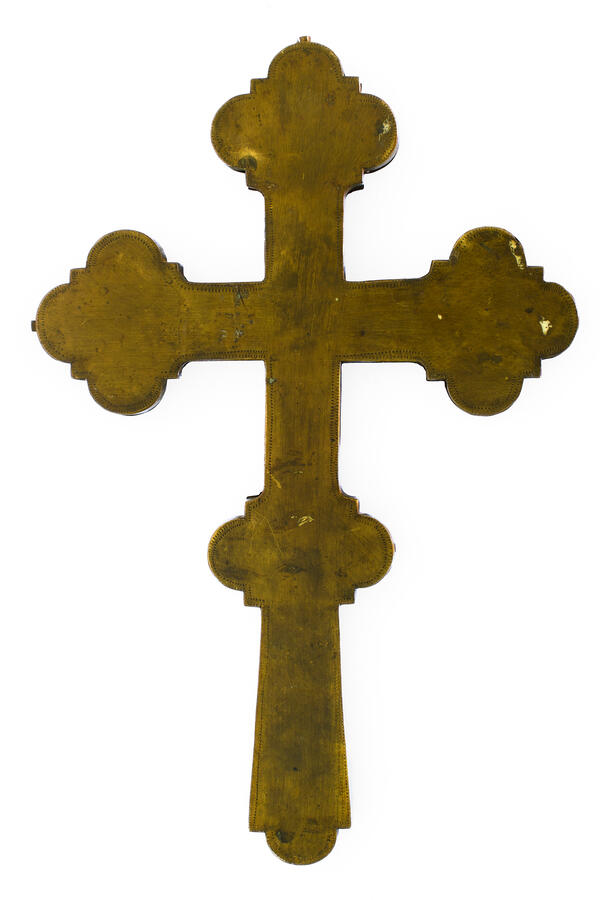
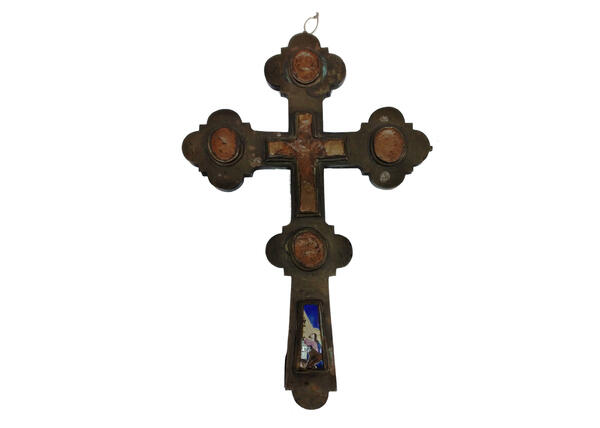
The displayed exhibit is a six-pointed cross cast from a copper alloy. The ends of arms of the cross are trefoil-shaped. The middle part formed by the crossbars features a relief cross. In the center of the upper beams are rounded figured medallions. Previously inside there were enameled inserts with images of saints. On the cross from the museum’s collection, only one enameled insert has been preserved on the lower beam.
In the trapezoidal medallion on the lower beam is an icon made of enamel depicting the “Agony in the Garden”. It is an episode when Jesus Christ turned to the Father on the eve of His arrest. Jesus knew that He was going to face a difficult test, and He went with several disciples to pray in the Garden of Gethsemane. There Jesus called out to God three times. In the first prayer, He asked the Lord to protect Him from the Cup of Suffering, which was associated with death. Then He twice expressed His submission to God’s will.
In the enameled insert of the cross, Jesus is depicted kneeling. His hands are raised in prayer, and His gaze is directed upwards to the Cup, which is high in the sky. In this image of Jesus, His Divine and human natures are united.
Above on the blue background is the Latin inscription of the name of the Son of God. Over time, the lower part of the enameled icon deteriorated.
Presumably, this relic was part of the liturgical utensils of the Savior Cathedral of Kainsk (the former name of Kuybyshev).
The construction of the Cathedral of Christ the Savior lasted from 1787 to 1828. It stood at the intersection of the main streets of Kainsk — Moskovskaya and Gostinodvornaya — and was the architectural landmark of the town. The Cathedral was destroyed in 1939. Many years after the destruction of the church, the cross was accidentally found by a resident of the town and donated to the museum.
In 2019, archaeologists began excavating the foundation of the cathedral, where they found almost 500 ancient graves. In 2020, work began on the construction of a new Savior Cathedral on the historic site. Its appearance has been restored from photographs kept in the Museum Complex of Kuybyshev. In August 2022, the cathedral was consecrated.
The displayed exhibit is a six-pointed cross cast from a copper alloy. The ends of arms of the cross are trefoil-shaped. The middle part formed by the crossbars features a relief cross. In the center of the upper beams are rounded figured medallions. Previously inside there were enameled inserts with images of saints. On the cross from the museum’s collection, only one enameled insert has been preserved on the lower beam.
In the trapezoidal medallion on the lower beam is an icon made of enamel depicting the “Agony in the Garden”. It is an episode when Jesus Christ turned to the Father on the eve of His arrest. Jesus knew that He was going to face a difficult test, and He went with several disciples to pray in the Garden of Gethsemane. There Jesus called out to God three times. In the first prayer, He asked the Lord to protect Him from the Cup of Suffering, which was associated with death. Then He twice expressed His submission to God’s will.
In the enameled insert of the cross, Jesus is depicted kneeling. His hands are raised in prayer, and His gaze is directed upwards to the Cup, which is high in the sky. In this image of Jesus, His Divine and human natures are united.
Above on the blue background is the Latin inscription of the name of the Son of God. Over time, the lower part of the enameled icon deteriorated.