In 1887, a carved panagia made of cypress was transferred from the collection of the Hermitage to the collection of the Radishchev Art Museum as a gift from Emperor Alexander III. It is called “Our Lady of the Sign with Selected Saints” or “The Baptism of the Lord with Selected Saints”.
A panagia is a small, richly decorated image of the Virgin Mary (“panagia” is translated from Greek as “all-holy”, referring to the Mother of God). However, there are also images of the Savior, the Trinity, the Crucifixion, saints or biblical scenes made in this genre.
Most often, such an image is round in shape; it is intended to be worn on the chest on a chain by the highest church ranks. A panagia is a smaller copy of a “panagiar”, a richly decorated vessel, which housed the “bread of the Mother of God”. Pieces of this consecrated bread — prosphora — were kept in small “collar” breast panagias.
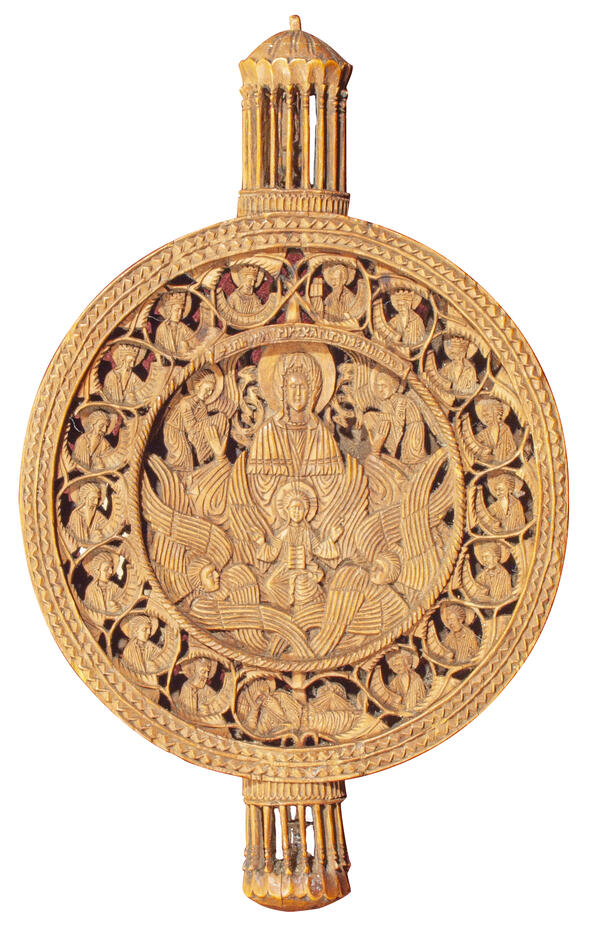
The panagia from the collection of the Radishchev Art Museum is a round double-sided icon made in the technique of miniature cypress carving. Small columnar rotundas with lamps inside are fixed at the top and bottom of the circle. On the front side, there is an image of the Virgin with a Child and angels, on the other — the Epiphany of the Lord.
On both sides, around the main central compositions, in separate rounded scenes, there are images of the forefathers and prophets, including King David with a harp and King Solomon with a temple, as well as scenes with the sleeping prophet Jesse and the prophet Jonah being swallowed by a fish.
The carved image was created by an unknown master, presumably in the 18th century on Mount Athos. According to ancient Christian tradition, in the year 49 the ship on which the Mother of God was sailing along with the Apostle John the Theologian was hit by a storm and was washed ashore on the Greek mountain Athos in the place where the Iberian Monastery is now located. The Virgin Mary was struck by the amazing beauty of this place and asked God for it as her inheritance. Therefore, Athos is also called the “lot” and “the garden of the Virgin.”
The secluded workshops of Athos have long been famous for their carvings. Thanks to numerous pilgrims, these works were constantly brought to the Slavic lands, where they were highly revered. Small carved crosses, panagias and icons made by Athos monks, which included many miniature scenes, impressed with their virtuoso technique. Those were both mass-produced products and individual highly artistic works, including the panagia from the collection of the Radishchev Art Museum.
A panagia is a small, richly decorated image of the Virgin Mary (“panagia” is translated from Greek as “all-holy”, referring to the Mother of God). However, there are also images of the Savior, the Trinity, the Crucifixion, saints or biblical scenes made in this genre.
Most often, such an image is round in shape; it is intended to be worn on the chest on a chain by the highest church ranks. A panagia is a smaller copy of a “panagiar”, a richly decorated vessel, which housed the “bread of the Mother of God”. Pieces of this consecrated bread — prosphora — were kept in small “collar” breast panagias.
The panagia from the collection of the Radishchev Art Museum is a round double-sided icon made in the technique of miniature cypress carving. Small columnar rotundas with lamps inside are fixed at the top and bottom of the circle. On the front side, there is an image of the Virgin with a Child and angels, on the other — the Epiphany of the Lord.
On both sides, around the main central compositions, in separate rounded scenes, there are images of the forefathers and prophets, including King David with a harp and King Solomon with a temple, as well as scenes with the sleeping prophet Jesse and the prophet Jonah being swallowed by a fish.
The carved image was created by an unknown master, presumably in the 18th century on Mount Athos. According to ancient Christian tradition, in the year 49 the ship on which the Mother of God was sailing along with the Apostle John the Theologian was hit by a storm and was washed ashore on the Greek mountain Athos in the place where the Iberian Monastery is now located. The Virgin Mary was struck by the amazing beauty of this place and asked God for it as her inheritance. Therefore, Athos is also called the “lot” and “the garden of the Virgin.”
The secluded workshops of Athos have long been famous for their carvings. Thanks to numerous pilgrims, these works were constantly brought to the Slavic lands, where they were highly revered. Small carved crosses, panagias and icons made by Athos monks, which included many miniature scenes, impressed with their virtuoso technique. Those were both mass-produced products and individual highly artistic works, including the panagia from the collection of the Radishchev Art Museum.