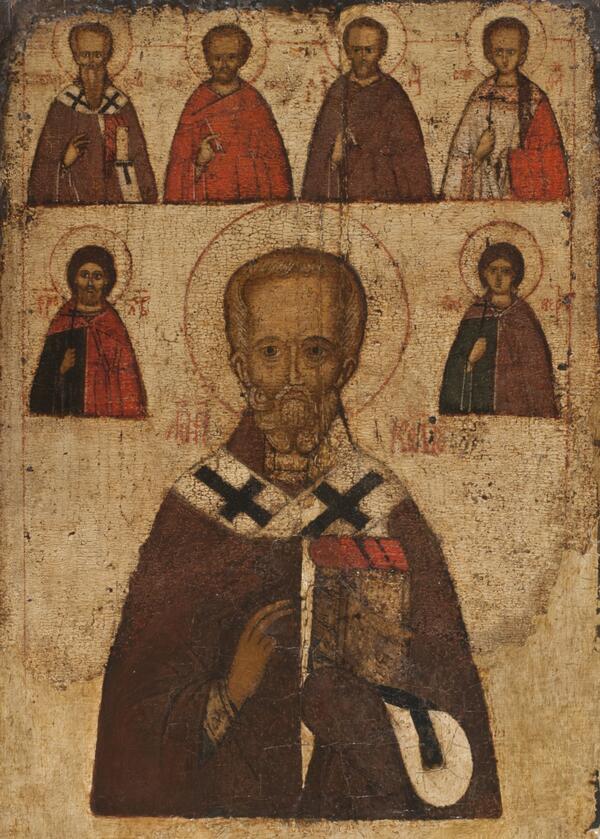
In 1922, it was decided to form a department of Old Russian art in the Radishchev Art Museum in Saratov. A collection of icons of the 15th–17th centuries, which came from private Moscow collections, was allocated from the National Museum Fund. One of them was the image of “Saint Nicholas with Selected Saints”.
Nicholas of Myra, the Wonderworker, was one of the most revered saints in Old Rus and occupied an exceptional place in the life of people of that time. Saint Nicholas was a mentor and a teacher, an intercessor and an assistant in all good undertakings, a patron of travelers and wanderers, fishermen and hunters, as well as peasants; he was able to defeat demons and comfort all those who were mourning. At the same time, he entered the history of the church as a strict defender of dogma and a ruthless persecutor of heresy.
Saint Nicholas served as bishop of the city of Myra in Lycia. He had a chance to witness both the persecution of Christians and the leading position that the Christian Church occupied under Emperor Constantine the Great.
There are many descriptions of the life of Nicholas the Wonderworker. One of the compilers of his life, the Greek writer Symeon the Metaphrast, spoke of him this way:
Nicholas of Myra, the Wonderworker, was one of the most revered saints in Old Rus and occupied an exceptional place in the life of people of that time. Saint Nicholas was a mentor and a teacher, an intercessor and an assistant in all good undertakings, a patron of travelers and wanderers, fishermen and hunters, as well as peasants; he was able to defeat demons and comfort all those who were mourning. At the same time, he entered the history of the church as a strict defender of dogma and a ruthless persecutor of heresy.
Saint Nicholas served as bishop of the city of Myra in Lycia. He had a chance to witness both the persecution of Christians and the leading position that the Christian Church occupied under Emperor Constantine the Great.
There are many descriptions of the life of Nicholas the Wonderworker. One of the compilers of his life, the Greek writer Symeon the Metaphrast, spoke of him this way: