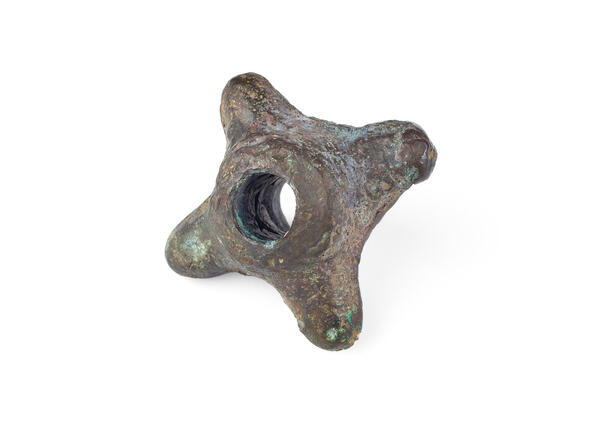
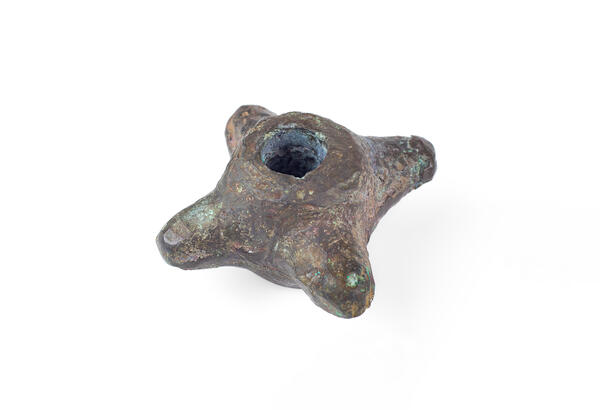
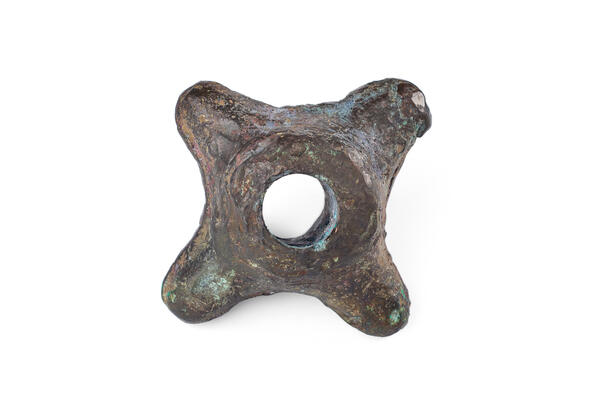
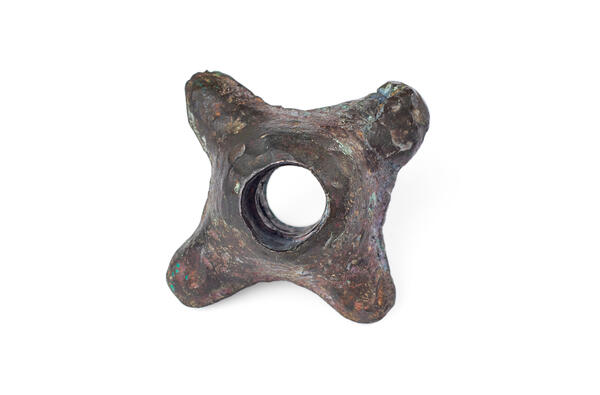
The head of a spherical cast mace with cross-shaped spikes and a through round hole was made of bronze. This artifact was discovered in May 2002 among the treasure trove items of a caster of the Xiongnu-Sarmatian era in the country village of Sayanogorsk. Researchers attributed it to the Tes archaeological culture. The object was dated to the period from the 2nd century BCE to the 1st century CE. The treasure was discovered by a local resident Gennady Markovich Pyrin while plowing the land.
The Tes culture got its name from a mound that was excavated in the late 1880s near the village of Tes (currently the Minusinsky district of the Krasnoyarsk Territory). In 1953, the Soviet archaeologist and orientalist Leonid Romanovich Kyzlasov defined it as the Tagar-Tashtyk transition stage, in which mutual assimilation of members of different cultures took place. In turn, another Soviet archaeologist and historian, Mikhail Petrovich Gryaznov, believed that the Tes culture should be considered the last stage of the Tagar culture.
The mace is a shock-crushing cold weapon in the form of a handle with a spherical or other shaped impact part, that is, a head. The most diverse shapes of mace heads are known. In addition to the usual spherical ones, scientists found biconic, polygonal, barrel-shaped and vertically flattened heads.
Compared with other types of weapons, the mace had both serious advantages and disadvantages. Mastering this weapon took a short time, while learning the skill of the sword play lasted longer. Also, the mace, unlike the battle ax, never got stuck in the shields or armor of the enemy. It could be used in cases where the enemy needed to be captured, just by stunning with a blow.
The disadvantage of the
mace was that it could not be used to defend oneself from counter blows. To do
this, the warrior additionally had to use a shield, armor and other means of
combat. It was inconvenient to use the mace during the offensive formation,
because an impressive swing was required to strike.