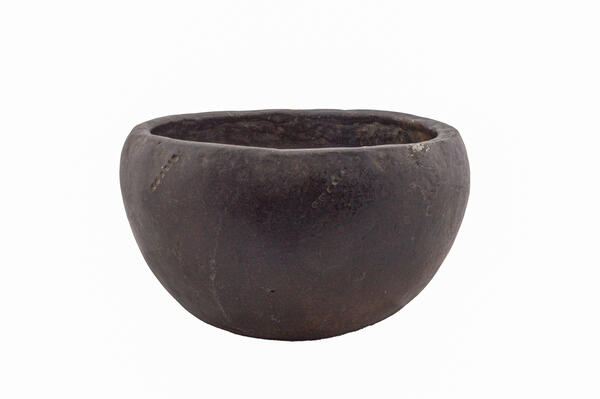
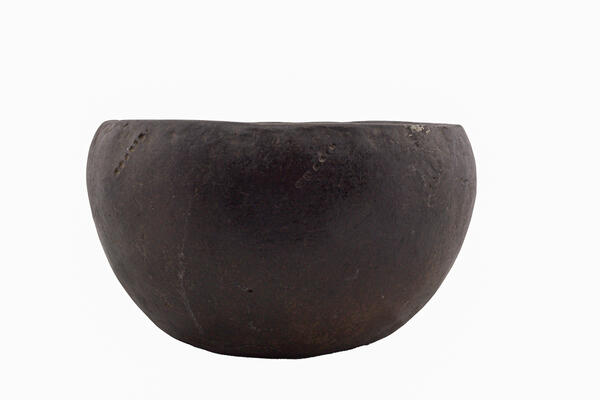
Pottery originated in Siberia in the Neolithic period. The Asian Eskimos, Itelmen, Yakut and Northern Shor peoples maintained the craft up to the early 20th century. In ancient times, the Shors practiced agriculture and animal domestication, but over time they also engaged in trade and transportation.
The evolution of pottery designs corresponded to the changing everyday needs of people: for example, vessels with a round or egg-shaped bottom were placed on hearth stones, while those with a flat bottom were used for cooking in the oven and serving food.
The historian, ethnographer, museologist, and specialist in the history and culture of the Turkic-speaking community Valery Makarovich Kimeev mentions in “Traditional Shor Crafts” that pottery, like weaving, was done by women.
The preparation of raw materials began in the evening: wooden troughs (“karit kuman salgan”) were placed inside the odag and clay and sand were mixed. The next day, the clay was placed on a thick block and flattened with the help of a spatula (“kalek”) and a special hammer (“tokpak”). Then, holding the workpiece between the feet, the potters began to build up the walls layer by layer. The inside of the future vessel was smoothed with a small mallet (“tunduk”), and the walls were leveled with a flat spatula (“chakpysh”), which could also be used to make patterns. A potter’s wheel was not used.
To fix the shape, the walls were fastened with seven or eight willow hoops (“shiyik”) of different diameters. When the vessel became dry, those hoops were removed with a wooden knife (“keskish”).
The Shor pottery was varied, and its shape often resembled the ceramic products of Russian peasants living in the Tomsk Governorate. To prepare soups and stews, thick-walled “selek kodesh” pots were used; melted butter and oil were stored in “tapnek” pots with a round bottom and a spout. A milk bowl with a handle (“molonzyek”) for milk had the same spout. Clay frying pans, cups, and mugs with handles, as well as “paspeshnek” oil lamps were also used in everyday life.
Most of the things the Shors produced were intended
for household needs. Net weaving and pottery eventually reached the level of
handicrafts, but now they have totally disappeared.