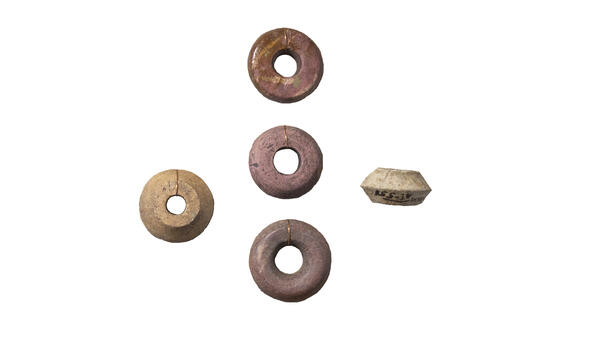
The pryaslitse or the spindle whorl is a rounded plummet with a hole in the center, which should be fitted onto the spindle to maintain smooth rotation and stability of the spindle.
The exact word “pryaslitse” had a different meaning in Ancient Russia. The ancient Slavs used the word “pryaslo” or “pryaslen” to describe the plummet for the spindle, while, according to the Explanatory Dictionary of Russian-language lexicographer Vladimir Ivanovich Dal, the word “pryaslitse” meant the base for tow (refined linen fiber) or for the comb for hand spinning, which is called “spinning wheel” nowadays. Soviet archaeologists tried to clarify that terminology confusion, but the word “pryaslitse” put down roots, and nowadays it is usually used to describe the plummet.
Such spindle whorls can preserve well because of material strength and small size, that is why they can be easily found during archaeological excavations. In the middle of the 10th century, slate spindle whorls were widespread; they were made near the town of Ovruch (modern Zhytomyr Oblast, Ukraine). There was the only pyrophyllite slate deposit in Europe. The slate has refractory characteristics and is easy to grind and cut.
The spindle whorls were traded and exchanged all over the territory of Ancient Russia and neighboring regions. Artemy Artsihovski, archaeologist and historian, noted
The exact word “pryaslitse” had a different meaning in Ancient Russia. The ancient Slavs used the word “pryaslo” or “pryaslen” to describe the plummet for the spindle, while, according to the Explanatory Dictionary of Russian-language lexicographer Vladimir Ivanovich Dal, the word “pryaslitse” meant the base for tow (refined linen fiber) or for the comb for hand spinning, which is called “spinning wheel” nowadays. Soviet archaeologists tried to clarify that terminology confusion, but the word “pryaslitse” put down roots, and nowadays it is usually used to describe the plummet.
Such spindle whorls can preserve well because of material strength and small size, that is why they can be easily found during archaeological excavations. In the middle of the 10th century, slate spindle whorls were widespread; they were made near the town of Ovruch (modern Zhytomyr Oblast, Ukraine). There was the only pyrophyllite slate deposit in Europe. The slate has refractory characteristics and is easy to grind and cut.
The spindle whorls were traded and exchanged all over the territory of Ancient Russia and neighboring regions. Artemy Artsihovski, archaeologist and historian, noted