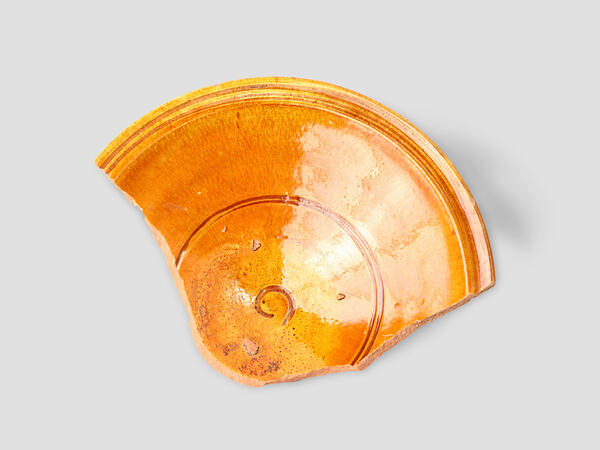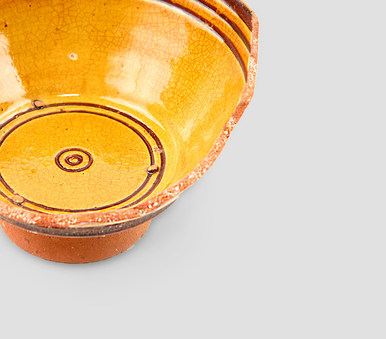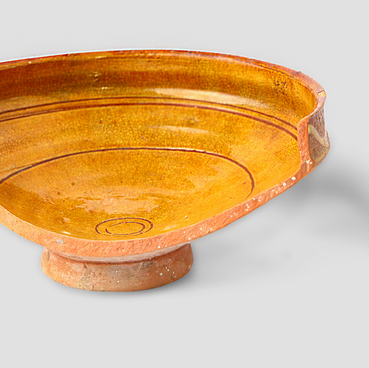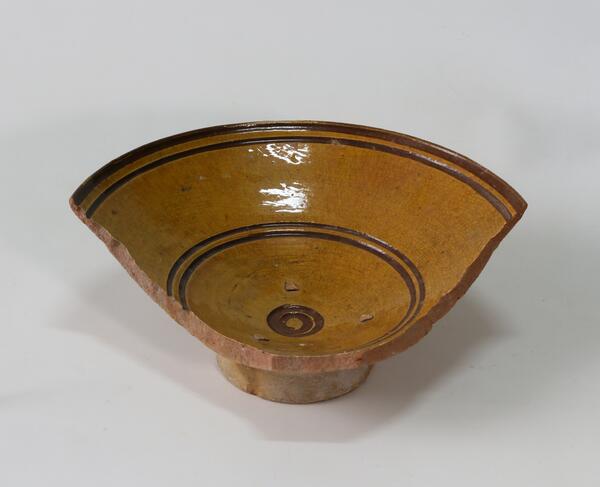
Studying glazed pottery of the Middle Ages, Anatoly Leopoldovich Yakobson noted its diversity and claimed that it embodied the artistic and technical culture of the peoples who created it.
The conditions of development of this type of art were similar in different countries. The products universally belonged to the urban type of handicrafts (the traces of a tripod indicate that the exhibit was part of a large batch).
Yakobson states that the formation of glazed pottery in the territory between the Byzantine Empire and Central Asia happened over a relatively short period of time — “mainly within the 9th and the 10th centuries”. At this time, the first few centers of pottery appeared, which made glazes; in the 11th century, there were still very few of them, but later they became more numerous and developed. In the 12th–13th centuries, numerous “local schools of art ceramics” began to appear in many countries against the backdrop of the rapid development of urban culture.
Researchers analyzed the composition of glazing and found that the mixtures used by potters included two components: lead materials and feldspathic quartz sand in different proportions. The subsequent firing of the product depended on these proportions. The characteristic yellowish coloring, just like in the presented exhibit, might have occurred because of the presence of lead dust or antimony impurities in the lead material.
Since there are no lead deposits in the Northern Black Sea Region, local craftsmen were dependent on imported raw materials and probably used them in the most economical way. Yellow lead (lead mica) was put in the furnace charge and was obtained by “heating molten metallic lead in the open or firing in a flame kiln (according to the Ceramics Encyclopedia)”.
The fact that lead ingots were imported to the Crimean Peninsula is supported by the numerous finds made by underwater archaeologists in the bays of Sudak and Chersonesus.