The variety of rims is one of the important factors in the classification of antique and medieval pottery.
The leading expert on the archaeology of South-Eastern Crimea in the Middle Ages Vadim Vladislavovich Maiko distinguishes four main types of ceramic wares that were produced between the mid-10th century and the turn of the 12th century.
The first type includes amphorae with a collared rim, which began to be produced in the Byzantine Empire and transported to the Crimean Peninsula in the second quarter of the 10th century. It is difficult to establish where exactly they were produced. Valery Viktorovich Bulgakov believes that it could be Trebizond; Viktor Nikolayevich Chkhaidze thinks that “imitations” of these vessels were produced on the Taman Peninsula.
Bulgakov offers a more specific classification of pottery types depending on the position of the handles toward the rim. The handles of the vessels of the first subtype are not above the rim or even do not reach it, while the rims themselves are defined as subtriangular or tear-shaped.
The second subtype is characterized by the massive rim and the insignificantly higher handles. The handles (mainly in amphorae) of the third subtype, which developed the last of them all, rise high above the rim and the funnel-shaped neck of the vessel.
The wares of the second type are pear-shaped globular amphorae made of orange clay with oval handles raised above the rim. It is believed that they originated in the area southwest of Constantinople, on the coast of the Marmara Sea (Sarkoy, Gaziki). Their variations differ in the position of the handles and the shape of the rims — the latter are mostly tear- or spindle-shaped, sometimes collared. There are also variations with a wedge-shaped rim and slightly raised handles, adjacent to its edge. The most recent wares are characterized by wedge-shaped or straight rims of relatively large diameter.
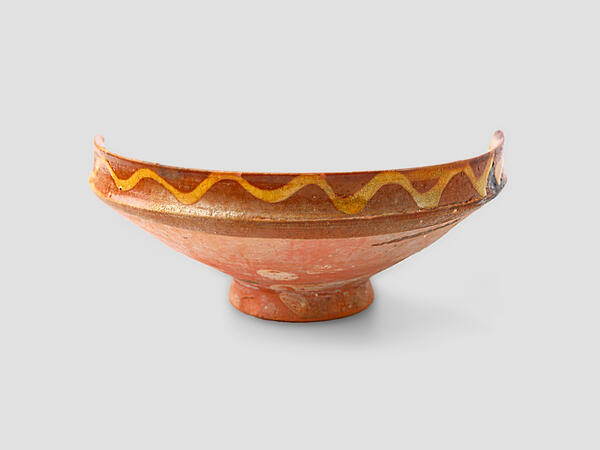
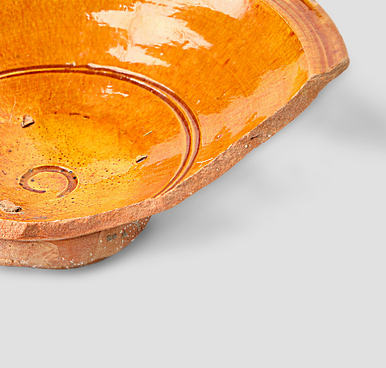
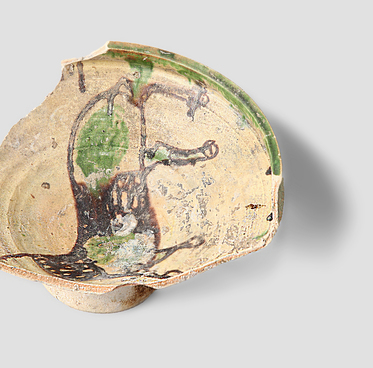
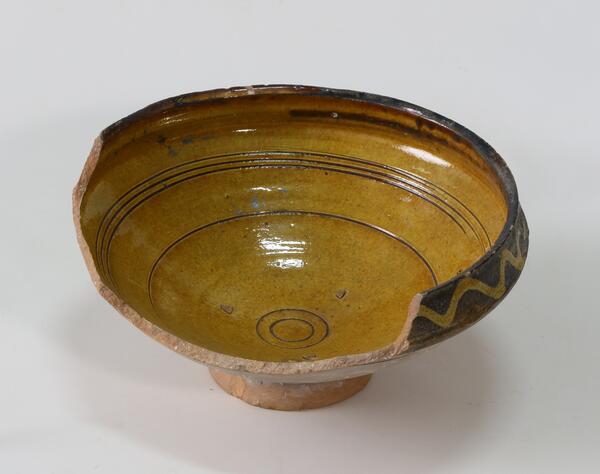
In various cultures, it was common to decorate the rims (of amphorae, bowls and pots) from the outside and sometimes from the inside. The bowl on display is decorated with a wavy pattern, underglaze painting and a white engobe on top of a brown glaze.